
By Kushal Magar · September 30, 2026 · 13 min read
HubSpot vs Zoho CRM: Features, Pricing, and Verdict 2026
HubSpot and Zoho CRM are the two CRMs SMBs actually put side by side. Most "CRM vs CRM" searches pit a category leader against a niche point tool. This one is a real shortlist decision, and it isn't "cheap vs expensive" the way it gets framed. It's a bundle-philosophy decision: Zoho sells breadth and low, flat per-seat pricing with the real cost hidden in implementation effort and UI friction; HubSpot sells polish and fast adoption with the real cost hidden in tier jumps and one-time onboarding fees. Run the seat math on both and the actual gap looks different than either pricing page implies.
HubSpot and Zoho CRM get compared constantly for a reason most "X vs Y" CRM posts don't share: they're genuinely fighting for the same buyer. An SMB or mid-market sales team evaluating CRMs this year is very likely to have both on the shortlist, not one CRM against a workflow tool bolted onto the other.
The framing that dominates search results is "HubSpot is expensive, Zoho is cheap" — and on a per-seat sticker-price basis, that's directionally true. But it skips the part that actually determines total cost: HubSpot's list price hides one-time onboarding fees and steep tier jumps, while Zoho's low sticker price hides admin time and configuration effort that doesn't show up on any pricing page. Below, we run the actual dollar math at 10 and 50 seats for both, and unpack where each vendor's real cost lives.
This is a different angle than our Salesforce vs Zoho CRM comparison, which covers Zoho's pricing tiers and cost advantage against an enterprise incumbent in depth. That post already owns the "Zoho is cheap" argument. This one is about what happens when the competitor isn't more expensive by design — it's a CRM built on a completely different bundle philosophy.
Quick Summary
HubSpot vs Zoho CRM is the rare CRM comparison where both products are genuinely on the same shortlist, and the real decision isn't which one is cheaper on paper — it's which hidden cost your team is better equipped to absorb. As of September 2026, HubSpot Sales Hub is priced at $7, $90, and $150 per seat per month (Starter, Professional, Enterprise, annual billing), confirmed directly on hubspot.com/pricing/sales — and both Professional and Enterprise carry mandatory one-time onboarding fees of $1,500 and $3,500 respectively, regardless of seat count. Zoho CRM's edition structure (Standard, Professional, Enterprise, Ultimate) is confirmed on zoho.com/crm/pricing.html, but that page geo-serves currency by visitor location and returned INR pricing (₹800/₹1,400/₹2,400/₹2,600 per user/month) at the time of our check. The USD figures used in this post — $14, $23, $40, and $52 per user per month — are therefore secondary-sourced from independent third-party pricing breakdowns rather than page-verified in USD directly, and should be confirmed with Zoho before budgeting. Running the seat math on the comparable automation tier (HubSpot Professional vs Zoho Professional) shows just how wide the gap is: at 10 seats, HubSpot costs roughly $12,300 in year one against Zoho's roughly $2,760; at 50 seats, roughly $55,500 against roughly $13,800. That gap isn't really about feature parity — Zoho's Blueprint automation and AI agents (Zia) at the Professional tier are genuinely capable, and Zoho's per-user pricing stays flat as headcount grows. What the price difference buys on HubSpot's side is admin-light adoption: reporting that a sales manager can build without a consultant, cleaner onboarding, and the strongest app marketplace in the category. What Zoho's price advantage costs in practice is implementation effort — it's a highly configurable platform, but configuring it well tends to require more hands-on admin time than HubSpot needs at the same functional depth. Neither company's pricing page volunteers that tradeoff, because neither one loses by omitting it. SyncGTM doesn't take a side in this decision — it connects to both, with 2-way HubSpot sync and native Zoho CRM integration, running a 76+ data-point waterfall across 50+ providers so records stay accurate inside whichever CRM a team actually picks.
TL;DR
- Short answer: HubSpot and Zoho CRM are the two CRMs SMBs actually shortlist together. The decision isn't cheap-vs-expensive — it's bundle philosophy: Zoho sells breadth at a flat low seat price with implementation effort as the hidden cost; HubSpot sells polish and adoption with tier jumps and onboarding fees as the hidden cost.
- Verified pricing (Sept 2026, annual billing, USD): HubSpot Sales Hub runs $7–$150/seat/month (Starter, Professional, Enterprise) — page-verified on hubspot.com/pricing/sales, and Professional/Enterprise both carry mandatory one-time onboarding fees ($1,500 / $3,500). Zoho CRM's edition structure (Standard, Professional, Enterprise, Ultimate) is confirmed on zoho.com/crm/pricing.html; that page geo-served INR pricing (₹800–₹2,600/user/month) at check time, so the USD figures used here ($14–$52/seat/month) are secondary-sourced and dated — treat them as such until confirmed directly with Zoho.
- At 10 seats on the comparable automation tier (HubSpot Professional vs Zoho Professional): HubSpot runs roughly $12,300 in year one ($10,800/year plus $1,500 onboarding). Zoho runs roughly $2,760 in year one, with no mandated onboarding fee.
- At 50 seats, same tiers: HubSpot runs roughly $55,500 in year one ($54,000/year plus the same flat $1,500 onboarding). Zoho runs roughly $13,800.
- Pick Zoho CRM if you have admin capacity to configure it and want the lowest flat per-seat cost as you scale headcount.
- Pick HubSpot if your team needs reporting and workflows that non-admins can actually build, and you'd rather pay more upfront than pay in admin time later.
- SyncGTM isn't a third CRM in this decision — it's the enrichment and signal layer that 2-way syncs into either one, so whichever bundle philosophy you pick, the data inside it doesn't go stale.
What We Evaluated
- Verified per-seat pricing at every published tier, with currency, billing cadence, and any mandatory one-time fees called out separately from recurring cost
- Explicit total-cost arithmetic at 10 and 50 seats on the comparable automation tier for each vendor, with the tier assumption stated
- Automation depth and where it's gated by tier (HubSpot workflows/sequences vs Zoho Blueprint/Zia)
- Reporting usability — whether non-admin users can build reports, or whether it requires admin or consultant involvement
- Implementation and admin overhead as a real, if unlisted, cost line item
- Ecosystem breadth — HubSpot's app marketplace vs Zoho's 45+ app Zoho One suite
1. SyncGTM — Teams on either HubSpot or Zoho CRM who need contact and account data to stay accurate without manual upkeep
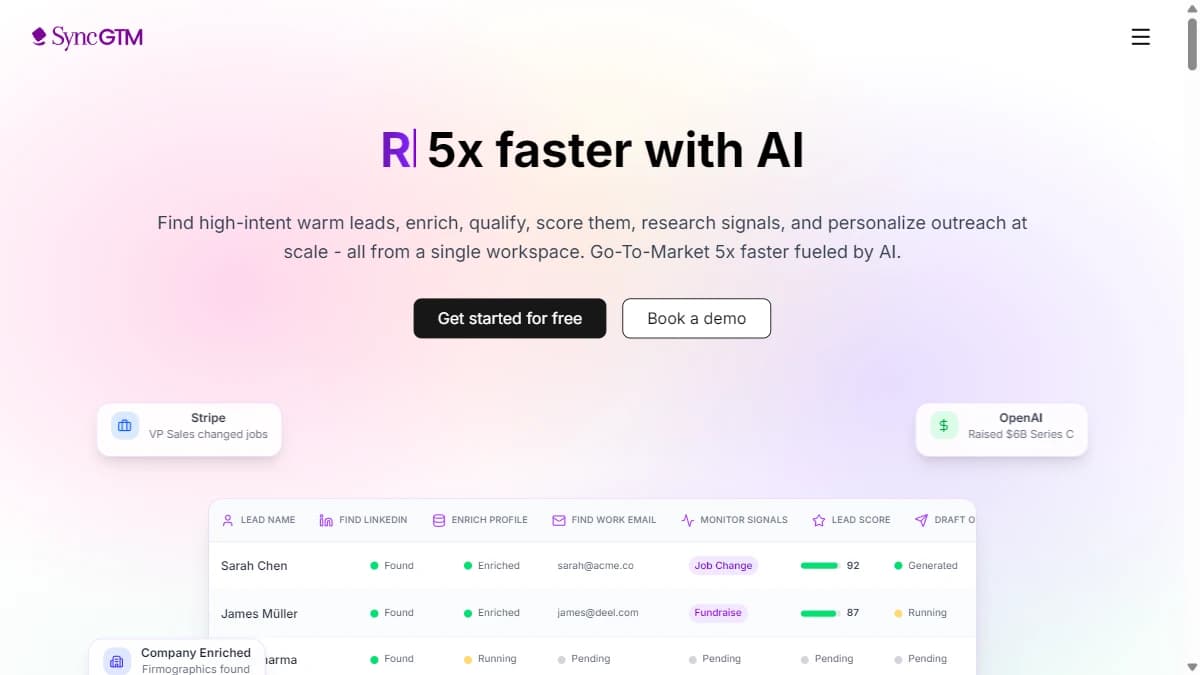
SyncGTM — Teams on either HubSpot or Zoho CRM who need contact and account data to stay accurate without manual upkeep
Quick context before the head-to-head: SyncGTM isn't a third CRM competing with HubSpot or Zoho here — it's the data layer that keeps whichever one you pick from going stale.
2-way HubSpot sync keeps enriched records flowing back into the CRM instead of sitting in a spreadsheet, and native Zoho CRM integration does the same on that side. Underneath both, a real-time waterfall across 50+ data providers adds 76+ data points per lead — verified email, direct phone, firmographics, and job-change or growth signals — so reps aren't working stale contact data regardless of which bundle philosophy your team lands on.
See the GTM agent library for how enrichment and sync connect end to end, or check pricing for current plans. Now, the actual HubSpot-vs-Zoho comparison.
Pros
- +2-way HubSpot sync and native Zoho CRM integration — works underneath either CRM in this comparison
- +76+ data points per lead from a 50+ provider waterfall, refreshed at lookup rather than a static append
- +Keeps records current regardless of which CRM a team lands on, so the CRM decision doesn't also become a data-quality decision
- +Not a competing CRM — no migration required to add it on top of an existing HubSpot or Zoho setup
Cons
- −Not a CRM itself — HubSpot or Zoho CRM is still required as the system of record
- −Value depends on actually acting on enrichment and signals inside the CRM workflow, not just having the data
Best for: Teams on either HubSpot or Zoho CRM who need contact and account data to stay accurate without manual upkeep
Pricing: Starts at $99/mo. Free tier available.
2. HubSpot — Teams that want reporting and automation non-admins can run themselves, and would rather pay more upfront than spend admin time configuring
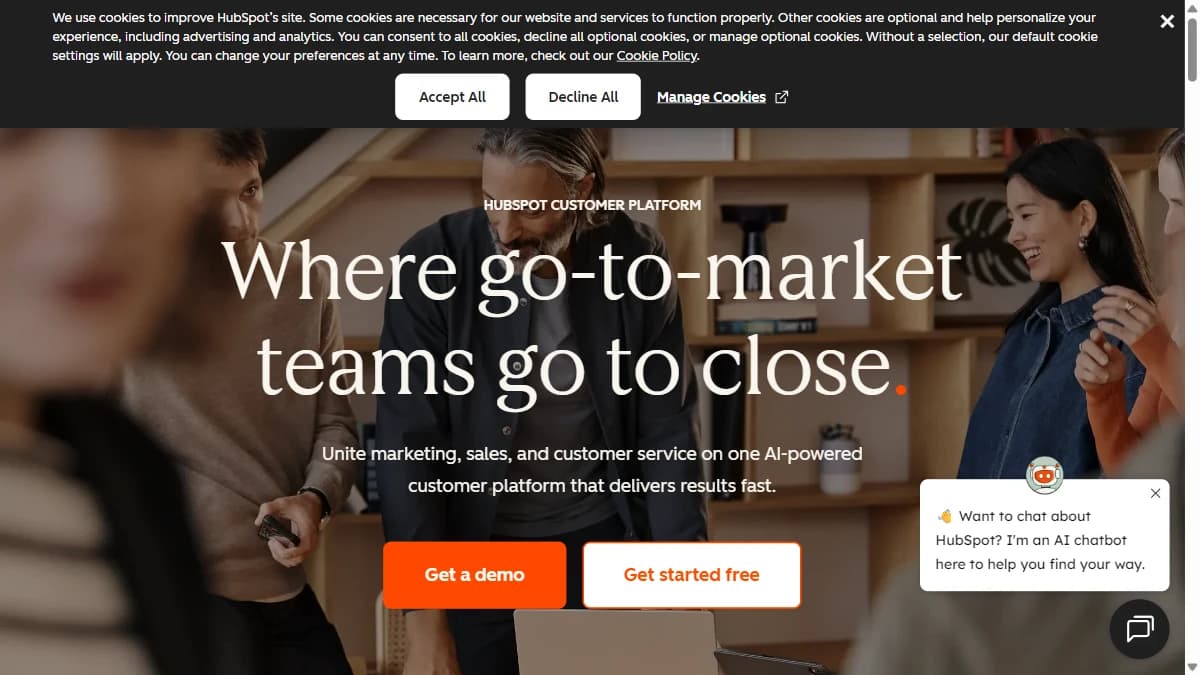
HubSpot — Teams that want reporting and automation non-admins can run themselves, and would rather pay more upfront than spend admin time configuring
HubSpot Sales Hub is priced in three paid tiers as of September 2026: Starter ($7/seat/month annual, $20 monthly), Professional ($90/seat/month annual, $100 monthly), and Enterprise ($150/seat/month annual), all confirmed on hubspot.com/pricing/sales — plus a free tier capped at 2 users.
The number that doesn't show up in the per-seat price: Professional and Enterprise both carry a mandatory one-time onboarding fee — $1,500 and $3,500 respectively — charged once regardless of team size. At 10 seats that's a meaningful chunk of year-one spend; at 50 it barely moves the total. The Professional-to-Enterprise jump is also steep in percentage terms (67% per seat), which is where HubSpot's "tier jumps bite" reputation comes from.
Marketing Hub is a separate product on a different pricing axis entirely — it scales by contact tier, not by seat count, so a HubSpot bill covering both marketing and sales seats needs to be modeled as two separate cost curves, not one. For a deeper look at HubSpot on its own across all its hubs, see our full HubSpot review.
Pros
- +Reporting and dashboards a non-admin sales manager can build without a consultant or developer
- +Fastest onboarding-to-productivity of the two, especially past Starter tier
- +Largest app marketplace in the CRM category, covering long-tail integrations
- +Starter tier ($7/seat/month annual) is a genuine low-cost entry point with no mandatory onboarding fee
Cons
- −Professional and Enterprise both carry mandatory one-time onboarding fees ($1,500 / $3,500) on top of the per-seat price
- −Professional-to-Enterprise is a 67% per-seat price jump, and features tend to gate hard at that boundary
- −Marketing Hub pricing scales by contact volume, not seats — a separate cost curve from Sales Hub that's easy to underestimate
- −Per-seat cost at Professional and Enterprise runs several multiples of Zoho's comparable tiers at any seat count
Best for: Teams that want reporting and automation non-admins can run themselves, and would rather pay more upfront than spend admin time configuring
Pricing: $7–$150/seat/month (Starter, Professional, Enterprise), billed annually in USD, plus one-time onboarding fees of $1,500 (Professional) or $3,500 (Enterprise). Verified on hubspot.com/pricing/sales, September 2026.
3. Zoho CRM — Teams with admin capacity to configure the platform, price-sensitive buyers, and teams that want CRM depth without HubSpot's tier-jump pricing
Zoho CRM — Teams with admin capacity to configure the platform, price-sensitive buyers, and teams that want CRM depth without HubSpot's tier-jump pricing
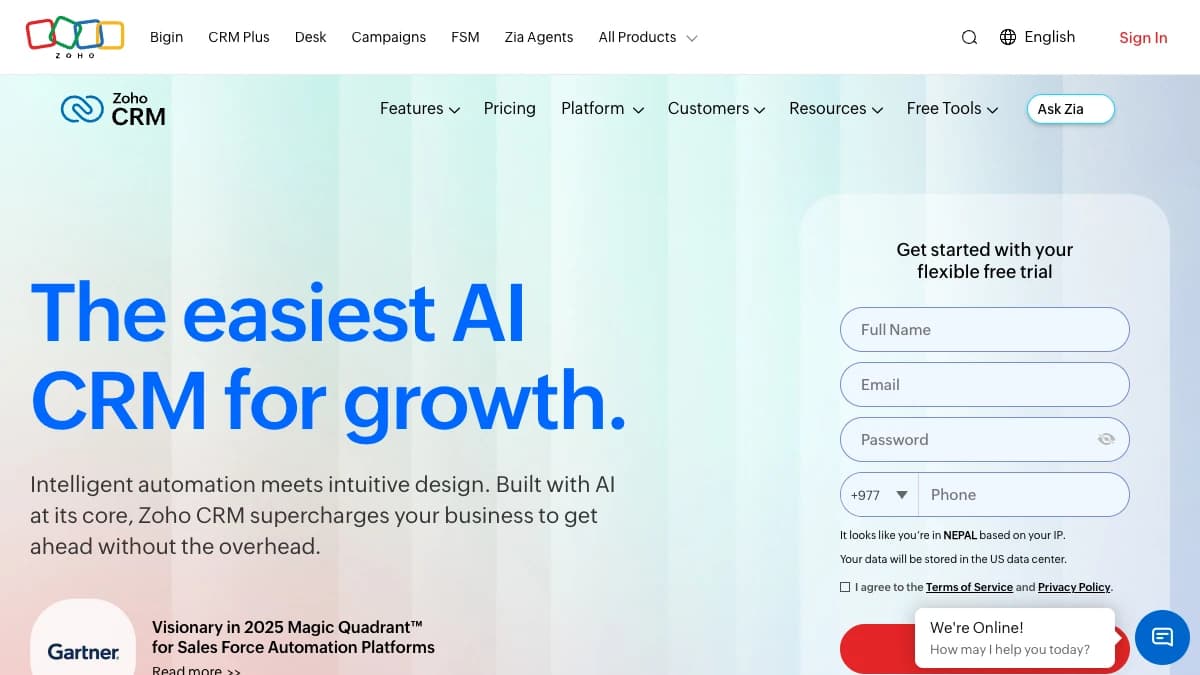
Zoho CRM is priced in four paid tiers — Standard, Professional, Enterprise, and Ultimate — plus a free tier for up to 3 users. The edition structure is confirmed directly on zoho.com/crm/pricing.html, but that page geo-detects currency and displayed INR (₹800 / ₹1,400 / ₹2,400 / ₹2,600 per user/month) at the time of our check rather than USD. The USD figures used in this post — $14, $23, $40, and $52 per user per month, annual billing — come from independent third-party pricing breakdowns rather than a direct page read in USD, so treat them as secondary-sourced and confirm directly with Zoho before budgeting.
Zoho's real pitch isn't just price — it's breadth. Zoho One bundles the CRM with 45+ other Zoho apps at a flat per-employee rate, and Zoho CRM itself stays deeply configurable at every tier: custom modules, Blueprint process automation, and Zia AI agents (both from Professional up) are genuinely capable. The tradeoff is that capability tends to require more hands-on configuration than HubSpot's equivalent features — Zoho is built to be tinkered with by whoever's running it, not necessarily to work well out of the box.
Unlike HubSpot, Zoho does not publish a mandatory onboarding fee on its CRM editions, so the seat-price math is close to the full year-one cost, not a floor that fees get added on top of. If you land on Zoho, see our guide to enrichment tools for Zoho CRM for keeping records accurate once it's configured.
Pros
- +Lowest per-seat cost at every tier — Ultimate ($52/user/month, secondary-sourced) still undercuts HubSpot's Professional tier by a wide margin
- +Per-seat price stays flat as headcount grows, with no onboarding fee stacked on top
- +Blueprint process automation and Zia AI agents from Professional tier up are genuinely deep and configurable
- +Part of a much larger app ecosystem (Zoho One, 45+ apps) for teams that want to consolidate beyond just CRM
Cons
- −Deep configurability trades off against out-of-the-box polish — implementation and admin time are the real hidden cost, not listed anywhere on the pricing page
- −Reporting is capable but leans more on admin or power-user setup than HubSpot's self-serve dashboards
- −Official pricing page geo-serves local currency rather than defaulting to USD, which makes direct price verification harder for USD-based buyers
- −Smaller third-party integration marketplace than HubSpot's, with less long-tail app coverage
Best for: Teams with admin capacity to configure the platform, price-sensitive buyers, and teams that want CRM depth without HubSpot's tier-jump pricing
Pricing: $14–$52/user/month (USD, annual, secondary-sourced) across four paid tiers (Standard, Professional, Enterprise, Ultimate), plus a free tier for up to 3 users. Edition structure verified on zoho.com/crm/pricing.html; the page displayed region-detected INR (₹800–₹2,600/user/month) at check time, so USD figures were cross-checked against independent third-party pricing breakdowns rather than read directly in USD.
Comparison Table
| Tool | Best For | Free Tier | Starting Price | Standout Feature |
|---|---|---|---|---|
| SyncGTM | Teams on either HubSpot or Zoho CRM who need contact and account data to stay accurate without manual upkeep | Yes | $99/mo | Works underneath both CRMs in this comparison, so the enrichment layer doesn't change if the CRM decision does |
| HubSpot | Teams that want reporting and automation non-admins can run themselves, and would rather pay more upfront than spend admin time configuring | Yes (up to 2 users) | $7/seat/month (Starter, annual) | Polish and fast adoption — the hidden cost shows up in onboarding fees and tier jumps, not day-to-day admin overhead |
| Zoho CRM | Teams with admin capacity to configure the platform, price-sensitive buyers, and teams that want CRM depth without HubSpot's tier-jump pricing | Yes (up to 3 users) | $14/user/month (Standard, annual, secondary-sourced) | Flat, low per-seat pricing with no onboarding fee — the cost shows up later, in implementation effort rather than on the invoice |
How to Choose
- SyncGTM if you need teams on either hubspot or zoho crm who need contact and account data to stay accurate without manual upkeep
- HubSpot if you need teams that want reporting and automation non-admins can run themselves, and would rather pay more upfront than spend admin time configuring
- Zoho CRM if you need teams with admin capacity to configure the platform, price-sensitive buyers, and teams that want crm depth without hubspot's tier-jump pricing