

RocketReach 2026 Review: Contact Database Tested — Pricing and Data Quality

By Kushal Magar · March 16, 2026 · 11 min read · Last updated: September 30, 2026
Key Takeaway
RocketReach is a B2B contact database with 700 million-plus professional profiles and 60 million companies, offering email and phone lookups, advanced search filters by title, company, location, industry, and revenue range, plus bulk export via CSV or API. As of September 2026, annual plans include unlimited lookups: Essentials costs 33 dollars per seat per month for unlimited email lookups, Pro costs 75 dollars and adds phone lookups, and Ultimate costs 175 dollars and adds 20,000 exports per year. RocketReach claims 98 percent deliverability for its A-grade emails; our assessment puts US email accuracy around 75 to 85 percent, with phone accuracy lower at 55 to 65 percent. The main limitation is static data. The database updates periodically rather than at the moment of lookup, so contacts who changed jobs recently may still show old information. It fits teams that want high lookup volume on a predictable annual budget and are willing to verify contacts before sending.
RocketReach is a B2B contact database with 700M+ professional profiles, offering email and phone lookups, advanced search filters, and bulk export capabilities. As of September 2026, annual plans start at $33/seat/month with unlimited email lookups. The database is large but static — data is updated periodically rather than in real time.
You are probably here because you need a big contact database with reliable search. RocketReach has been around since 2016 and has built one of the larger B2B databases in the market.
The problem is that databases are only as good as their last update. This RocketReach review covers database quality, real pricing math, limitations, and why static data alone is not enough in 2026.
RocketReach Review: What You Get (and What You Don't)
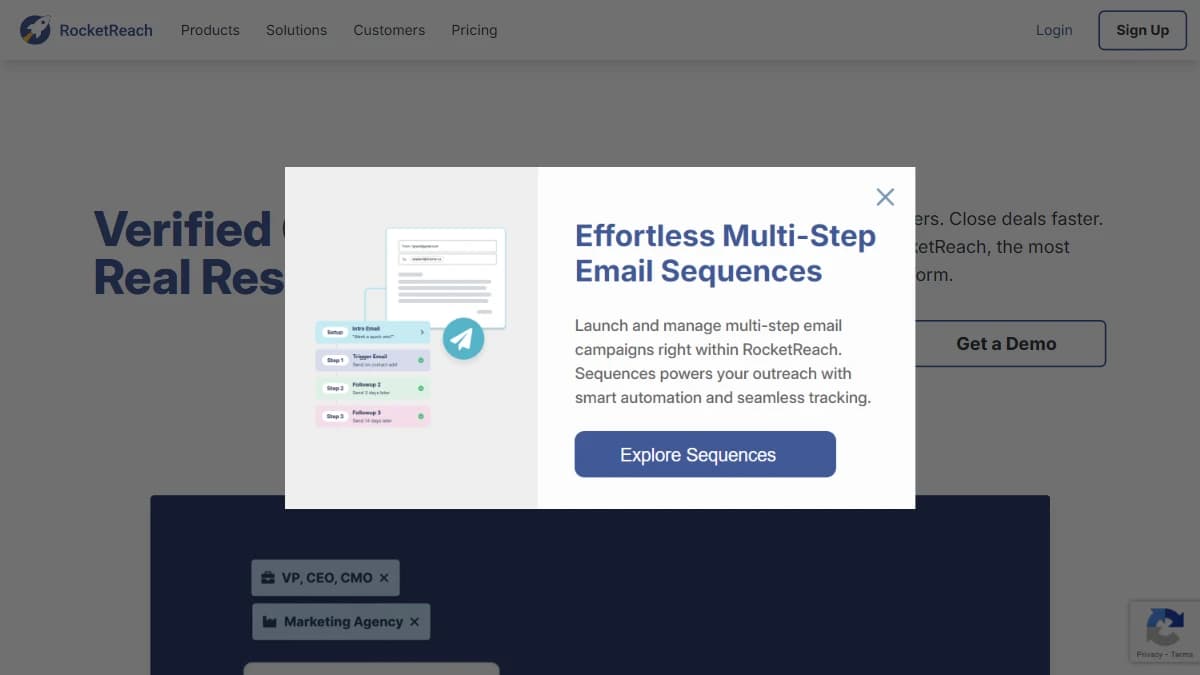
RocketReach provides a searchable contact database with email addresses, phone numbers, and company data. The search portal supports filters by title, company, location, industry, and revenue range. Compared to enrichment-focused tools like Apollo.io and ZoomInfo, RocketReach emphasizes raw database size over workflow features.
| Feature | What's Included | Limitations |
|---|---|---|
| Contact Database | 700M+ profiles and 60M companies with email and phone | Static data; not real-time enrichment |
| Search Filters | Title, company, location, industry, revenue | Only as current as the underlying profile data |
| Bulk Lookups | Batch export via CSV or API; unlimited lookups on annual plans | Exports are capped (20K/year on Ultimate) |
| Buying Signals | Intent data listed as a feature (as of September 2026) | Built around contact lookups, not signal-driven workflows |
| CRM Integration | Salesforce, HubSpot, Outreach, and Zapier | No automated enrichment on CRM entry |
RocketReach Database: 700M+ Profiles Tested
RocketReach's database is genuinely large. 700M+ profiles (plus 60M companies, per RocketReach) cover a wide range of industries, geographies, and seniority levels. The search filters are detailed enough to build targeted prospect lists.
However, database size does not equal data freshness. RocketReach updates its database periodically, not in real time. A contact who changed jobs 3 months ago may still show their old company. An email that bounced last week may still appear as verified.
This is the fundamental problem with static databases. They decay. Industry estimates put B2B data decay at 30% per year. A 700M profile database has ~210M records that are stale at any given time.
RocketReach Data Quality: How Accurate Is It?
RocketReach says its A-grade emails have a 98% deliverability rate and that users typically see bounce rates of 5-10%. Across all email grades, our assessment is that email accuracy sits around 75-85% for US contacts. Phone number accuracy is lower at 55-65%. Company-level data is generally reliable for mid-market and enterprise companies. For comparison, Lusha and Hunter.io achieve higher accuracy through real-time verification approaches.
Accuracy drops for contacts at small companies, international markets outside the US and Europe, and recently hired or promoted individuals. The static nature of the database means recently changed data is the least reliable.
RocketReach Pricing Breakdown
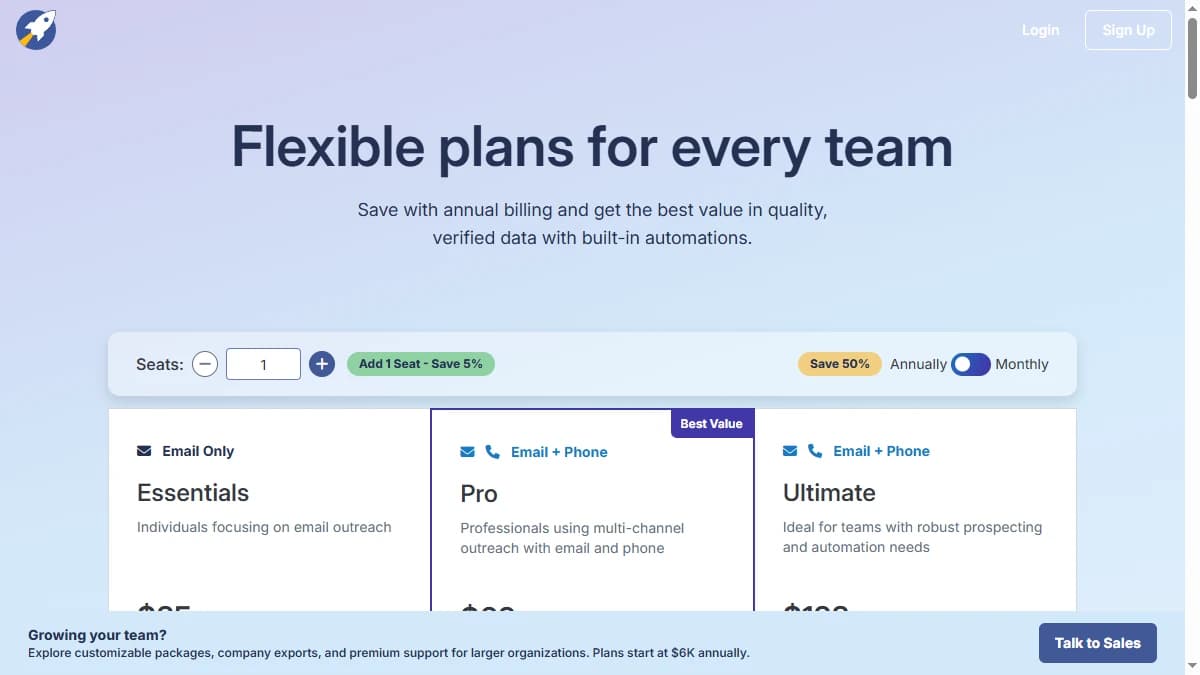
RocketReach moved away from strictly metered plans. As of September 2026, its annual plans include unlimited lookups and are priced per seat:
- --Essentials ($33/seat/mo, billed annually): Unlimited email lookups.
- --Pro ($75/seat/mo, billed annually): Unlimited email and phone lookups.
- --Ultimate ($175/seat/mo, billed annually): Unlimited email and phone lookups plus 20K exports per year.
- --Custom team plans: From $6,000/year.
Unlimited lookup credits are only offered on annual billing, so monthly subscribers still work from a metered lookup allowance. The pricing screenshot above was captured when plans were sold per lookup, so check RocketReach's pricing page for current monthly rates.
- Unlimited requires a year upfront: Unlimited lookups are annual-only; monthly plans stay metered.
- Per-seat pricing: Every user needs a seat, so cost scales with headcount rather than usage.
- Export caps: Even Ultimate includes 20K exports per year.
What Are the Downsides of Using RocketReach?
Static data decays fast
30% annual decay means a significant portion of RocketReach's database is stale at any time. Verify emails before large sends, especially for contacts who changed roles recently.
Signals are secondary
RocketReach lists intent data among its features as of September 2026, but the product is built around contact lookups, not signal-driven workflows. If timing outreach to buying signals matters to your team, test how well its intent data covers your market before you commit to an annual plan.
Per-seat pricing adds up
Unlimited lookups removed the per-lookup math, but pricing is now per seat and annual. A five-person team on Pro pays $4,500 a year ($75 × 5 seats × 12 months), and even Ultimate caps exports at 20K per year.
How RocketReach Works: From Search to Outreach
RocketReach is simple to learn, but the order you use it in affects both data quality and cost. Here is how a typical prospecting workflow runs, based on the features RocketReach lists as of September 2026.
- Search the database. Filter 700M+ profiles and 60M companies by title, company, location, industry, and revenue to build a first list.
- Look up contacts in context. Run lookups in the web app or through the Chrome extension while you browse company sites and profiles. RocketReach grades emails, and says its A-grade emails reach 98% deliverability, so prioritize those for cold outreach.
- Map the account. Use org charts to find other stakeholders at the same company instead of relying on a single contact.
- Export or sync. Bulk-export lists as CSV, pull data through the API, or push records to Salesforce, HubSpot, Outreach, or Zapier. On Ultimate, exports are capped at 20K per year, so export the lists you will actually work.
- Send, or hand off. RocketReach includes lightweight built-in outreach, with an AI email writer, templates, dynamic list generation, and automated follow-up emails. Teams with a dedicated sequencer usually sync contacts there instead.
- Re-verify before big sends. Because profiles update periodically, re-check older records and contacts with recent job moves before a large campaign.
The shift to unlimited annual lookups changes how teams should use the tool. Under per-lookup pricing, reps rationed lookups; on an annual plan, the constraint moves to seats and exports, so the efficient pattern is to look up freely, then export and sync only the contacts you are ready to work.
Is RocketReach Worth It?
RocketReach is worth it for occasional lookups where you need a large database with decent filters. The search portal is easy to use and the data coverage is broad. See how it compares in our best sales prospecting tools for B2B teams roundup.
RocketReach is not worth it for teams that need real-time data or signal-driven workflows, or for large teams that will feel the per-seat pricing and export caps. The static database and the annual commitment required for unlimited lookups are the main trade-offs. Visit RocketReach's official site for current pricing, and check RocketReach reviews on G2 for user feedback.
The verdict: RocketReach is a big, easy-to-search database, and unlimited lookups on annual plans make high-volume use predictable. It is still a lookup tool first: data freshness and signal depth are where it falls short.
If RocketReach's periodically updated, static data is a dealbreaker, SyncGTM is one alternative worth a look: it runs waterfall enrichment across 50+ data providers and tracks real-time buying signals such as job changes.