
By Kushal Magar · September 28, 2026 · 11 min read
Salesloft vs Clari: What the 2025 Merger Means
Search "Salesloft vs Clari" in 2026 and most of what ranks still treats them as two competing vendors to pick between. That's stale. Clari and Salesloft completed a merger on December 3, 2025 and now operate as one company, with former Salesloft CEO Steve Cox running the combined organization. There's no longer a Salesloft-vs-Clari purchase decision in the traditional sense — but there is still a real question underneath it: if you need a cadence engine and a forecasting layer, which do you stand up first, now that both live inside one vendor relationship?
If you landed here comparing Salesloft and Clari as two separate products to choose between, the comparison itself is outdated. On December 3, 2025, Clari and Salesloft completed a merger and now operate as a single combined company, with Steve Cox — previously Salesloft's CEO — appointed CEO of the merged organization. This wasn't a partnership or an integration announcement; it was a full corporate merger. A lot of comparison content written before that date (and some still being published after it) hasn't caught up.
That changes the question worth answering. It's no longer "Salesloft or Clari, which do we buy." It's: what does each product still do inside one vendor relationship, are they still separately purchasable, and — if you're choosing what to stand up first — do you need cadence execution or forecasting more urgently. We'll go through the merger itself, what's verifiable about product structure today, and that buying decision. For the nearest adjacent comparison, see our Salesloft vs Gong breakdown, which covers the same execution-vs-intelligence split from a still-separate-vendors angle.
One thing upfront: we're not going to guess at what the combined roadmap does next. The merger closed under ten months ago as of this writing, and the company itself has been explicit that product-integration details are still being worked out. Where the public record is unclear, we'll say so instead of filling the gap with a confident-sounding guess.
Quick Summary
Salesloft and Clari are no longer separate vendors to compare — they completed a merger on December 3, 2025, forming one combined company with Steve Cox (formerly Salesloft's CEO) running the organization. That's the headline fact anyone searching "Salesloft vs Clari" in 2026 needs first, because a lot of the content still ranking for this term predates the deal. Inside the combined company, the two products still do recognizably different jobs: Salesloft is the sales engagement layer — multi-step outbound cadences across email, calls, and LinkedIn, a dialer, deal management, and built-in conversation intelligence. Clari is the forecasting and pipeline-inspection layer — deal-risk scoring, revenue cadences (the recurring-review-process kind), and an AI Action Hub for revenue strategy. The company's own merger page states plainly that "Clari Forecast retains the Clari name" and that "capabilities customers rely on today continue as part of Salesloft," while describing product integration as "ongoing" rather than finished. What isn't publicly clear yet is the commercial structure going forward — whether the two remain distinct SKUs, get bundled into a unified contract, or converge into a single product line over time. We're not going to guess at that; it's a due-diligence question worth asking the vendor directly if you're evaluating either product today. What hasn't changed is the underlying buyer logic: teams without a repeatable outbound motion still get more immediate value from the cadence-engine side (Salesloft), and teams with activity already flowing but weak forecast visibility still get more value from the forecasting side (Clari). The difference in 2026 is that both conversations now happen with the same vendor, which simplifies procurement but raises a different question — overlapping products inside one merged company can be repositioned, rebundled, or sunset over time, so it's worth asking directly about roadmap plans for whichever module you're buying rather than assuming the current structure is permanent. SyncGTM sits outside this merger entirely, as the enrichment and Salesforce-sync layer feeding both the cadence data Salesloft sequences and the account context that forecasting depends on.
TL;DR
- The premise changed: Salesloft and Clari are not competing vendors anymore. They completed a merger on December 3, 2025, and now operate as one company under CEO Steve Cox.
- What each product still does: Salesloft covers sales engagement — cadences, dialer, email, deal management, conversation intelligence. Clari covers forecasting, pipeline inspection, and revenue cadences (the process kind, not the outbound kind) — and per the company's own merger page, "Clari Forecast retains the Clari name."
- Separately sold or bundled? The company states integration is "ongoing" and that customers will see "capabilities deepening over time — not disruption to what you rely on today." It has not published a clear public statement on unified SKUs or bundled pricing as of this writing — that's a live due-diligence question, not something we're going to guess at.
- The decision that still exists: if you need a cadence engine before a forecasting layer (no repeatable outbound motion yet), or a forecasting layer before more cadence tooling (activity already flowing, forecast accuracy is the gap) — that buyer logic hasn't changed. It's just now a conversation with one sales team instead of two.
- Consolidation risk: overlapping products inside a merged company can be repositioned, rebundled, or retired over time. Ask the vendor directly about roadmap plans for the specific modules you'd be buying, rather than assuming today's structure holds.
- SyncGTM isn't part of this merger and doesn't compete with either product — it's the data layer underneath whichever one you run: 2-way Salesforce sync, 76+ waterfall enrichments, and an AI Email Writer that drafts the cadence copy Salesloft sends and the account context Clari-side forecasting depends on.
What We Evaluated
- Whether the comparison you're reading (including this one) predates or postdates the December 2025 merger
- What each product still does today — sales engagement (Salesloft) vs. forecasting and pipeline inspection (Clari)
- Whether the two remain separately purchasable, bundled, or converging — verify directly with the vendor rather than assuming
- Which layer you need first: cadence execution if outbound motion isn't repeatable yet, forecasting if activity exists but visibility doesn't
- Consolidation and roadmap risk — ask what happens to the specific modules you're buying over the next 12–24 months
- Existing-contract impact if you're already a Salesloft or Clari customer versus a net-new buyer
- How the underlying contact and account data feeding both cadences and forecasts is kept current
1. SyncGTM — Teams running Salesloft, Clari, or both post-merger, who need the contact and account data behind cadences and forecasts to stay accurate and synced
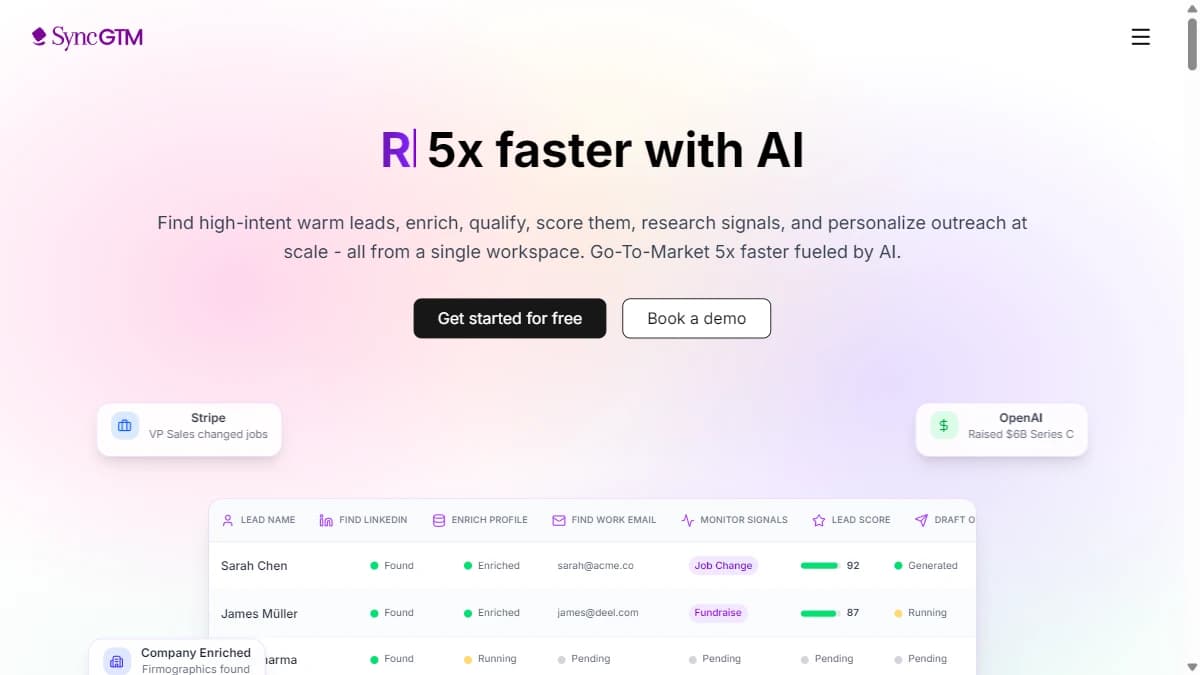
SyncGTM — Teams running Salesloft, Clari, or both post-merger, who need the contact and account data behind cadences and forecasts to stay accurate and synced
SyncGTM has no relationship to the Clari-Salesloft merger — it's not an engagement platform or a forecasting tool, and it doesn't compete with either side of the combined company. It's the data layer underneath whichever one you run.
2-way Salesforce sync keeps enriched contact and account records flowing in both directions, so the data feeding Salesloft's cadences — and the account context behind deals the Clari side is forecasting — stays current instead of drifting stale. A real-time waterfall across 50+ providers adds 76+ data points per lead: verified email, direct phone, firmographics, and job-change or growth signals.
The AI Email Writer turns that verified data into sequence-ready copy for cadence tools like Salesloft, starting reps with a draft grounded in real account context instead of a blank step. See the GTM agent library and a ready outreach workflow template, or check pricing for current plans.
Pros
- +2-way Salesforce sync — enriched data flows back into the CRM instead of sitting in a separate export
- +76+ data points per lead from a 50+ provider waterfall, refreshed at lookup rather than a static append
- +AI Email Writer drafts cadence copy from verified contact and account data
- +Sits underneath both engagement and forecasting tools without competing with either
Cons
- −Not a cadence, dialer, or forecasting tool — teams still need Salesloft, Clari, or the combined portfolio to run and forecast the motion
- −Not a CRM — Salesforce (or another CRM) is still required as the system of record
Best for: Teams running Salesloft, Clari, or both post-merger, who need the contact and account data behind cadences and forecasts to stay accurate and synced
Pricing: Starts at $99/mo. Free tier available.
2. Salesloft — Teams that don't yet have a repeatable outbound motion and need to generate consistent activity first — early-stage or scaling into a new segment
Salesloft — Teams that don't yet have a repeatable outbound motion and need to generate consistent activity first — early-stage or scaling into a new segment
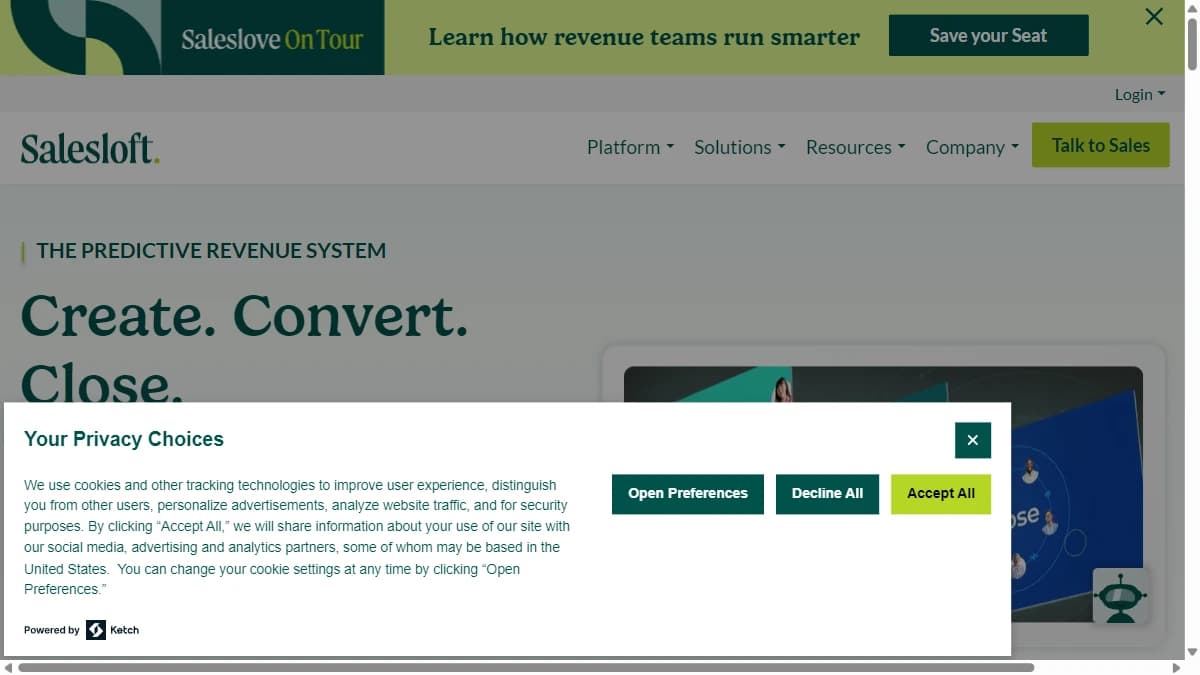
Salesloft is the sales engagement side of the combined company — built around the Cadence, a structured, multi-step sequence of calls, emails, and LinkedIn touches that reps work through in a prioritized queue.
It's the layer that generates outbound activity: dialer, email sends, deal management, and built-in conversation intelligence (call recording, transcription, coaching). Activity syncs back into a connected CRM, most commonly Salesforce.
Per the company's own merger page, capabilities customers rely on today "continue as part of Salesloft," and the brand name carries forward for this side of the product — while newly-added AI agents (Account Research, Person Research, Ask Salesloft) extend it further into research and workflow.
Pros
- +Purpose-built cadence engine with multi-channel sequencing (call, email, LinkedIn) and dynamic branching
- +Generates the outbound activity that forecasting depends on having volume of before it's useful
- +Built-in conversation intelligence and coaching alongside the core engagement product
- +Native two-way activity sync into Salesforce and other CRMs
Cons
- −Not a system of record — still requires a CRM underneath it for pipeline, accounts, and reporting
- −Public self-serve pricing isn't published; cost is quoted per seat via sales
- −Post-merger commercial structure (bundling, unified contracts) isn't fully public yet — confirm directly before assuming continuity
- −Product-integration work with the Clari side is explicitly described as "ongoing," not finished
Best for: Teams that don't yet have a repeatable outbound motion and need to generate consistent activity first — early-stage or scaling into a new segment
Pricing: Sold via annual contract with per-seat pricing quoted by sales; no public self-serve tier.
3. Clari — Teams with existing pipeline and activity volume that need forecast accuracy and deal-risk visibility rather than more outbound tooling
Clari — Teams with existing pipeline and activity volume that need forecast accuracy and deal-risk visibility rather than more outbound tooling
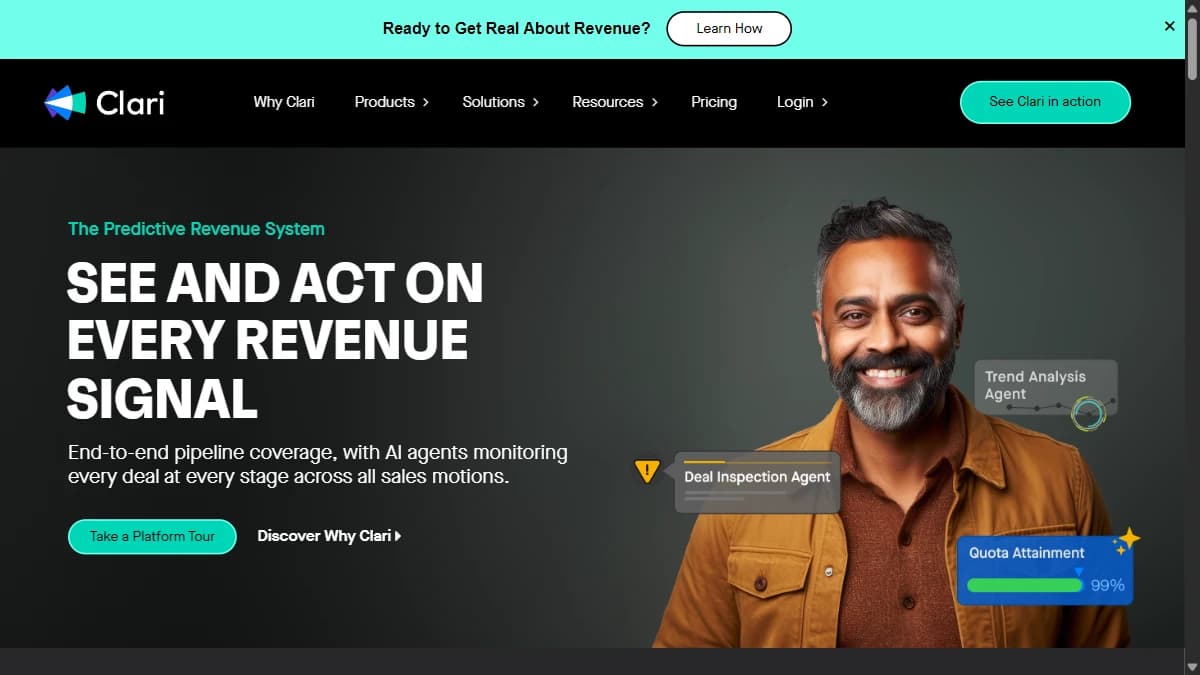
Clari is the forecasting and pipeline-inspection side of the combined company — built around deal-risk scoring, revenue cadences (the recurring pipeline-review process, not outbound sequencing), and an AI Action Hub for revenue strategy.
Its strength is visibility: surfacing which deals are at risk, rolling activity and pipeline signal up into a forecast, and giving RevOps and sales leadership a structured, recurring review process instead of a spreadsheet rollup.
Per the company's merger page, "Clari Forecast retains the Clari name" inside the combined portfolio, and the stated direction is connecting "the full revenue lifecycle from pipeline creation to close" with Salesloft's engagement data feeding into it.
Pros
- +Dedicated forecasting and deal-risk scoring, built on pipeline and activity signal rather than gut-feel rep rollups
- +Revenue cadences give leadership a structured, recurring pipeline-review process
- +AI Action Hub surfaces recommended actions on at-risk deals rather than just flagging risk
- +Now positioned to draw on Salesloft's engagement data directly as part of one combined company
Cons
- −Forecasting output is only as good as the activity and CRM data feeding it — a data-quality problem neither merger partner solves on its own
- −No public self-serve pricing; quote-based like Salesloft
- −Post-merger commercial and product structure isn't fully public — confirm current SKU and contract details directly with the vendor
- −Less useful for teams without an established motion yet — there's not enough signal to forecast against
Best for: Teams with existing pipeline and activity volume that need forecast accuracy and deal-risk visibility rather than more outbound tooling
Pricing: Quote-based, per-seat annual contracts; no public list pricing.
Comparison Table
| Tool | Best For | Free Tier | Starting Price | Standout Feature |
|---|---|---|---|---|
| SyncGTM | Teams running Salesloft, Clari, or both post-merger, who need the contact and account data behind cadences and forecasts to stay accurate and synced | Yes | $99/mo | The 2-way Salesforce data layer and AI-drafted sequence copy that sits underneath either side of the merged portfolio |
| Salesloft | Teams that don't yet have a repeatable outbound motion and need to generate consistent activity first — early-stage or scaling into a new segment | No (demo-based sales process) | Custom quote | The cadence-execution engine inside the merged company, largely unchanged day-to-day by the deal |
| Clari | Teams with existing pipeline and activity volume that need forecast accuracy and deal-risk visibility rather than more outbound tooling | No (demo-based sales process) | Custom quote | The forecasting and pipeline-inspection layer inside the merged company, still operating under the Clari Forecast name |
How to Choose
- SyncGTM if you need teams running salesloft, clari, or both post-merger, who need the contact and account data behind cadences and forecasts to stay accurate and synced
- Salesloft if you need teams that don't yet have a repeatable outbound motion and need to generate consistent activity first — early-stage or scaling into a new segment
- Clari if you need teams with existing pipeline and activity volume that need forecast accuracy and deal-risk visibility rather than more outbound tooling