


5 Best Sumble Alternatives for Account Intelligence in 2026

By Kushal Magar · November 28, 2026 · 11 min read
Key Takeaway
Sumble turns job posts into team-level account intelligence, but its December 1, 2026 pricing change makes browsing cost credits, and CRM delivery stays Enterprise-only. SyncGTM puts job openings, tech stack and verified contacts in one table. TheirStack is the cheapest raw job-post data, PredictLeads the most flexible pay-as-you-go API, Crustdata the developer pick, and HG Insights the enterprise install-base option.
The best Sumble alternatives in 2026 are SyncGTM, TheirStack, PredictLeads, Crustdata and HG Insights. Each one covers part of what Sumble does: tech stack, hiring and team signals read from job posts.
This guide ranks them on how they source and evidence their data, how much of the market they cover, and what you actually pay. Every price below was checked on November 28, 2026, on the vendor's own pages or, where a vendor doesn't publish one, in its launch coverage.
TL;DR
- SyncGTM — Best all-in-one workflow: job openings, tech stack and verified contacts in one table, pushed to your CRM or sequencer. Free plan, paid from $49/month.
- TheirStack — Best raw job-post and technographic data for the money: 278M jobs, 33k technologies, plans from $19/month.
- PredictLeads — Best pay-as-you-go signal API: job openings on 3M+ companies, top-ups from $10, credits valid for 12 months.
- Crustdata — Best for engineers building agents on people, company and job data through an API or MCP server.
- HG Insights — Best for enterprise tech vendors who need install-base and IT-spend data, with budgets to match.
Why Teams Look for Sumble Alternatives
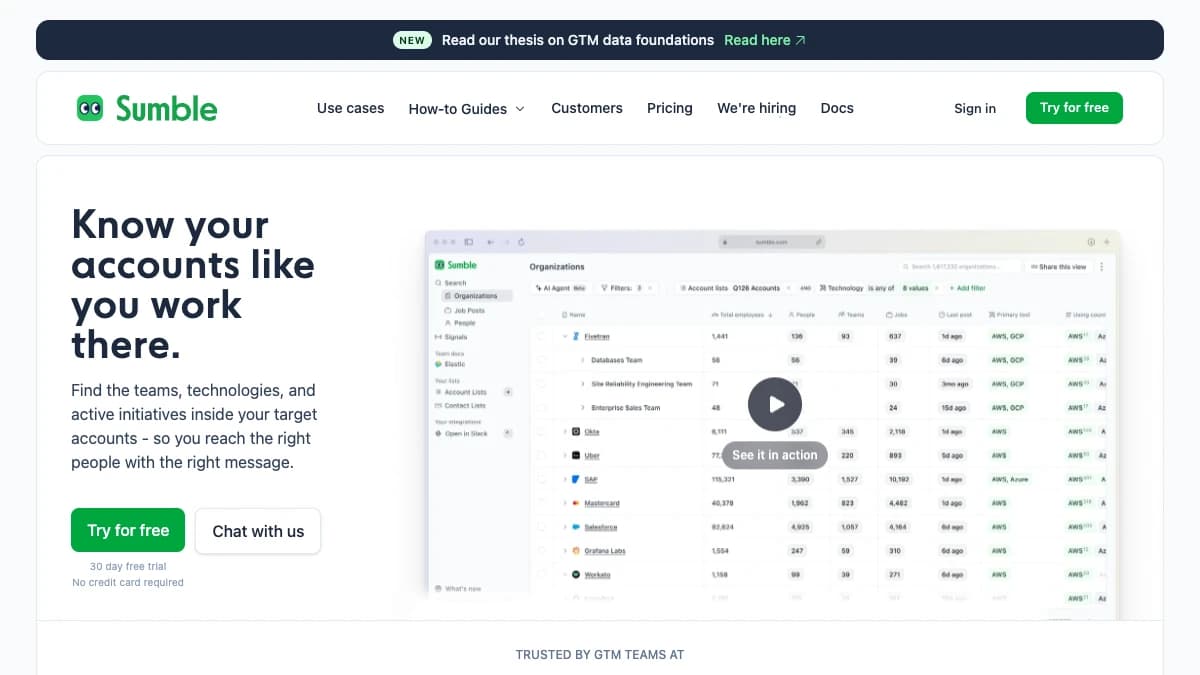
Sumble — team-level account intelligence built from job posts
Sumble maps the teams, technologies and active initiatives inside a target account. Its homepage pitches the difference as going from "Wells Fargo uses Grafana" to which team uses Grafana, who leads it, and the job post that proves it.
That team-level view is the reason people pick Sumble, and our Sumble review covers it in depth. Teams start looking elsewhere for four practical reasons.
- Browsing starts costing credits. From December 1, 2026, opening pages in the web app draws on your credits (details in the next section).
- CRM delivery is Enterprise-only. Sumble's plan comparison lists CRM, data warehouse and webhook delivery as Enterprise features, not Free or Pro.
- Contacts are an add-on cost. Email and phone reveals need Pro or Enterprise and cost 10 credits per email and 80 per phone.
- Credits belong to one person. Sumble's credits FAQ says credits can't be shared between users, except through an Enterprise company pool.
There's also a structural limit that applies to every job-post tool, Sumble included. The data is only as rich as a company's hiring, so accounts that rarely post roles, or post vague ones, show up thin.
Sumble Pricing in 2026 and the December 1 Change
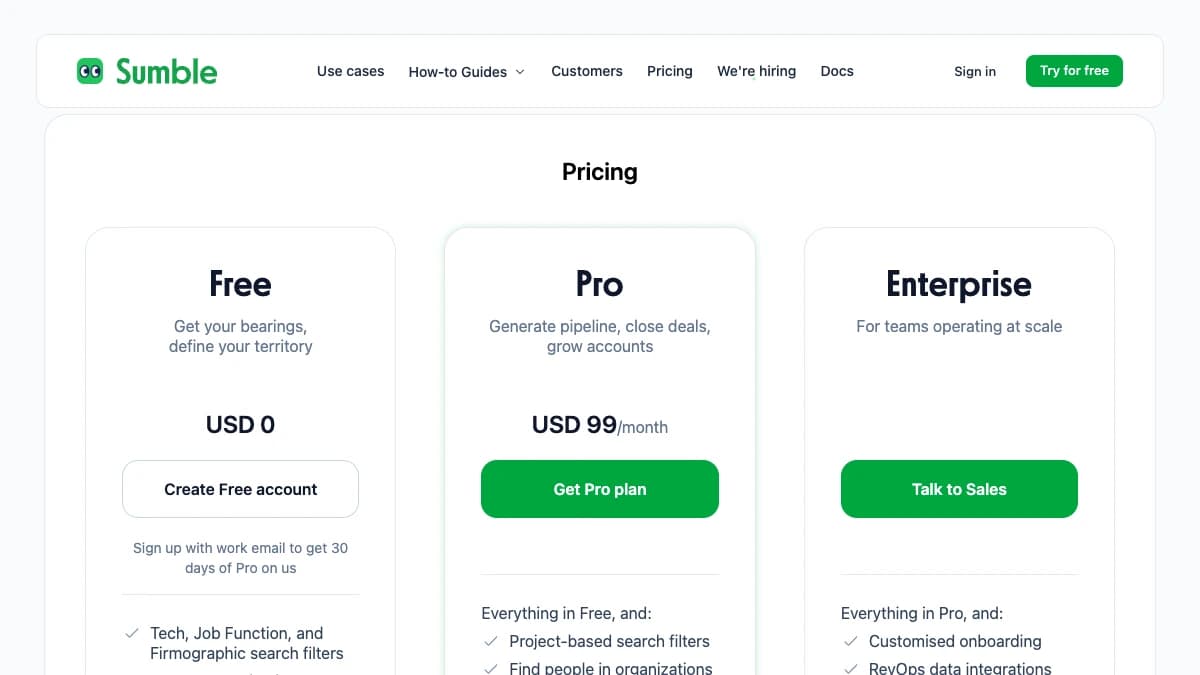
Sumble pricing page, November 28, 2026
Sumble's pricing page lists three plans: Free at USD 0, Pro at USD 99 a month, and Enterprise through sales. New users who sign up with a work email get 30 days of Pro, and the homepage says no credit card is required.
The part most comparison posts miss is in Sumble's plans and billing docs: Free and Pro pricing changes on December 1, 2026. Pro stays at $99 per user per month, but the credit model changes.
| Plan | Until your account switches | From December 1, 2026 |
|---|---|---|
| Free | 500 credits a month; browsing costs no credits; first page of search results only | 75 credits a day; browsing costs credits; no MCP; no email or phone reveals |
| Pro ($99/user/mo) | 9,900 credits a month; up to 20 pages of results; browsing costs no credits | 300 credits a day plus 6,000 a month; browsing costs credits; MCP and reveals included |
| Enterprise | Custom | Custom; browsing included; CRM, warehouse and webhook delivery |
Under the new model, Sumble's credits documentation charges 2 to 4 credits per page you open and 20 credits for an intelligence brief. Each page is charged once a day, and daily credits that you don't use expire at 00:00 UTC.
Existing Pro accounts move to the new terms at their first renewal on or after December 1. If your team lives in the web app all day, that's the moment to compare the alternatives below.
How We Ranked Each Tool
We scored each Sumble alternative on the three things that matter when you replace a job-post intelligence tool:
- Accuracy — Where the data comes from and how the vendor backs it up: job-post evidence, confidence scoring, refresh cadence, point-in-time history.
- Coverage — The dataset sizes each vendor publishes, and which signals it covers: hiring, tech stack, team or department data, contacts.
- Price — The published entry price, the cost per unit of data, and whether a free tier or trial exists.
We didn't run a head-to-head accuracy test, so no tool gets an accuracy percentage here. Dataset sizes and prices come from each vendor's own pages as of November 28, 2026, linked next to each figure.
1. SyncGTM
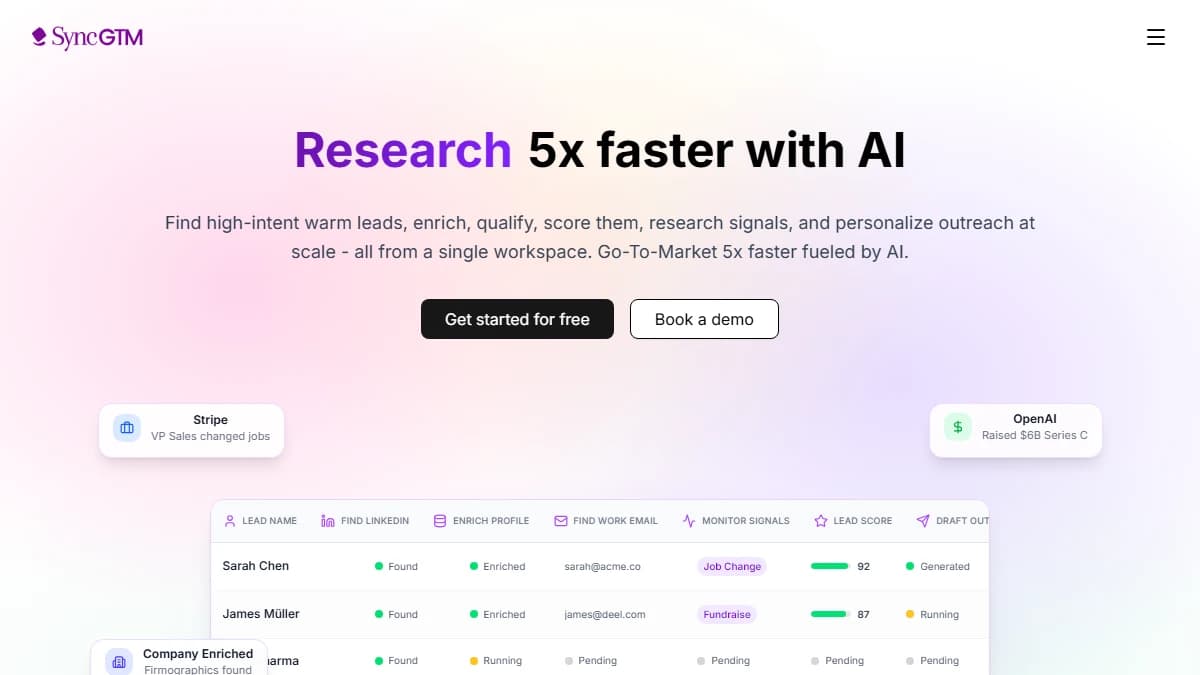
SyncGTM — job openings, tech stack and verified contacts in one workflow
SyncGTM is a GTM data platform that finds accounts showing buying signals, then finds and verifies the people to contact there. For a Sumble user, the draw is that hiring data, tech stack and contacts land in one table instead of three tools.
On the signal side, you can pull a company's open job listings, flag accounts that are hiring in sales or marketing, look up a company's tech stack, and catch tech stack changes such as a competitor being adopted. Job searches run across multiple providers and fall back to the next one if a provider fails.
Sumble's strength is team-level context, and SyncGTM doesn't replicate its org graph. The closest proxies are headcount by department and job-opening growth over three and six months, broken down by job function.
Then comes the step Sumble charges extra for: contacts. SyncGTM runs a work email waterfall, mobile lookup and email verification, and pushes the result to HubSpot, Salesforce, Attio, Pipedrive, Close or Zoho, or to Instantly, Smartlead and HeyReach for outreach.
In SyncGTM's MCP server, a job search costs 0.3 credits per job returned and a tech stack lookup costs 1 credit. A work email costs 1 credit (misses aren't billed), a mobile number 10 and a verification 0.2, so Solo's 1,000 credits cover about 3,300 job records or 1,000 email lookups.
Columns can re-run on a schedule, from daily to yearly, so a watchlist of accounts picks up new job posts and stack changes without manual exports. SyncGTM tracks 30+ buying signals in total, from job changes to funding rounds.
Pros
- ✓ Job openings, tech stack and contact data in the same table
- ✓ Job searches fall back across multiple providers if one fails
- ✓ Team-level proxies: headcount by department and job-opening growth by function
- ✓ Work-email misses aren't billed
- ✓ Pushes straight to CRMs and sequencers on every paid plan
Cons
- ✗ No org graph of named teams and reporting lines like Sumble's
- ✗ Tech stack is company-level, not tied to a specific team
- ✗ No multi-year job archive or bulk dataset delivery
- ✗ Credits are spent per job returned, so market-wide scans add up
Best for: Sales and RevOps teams that want to act on hiring and tech-stack signals without stitching three tools together.
Pricing: Free plan to test. Paid plans start at $49/month (Solo, 1,000 credits), then Starter $99, Pro $249 and Business $649. See SyncGTM pricing.
2. TheirStack
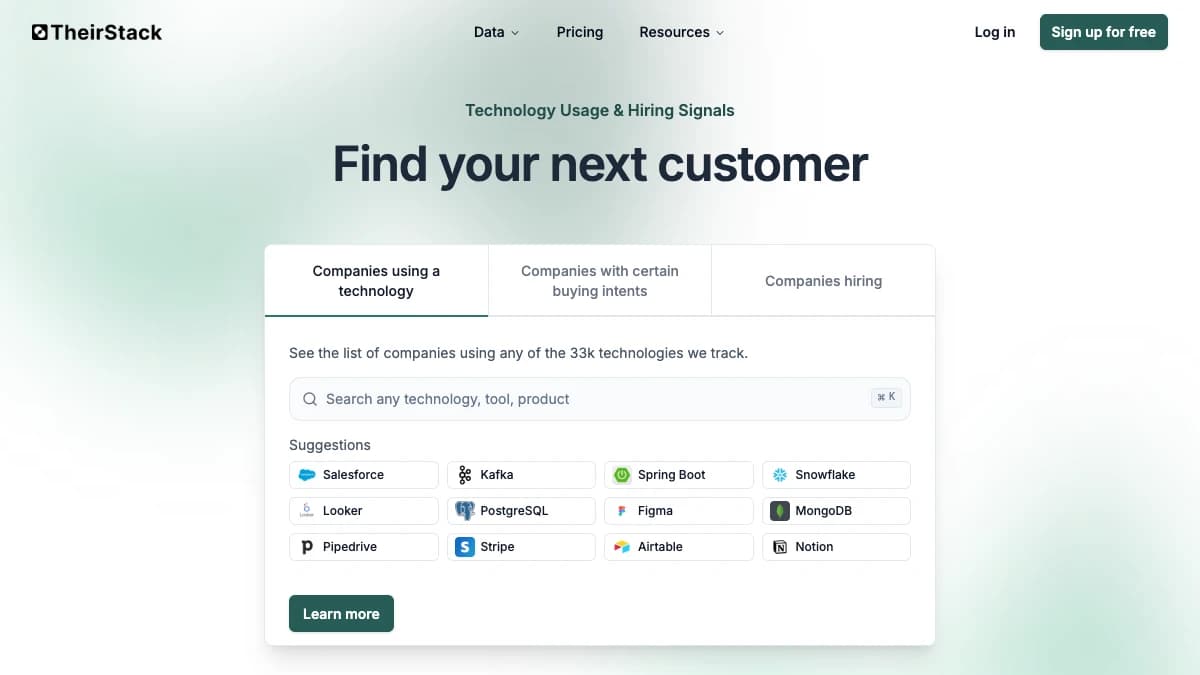
TheirStack — job postings, technographics and buying intents from one credit pool
TheirStack is a job-postings and technographics data provider built for outbound, enrichment and market research. It is the closest match to Sumble's raw ingredient, because both read job posts to work out what a company runs.
TheirStack's methodology page says it sources tech usage data from job postings and applies confidence scoring. Its homepage says it tracks 33k technologies and analyzes 278M jobs from over 195 countries.
The pricing page breaks the data into three datasets. Jobs holds 278M records plus 472k new per day, technographics 54M records, and buying intents 411M records detected in job postings.
Pricing is one credit pool for the app, API, webhooks and MCP: 1 credit per job and 3 per company or technographics lookup. Unused paid credits roll over for 12 months, and any number of teammates can share the balance.
What you don't get is the team layer. TheirStack tells you a company uses Snowflake and is hiring data engineers, not which team owns it or who runs that team. Read our TheirStack review for the full breakdown.
Pros
- ✓ 278M-job archive back to 2021, across 195 countries
- ✓ Tech stack inferred from job posts with confidence scoring
- ✓ Free tier plus paid plans from $19/month
- ✓ Unlimited team members share one credit balance
- ✓ Webhooks for new jobs, closed jobs and new companies
Cons
- ✗ Company-level data; no team or reporting-line mapping
- ✗ No contact emails or phone numbers
- ✗ Repeated API requests for the same data cost credits each time
- ✗ App exports cap at 200 jobs per company
Best for: Teams that want the most job-post and technographic data per dollar, through an app, API, webhooks or MCP.
Pricing: Free plan with 350 credits a month. Paid plans start at $19/month for 1,500 credits and scale to $5,500 for 5M credits (TheirStack pricing).
3. PredictLeads
PredictLeads — company signals, job openings and technologies for GTM teams and platforms
PredictLeads is a company intelligence data provider that sells job openings, technologies, news events and other company signals through APIs, an MCP server, webhooks and flat files. It has been around since 2015, which shows in the depth of its history.
Its homepage says the job openings dataset covers more than 3 million companies, averages 9.8 million active jobs at any given time, and holds 300M+ historical records back to 2016. Jobs come from company websites, including career subpages and ATS integrations, and full job opening data is refreshed at least once every 36 hours.
The same page puts technology data on some 99 million companies. Flat-file customers get full history from 2015 with point-in-time records, which matters if you want to backtest which signals preceded your closed-won deals.
The pricing model is simple: Enrich costs 1 credit per page of up to 1,000 results, so the latest 1,000 job openings for one company cost 1 credit. Discover costs 1 credit per company returned, and Track costs 1 credit per company signal with filters on, or 0.1 without.
There's no person-level data, so you'll still need a contact source for outreach. Our PredictLeads review goes deeper on its datasets, and our list of PredictLeads alternatives covers tools built around job openings data.
Pros
- ✓ No subscription: top up from $10, credits last 12 months
- ✓ $20 in free credits to test the data
- ✓ 300M+ historical job records, refreshed at least every 36 hours
- ✓ Point-in-time history in flat files back to 2015
- ✓ One balance covers enrichment, discovery and signal tracking
Cons
- ✗ Company-level data only; no contacts in its dataset list
- ✗ No team or reporting-line mapping
- ✗ Built for APIs and data pipelines more than reps browsing accounts
Best for: Data teams and GTM platforms that want job-opening and company signals on a pay-as-you-go API.
Pricing: Pay as you go from $10. Credits cost $0.04 each at the base tier and drop to $0.0025 at $10,000+; new accounts get $20 free (PredictLeads pricing).
4. Crustdata
Crustdata — people, company and job data for AI agents via API or MCP
Crustdata is an API-first B2B data provider that sells people, company and job data to teams building AI agents and internal tools. Its homepage says you can search, enrich and watch 1B+ profiles and 60M+ companies.
For a Sumble replacement, the useful pieces are job search, company enrichment and contact enrichment. Crustdata's pricing docs list job search at 0.03 credits per result and company enrich at 2 to 9 credits per record, with 2 more when you request technographics.
Contact enrichment is billed per matched person: 1 credit for business emails, 2 for personal emails and 2 for phone numbers. Watchers re-run a search on a schedule and notify you of new matches, priced by how fresh you want the data kept.
The trade-off is budgeting. Credit costs per endpoint are documented in detail, but there's no public dollar price per credit, so you need to sign up or talk to sales before you can price a project. See our Crustdata review for endpoint-level detail.
Pros
- ✓ Company, people and job data behind one API and MCP server
- ✓ Job search costs 0.03 credits per result
- ✓ Contact enrichment available, billed per matched person
- ✓ Watchers turn saved searches into alerts
- ✓ Free credits on every new self-serve account
Cons
- ✗ No published dollar price per credit or per plan
- ✗ Built for engineers; little to offer reps without a builder
- ✗ Live and batch endpoints are plan-gated
- ✗ Fresher watcher SLAs cost more per record
Best for: GTM engineers and product teams building agents or internal tools on live company, people and hiring data.
Pricing: Credit-based tiers with monthly and annual plans; dollar prices aren't published (Crustdata pricing). New self-serve accounts get free credits.
5. HG Insights
HG Insights — install-base technographics, IT spend and buyer intent
HG Insights is a technographic, IT-spend and buyer-intent intelligence platform for B2B sales and marketing teams. It answers "what do they run and what do they spend" rather than "which team is hiring for it this month".
In October 2026 HG bundled its products into the Contextual Intelligence Platform: the Fabric dataset, HG Copilots, HG Agents, an MCP server, and Customer Voice powered by TrustRadius. PPC Land's coverage says Fabric spans 70M+ companies and 640M+ verified installs.
HG's pricing page runs on Intelligence Credits allocated annually and distributed monthly, with up to 20% of unused monthly credits rolling over. An entity with firmographics and hierarchy costs 0.1 credits, and a buyer intent data point costs 3.
It's the heaviest option here, and the furthest from Sumble's job-post approach. Our HG Insights review covers who it fits.
Pros
- ✓ Install-base data on 70M+ companies and 640M+ verified installs
- ✓ Technology adoption, spend and purchase-intent signals in one platform
- ✓ Buyer intent from TrustRadius, which HG acquired in June 2025
- ✓ Copilots, agents and an MCP server launched in October 2026
Cons
- ✗ No pilot or free trial
- ✗ Two-year standard contract term
- ✗ Entry pricing starts at $22,000
- ✗ Focused on installs and spend rather than hiring signals
Best for: Enterprise technology vendors sizing markets and territories on install-base and IT-spend data.
Pricing: Copilot modules start at $22,000 for the first tier, per PPC Land's launch coverage. Standard contracts run two years, with no pilot or free trial (HG Insights pricing).
Sumble Alternatives Compared Side by Side
| Tool | Data Source | Signals | Contacts | Delivery | Starting Price |
|---|---|---|---|---|---|
| Sumble (baseline) | Job posts linked to an org graph of teams, people and technologies | Tech stack by team, hiring, projects, reporting lines | Email and phone reveals on Pro and Enterprise | Web app, API, Slack; MCP on Pro+; CRM, warehouse and webhooks on Enterprise | Free; Pro $99/user/mo; Enterprise custom |
| SyncGTM | Job listings and tech stack pulled across multiple providers, plus LinkedIn company data | Hiring, job-opening growth by function, tech stack and stack changes, headcount by department | Work email, mobile and email verification in the same table | Tables, MCP, CLI; pushes to HubSpot, Salesforce, Attio, Pipedrive, Close, Zoho, Instantly, Smartlead, HeyReach | Free plan; Solo $49/mo |
| TheirStack | Job postings from career sites, ATSs and job boards | Hiring, tech stack (inferred from job posts), buying intents | Not among its datasets | App, API, webhooks, MCP, bulk datasets | Free (350 credits/mo); from $19/mo |
| PredictLeads | Company websites, career pages, ATS integrations and news | Job openings, technologies, news events, financing, company signals | Not among its datasets | API, MCP, webhooks, flat files | Pay as you go from $10; $20 free credits |
| Crustdata | Indexed company, people and job data | Hiring, headcount, funding, technographics (add-on), watchers | Contact enrichment billed per matched person | API, MCP, watchers | Credit tiers; no published dollar price |
| HG Insights | Install-base technographics, spend and TrustRadius intent | Technology installs, IT spend, buyer intent | Not published on its pricing page | Platform, copilots, agents, MCP server | Copilot modules from $22,000; no free trial |
What Each Tool Charges per Unit
Every tool here bills in credits, but a credit buys very different things. This table puts the published unit costs side by side, so you can model a real workload before you sign up.
| Tool | What a credit buys | Entry point |
|---|---|---|
| Sumble | 2–4 credits per page opened (from Dec 1, 2026), 20 per intelligence brief, 10 per email reveal, 80 per phone reveal | Pro $99/user/mo with 300 daily + 6,000 monthly credits |
| SyncGTM | 0.3 credits per job returned, 1 per tech stack lookup, 1 per work email found, 10 per mobile, 0.2 per email verification | Solo $49/mo with 1,000 credits |
| TheirStack | 1 credit per job, 3 per company, 3 per technographics or buying-intents lookup | $19/mo for 1,500 credits |
| PredictLeads | Enrich: 1 credit per page of up to 1,000 results. Discover: 1 credit per company returned | $0.04 per credit at the $10 tier, down to $0.0025 at $10,000+ |
| Crustdata | 0.03 credits per job search result, 2–9 per company enrich (+2 with technographics) | Free credits on new self-serve accounts; dollar price not published |
| HG Insights | 0.1 credit per entity with firmographics and hierarchy, 3 per buyer intent data point | Copilot modules from $22,000; two-year standard term |
A quick way to size a job-post workload: run your filters for jobs posted in the last 30 days and use the result count as your monthly volume. TheirStack suggests exactly this on its pricing page, and the method works for any per-job pricing model.
How to Choose
- You need signals and contacts in one workflow → SyncGTM. Hiring, tech stack and verified emails land in one table and sync to your CRM or sequencer.
- You need the most job-post data for the least money → TheirStack. Plans start at $19/month and the free tier gives you 350 credits a month to test.
- You want an API with no subscription → PredictLeads. Top up from $10 and spend credits over 12 months.
- You're building an agent or internal tool → Crustdata. People, company and job data share one API and MCP server.
- You sell enterprise software into IT buyers → HG Insights. Install-base and spend data at enterprise contract sizes.
- You rely on team-level org charts → Stay on Sumble. None of these tools maps named teams and reporting lines the way Sumble does.
For a wider list that includes tools outside this shortlist, see our guides to hiring signal tools and job posting data providers.
Final Verdict
Sumble is still the strongest tool for team-level account intelligence, and nothing on this list fully replaces its org graph. But if the December 1 credit change, Enterprise-only CRM delivery or per-user credits are pushing you out, the right Sumble alternative depends on the job.
TheirStack wins on raw job-post data per dollar, PredictLeads on pay-as-you-go flexibility, Crustdata for builders, and HG Insights for enterprise install-base work. If you want to go from "this account is hiring for the tool we replace" to a verified contact in your CRM in one pass, SyncGTM is the pick.
Start with SyncGTM's free plan and run job openings, tech stack and work emails on your own target accounts.