

5 Best PredictLeads Alternatives for Job Openings Data in 2026

By Kushal Magar · November 28, 2026 · 13 min read
Key Takeaway
PredictLeads is strong, cheap company-level job data for known account lists, refreshed every 36 hours. Switch to Hirebase for hourly freshness, TheirStack for the cheapest per-job API, Coresignal for volume and history, Crustdata for postings joined to firmographics, or SyncGTM when you need the hiring signal and the buyer's contact details in one step.
TL;DR
The best PredictLeads alternatives for job openings data split by what you need most: freshness, volume, cheap credits, or contacts. Here is the one-line verdict on each.
- SyncGTM — best when you want job openings, hiring-growth signals and verified contact details in one workflow, at 0.3 credits per job.
- TheirStack — best cheap self-serve job API, from $19/month for 1,500 credits, with tech-stack signals mined from postings.
- Coresignal — best for volume and history: 580M+ postings and 52M+ active jobs, rescraped every 24 hours.
- Crustdata — best for postings joined to firmographics in one API, at 0.03 credits per job result.
- Hirebase — best for freshness: hourly re-scans straight from 1.2M+ career pages, from $99/month.
Why Teams Look for PredictLeads Alternatives
PredictLeads is a company intelligence API covering 130M+ companies, with job openings, news events, technologies, financing events and more on one credit balance. Its job openings dataset averages 9.8M+ active jobs across 3M+ companies, with 300M+ historical records back to 2016.
It is also cheap to start. The pricing page offers $20 in free credits, top-ups from $10, and no subscription.
So why look elsewhere? Four reasons come up again and again.
- No people data. Every PredictLeads dataset is company-level: companies, news, jobs, technologies, customers, filings. To email the hiring manager behind a posting, you need a second tool.
- 36-hour refresh. PredictLeads refreshes each job opening once every 36 hours. That is fine for trend tracking, but slow if your edge is reaching a new req before anyone else does.
- Discover bills per company returned. A search that finds 100 matching companies costs 100 credits, so broad market searches add up quickly.
- Credits expire. Credits stay valid for 12 months, so a large discounted top-up you don't burn through is money lost.
None of these are dealbreakers on their own. Our PredictLeads review covers where it still wins, and this post covers where each alternative beats it.
How We Compared Each Tool
We scored every tool on the three things that decide whether job openings data is usable for outbound. All prices and figures come from each vendor's own pricing page or docs, checked in November 2026.
- Coverage: active jobs, companies tracked, sources (career pages, ATS feeds, job boards) and how far the history goes back.
- Freshness: how often active postings are re-checked and how fast a new posting shows up.
- Credit pricing: the billing unit (per job, per company, per page) and what 10,000 job records cost on the entry plans.
We also noted what each tool gives you beyond the posting itself. Contact data matters here, because a hiring signal without a decision-maker's email is only half a lead. For the wider picture on timing outreach around hiring, see how to use hiring signals to time sales outreach.
1. SyncGTM
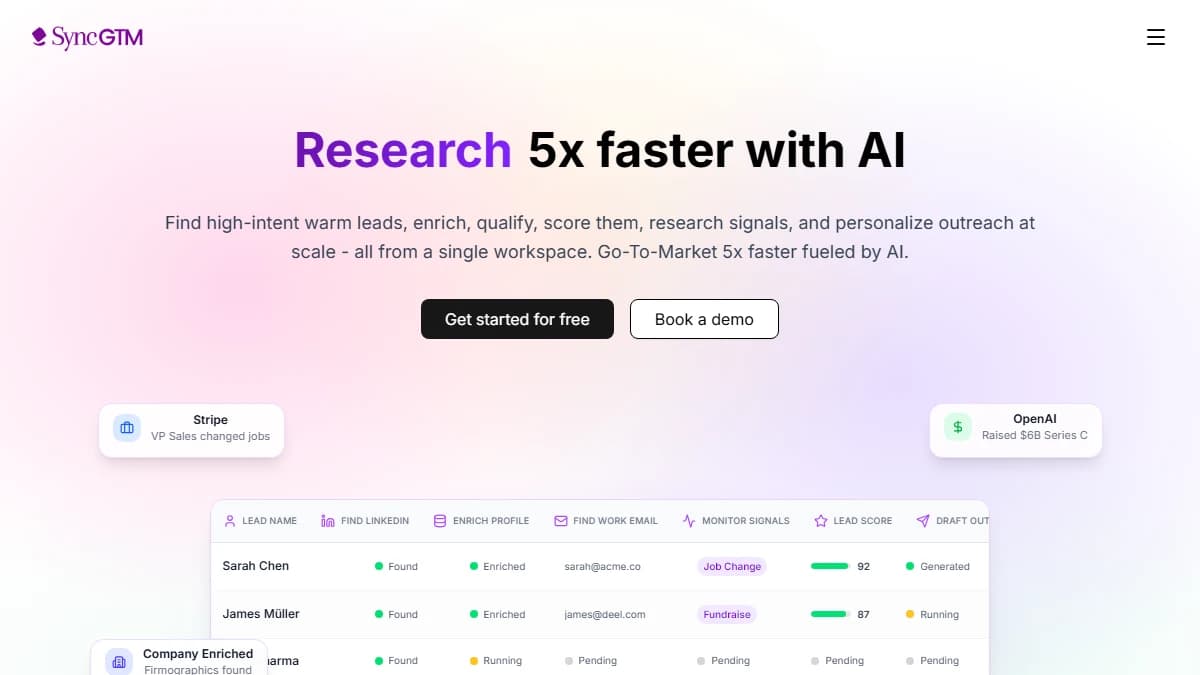
SyncGTM — job openings, hiring signals and waterfall contact enrichment in one workspace
SyncGTM is a GTM data and signals platform that pairs job openings search with waterfall contact enrichment, starting free with paid plans from $49/month (see pricing). Where PredictLeads stops at the company, SyncGTM keeps going to the people you need to reach.
The Job Listing lead source searches open roles by title, location and posting date, at 0.3 credits per job returned. Under the hood, SyncGTM's job search queries multiple providers and falls back to the next one if a provider fails, so one broken source doesn't kill the list.
For a single account, the Company Job Listings action returns every active opening with title, department, location and posting URL. The Is Hiring signal flags which departments are recruiting and how many roles are open.
Hiring growth is covered too. The job openings growth signal shows how open postings changed over 3 and 6 months by job function, and headcount growth tracks employee growth at 2 credits per company.
SyncGTM also covers much of what teams use PredictLeads' news data for. Its 30+ buying signals include funding rounds, leadership changes, product launches, M&A and new office locations.
The real difference is the next step. Waterfall enrichment runs each decision-maker through 50+ data providers until one returns a verified work email or mobile, and work email lookups cost 1 credit with no charge on a miss.
Columns can re-run on a schedule, from daily to yearly, so a hiring list refreshes itself. Enriched leads then push to your sequencer or CRM.
Pros
- ✓ Job openings, hiring-growth signals and contact enrichment on one credit balance
- ✓ Job search falls back to the next provider when one fails
- ✓ LinkedIn job filters for posted-in-last-24-hours, seniority, salary, company size and agency exclusion
- ✓ Work email lookups cost 1 credit, and misses are not billed
- ✓ Company events beyond hiring: funding, leadership changes, product launches, M&A and new locations
- ✓ Pushes to Instantly, Smartlead, HeyReach, HubSpot, Salesforce, Attio, Pipedrive, Close and Zoho, with duplicates removed before sync
Cons
- ✗ Not a bulk jobs dataset: no flat-file job archive for multi-year trend modelling
- ✗ 0.3 credits per job costs more per record than TheirStack or Hirebase at high volume
- ✗ Doesn't send outreach itself; sequences run in Instantly, Smartlead or HeyReach
- ✗ The free plan is for testing; real list volume needs a paid plan
Best for: GTM teams that want hiring signals turned into enriched, outbound-ready accounts without stitching a jobs API to a separate contact tool.
Pricing: Free plan to test. Paid plans from $49/month (Solo, 1,000 credits), $99/month (Starter, 3,000 credits) and $249/month (Pro, 10,000 credits). See SyncGTM pricing.
2. TheirStack
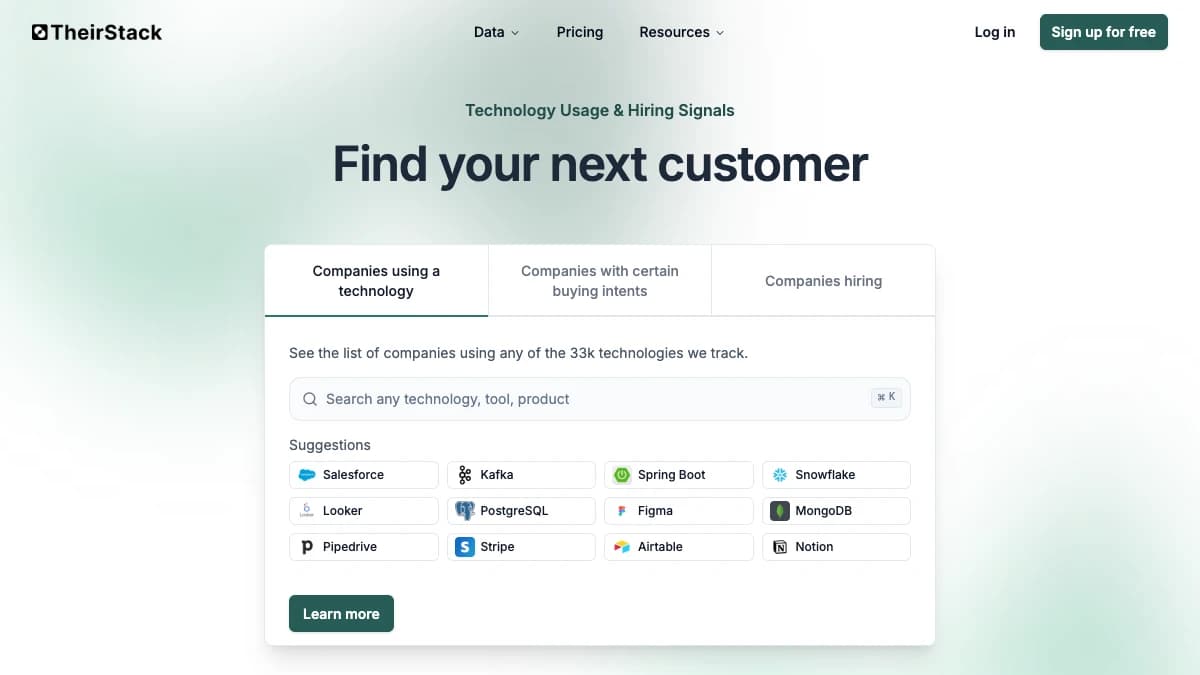
TheirStack — job postings, technographics and buying intents from 278M job records
TheirStack is a job postings and technographics data platform with a free plan and paid plans from $19/month, billed at 1 credit per job. Its pricing page lists a jobs dataset of 278M records with 472k new per day, collected from career sites, ATSs and job boards and deduplicated.
History goes back to 2021 across 195 countries and 376k sources. Its jobs dataset carries 40+ fields per job, including salary, seniority and the hiring company's domain, industry and size.
The pricing model is simple. A job costs 1 credit, a company costs 3, and tech-stack or buying-intent lookups cost 3, whether you pull them in the app, the API, a webhook or the MCP server.
TheirStack also cut its prices recently: the pricing page now says credits cost up to 2.8x less. Our TheirStack review digs into signal quality, and our list of TheirStack alternatives covers tools that go beyond it.
Pros
- ✓ Cheapest self-serve entry here: $19/month for 1,500 credits, plus a free plan
- ✓ One credit type across the app, API, webhooks and MCP server
- ✓ Webhooks push new jobs, closed jobs and new companies
- ✓ Technographics and buying intents detected from job descriptions
- ✓ Unused paid credits roll over for 12 months
- ✓ Unlimited team members share the same credits
Cons
- ✗ No people or contact data: datasets are jobs, technographics and buying intents
- ✗ Job history starts in 2021, versus 2016 at PredictLeads
- ✗ App exports are capped at 200 jobs per company; full history needs the API
- ✗ 4 requests per second rate limit on every plan
- ✗ Company records cost 3 credits each, versus 1 per job
Best for: Sales and data teams that want a cheap, self-serve job postings API with tech-stack signals built in.
Pricing: Free plan with 350 credits/month. Paid from $19/month (1,500 credits); 10,000 credits cost $69/month and 1,000,000 credits cost $1,399/month. TheirStack pricing.
3. Coresignal

Coresignal — 580M+ job postings from multiple sources, deduplicated
Coresignal is a public web data provider selling company, employee and job postings data through APIs and datasets, with self-serve plans from $49/month. Its Jobs API page lists 580M+ job postings, 52M+ active jobs, 195+ countries and 28M active jobs in the US.
Sources include company websites, professional networks, ATS platforms and major job aggregators. Coresignal says it adds 1 million new jobs a day and rescrapes all active jobs every 24 hours, with historical postings back to August 2020.
A full job record costs 1 credit, the same as TheirStack. The catch is plan size: 10,000 job records a month means the Starter plan at $199, because Mini only includes 2,500 credits.
Coresignal can also go one level deeper than PredictLeads. Its pricing page lists employee contact enrichment at 10 credits per email found, so you can attach some contact data to the same account. See our Coresignal alternatives if you want other options at this scale.
Pros
- ✓ Largest active job count on this list: 52M+
- ✓ All active postings rescraped every 24 hours
- ✓ Full job records cost 1 credit each
- ✓ 7-day free trial with 2,000 credits, no card required
- ✓ Employee and company data on the same credits
- ✓ Bulk datasets for data teams that want files, not API calls
Cons
- ✗ The Mini plan's 2,500 credits/month runs out fast for job pulls
- ✗ Monthly plan credits reset each billing cycle and don't roll over
- ✗ Employee and company records cost 20 credits each
- ✗ Lower tiers are capped at 5 requests per second
- ✗ Dataset pricing is set by contract, not self-serve
Best for: Data teams, HR-tech platforms and market-intelligence products that need large multi-source job volumes and several years of history.
Pricing: 7-day free trial (2,000 credits). Mini $49/month (2,500 credits), Starter $199/month (12,000 credits), Pro $499/month (35,000 credits), Growth $1,000/month (150,000 credits). Coresignal pricing.
4. Crustdata
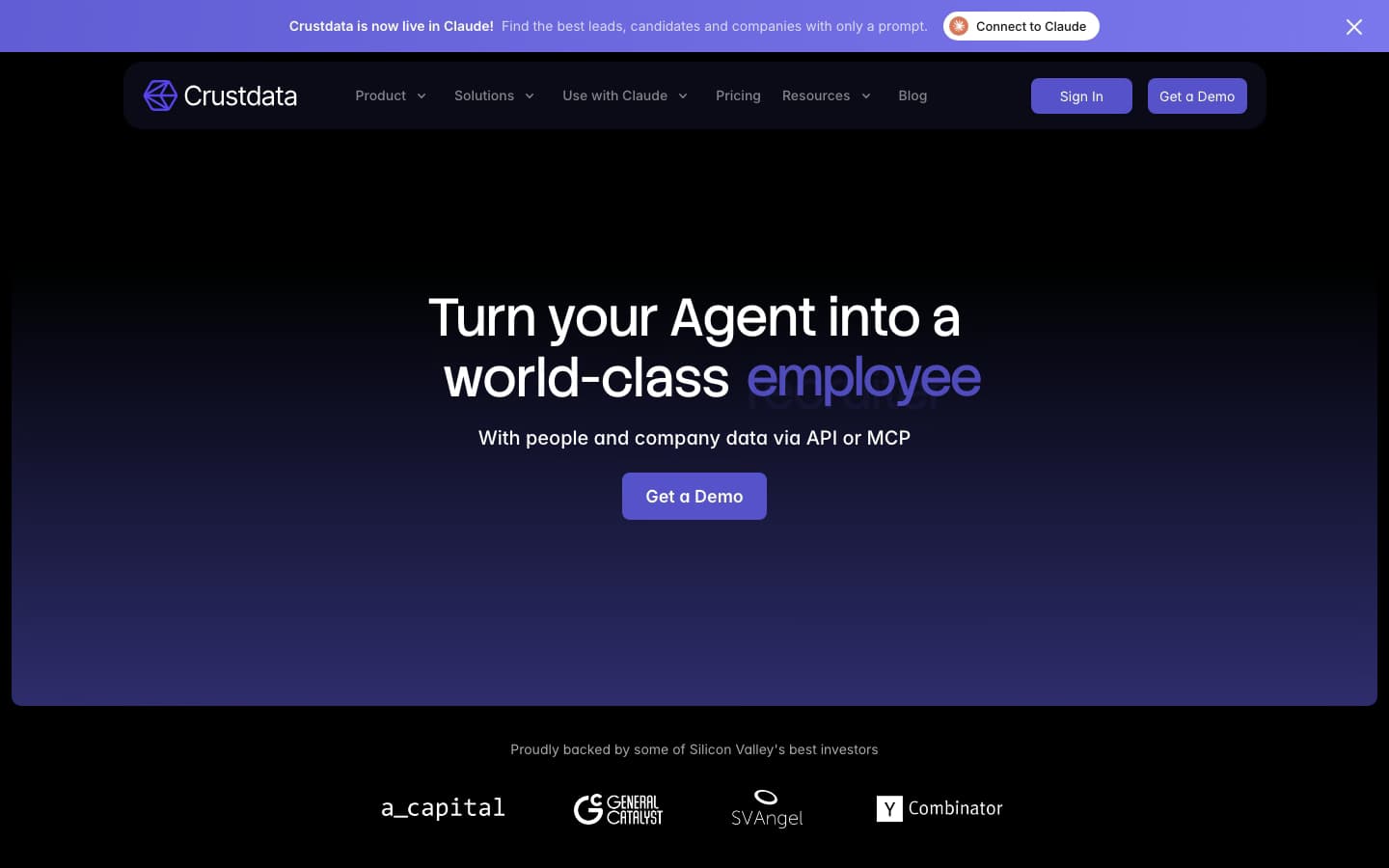
Crustdata — job postings tied to a live company and people graph
Crustdata is a real-time company and people data API whose job postings sit on the same graph as its company and person records. Its Jobs API page says every listing ties back to a graph of 1B+ people and 60M+ companies, with 30+ datapoints per listing.
You can filter by title, category, location, workplace type, posting date and number of openings, plus company-side filters like headcount growth or last funding round. That joined view is the main reason to pick it: one query returns the posting and the hiring company's context together.
Freshness depends on which endpoint you use. The data updates docs say indexed job postings refresh every 1 to 30 days, while the live endpoint fetches a company's postings at request time on enterprise plans or with the live add-on.
Watchers are the alerting layer. A job search watcher costs 0.5 credits per new job at the default 30-day SLA, or 150 credits per new job at a 1-day SLA. More detail in our Crustdata review.
Pros
- ✓ Each posting carries headcount, funding and company context on the same record
- ✓ Job search costs 0.03 credits per result
- ✓ Watchers alert a webhook, Slack or email when tracked companies post new roles
- ✓ Live per-company job pull when an indexed record is too old
- ✓ MCP server and a Claude connector for agent workflows
- ✓ Purchased credits stay valid for 12 months
Cons
- ✗ No public dollar pricing; the per-credit rate comes from sales or your dashboard
- ✗ Indexed job postings can be up to 30 days old
- ✗ A 1-day watcher SLA costs 150 credits per new job, versus 0.5 at the 30-day default
- ✗ Expired listing text is not stored, so historical job-description analysis is out
- ✗ Live job pulls and contact enrichment need enterprise plans or add-ons
Best for: Teams building AI SDRs or internal tools that want job postings joined to firmographics and people data in one API.
Pricing: Credit-based, with monthly and annual plans; the pricing page lists no dollar rates. Job search costs 0.03 credits per result per the Crustdata docs.
5. Hirebase

Hirebase — job data indexed straight from 1.2M+ career pages and 80+ ATS platforms
Hirebase is a job data API that indexes 1.2M+ company career pages and 80+ ATS platforms directly, with a free plan and paid plans from $99/month. Skipping job boards is the whole pitch: postings come straight from Greenhouse, Lever, Workday and the like.
That shows up in freshness. Hirebase says it re-scans active listings every hour and that new jobs go live within 1–2 hours of posting, against PredictLeads' 36-hour cycle.
The tradeoff is size. The homepage lists 6.6M+ active jobs across 140+ countries, with historical records back to 2023.
Hirebase also edges toward contact data. Its Hiring Manager API runs at $0.30 per run and surfaces the decision-maker behind an open role. Our Hirebase review goes through its pricing, freshness claims and docs, and we compare it with other job feeds in our roundup of the best job postings APIs.
Pros
- ✓ Freshest data here: active listings re-scanned every hour, new jobs live within 1–2 hours
- ✓ Indexed directly from career pages and ATS platforms, not job boards
- ✓ Free plan with 500 jobs and 50 companies a month
- ✓ Starter includes 25,000 jobs a month for $99
- ✓ Hiring Manager API surfaces the decision-maker behind a role at $0.30 per run
- ✓ Free estimate endpoint to check result counts before you spend
Cons
- ✗ 6.6M+ active jobs is smaller than aggregator-based datasets
- ✗ History only goes back to 2023
- ✗ Free and Starter have hard caps; usage pauses at the monthly limit
- ✗ The Free plan refreshes daily and shows only the first page of results in the web app
- ✗ Pay-as-you-go through Apify costs $5.00 per 1,000 jobs, more than a subscription
Best for: Recruiting firms, job boards and sales teams that win by reaching a new posting first.
Pricing: Free ($0, 500 jobs/month). Starter $99/month (25,000 jobs), Growth $249/month (250,000 jobs), Scale $999/month (2M jobs). Hiring Manager API $0.30/run. Hirebase pricing.
PredictLeads Alternatives Compared
The "10,000 job records" column shows what a month of job pulls at that volume costs on each tool's entry plans. PredictLeads bills per company page instead, so its row shows the billing unit rather than a total.
| Tool | Job coverage | Freshness | Billing unit | 10,000 job records | Contact data |
|---|---|---|---|---|---|
| PredictLeads (baseline) | 9.8M+ active jobs, 3M+ companies, history from 2016 | Each job refreshed every 36 hours | 1 credit per page of up to 1,000 jobs at one company; $0.04 to $0.0025 per credit | Billed per company page, not per job | None (company datasets only) |
| SyncGTM | Job search across multiple providers, plus LinkedIn job search | Filter LinkedIn jobs posted in the past 24 hours; scheduled column re-runs | 0.3 credits per job returned | 3,000 credits (Starter, $99/mo) | Waterfall work email (1 credit) and mobile |
| TheirStack | 278M job records, 195 countries, history from 2021 | 472k new jobs a day; new and closed job webhooks | 1 credit per job, 3 per company | 10,000-credit plan ($69/mo) | None (jobs, tech stack, buying intents) |
| Coresignal | 580M+ postings, 52M+ active, history from August 2020 | All active jobs rescraped every 24 hours | 1 credit per full job record | Starter ($199/mo, 12,000 credits) | Employee emails, 10 credits per email found |
| Crustdata | Postings tied to a graph of 60M+ companies and 1B+ people | Index refreshed every 1 to 30 days; live pull on enterprise or add-on | 0.03 credits per job result | 300 credits (dollar rate not public) | Contact enrichment on enterprise plans |
| Hirebase | 6.6M+ active jobs from 1.2M+ career pages, history from 2023 | Hourly re-scan; new jobs live in 1–2 hours | Jobs counted per result returned | Inside Starter ($99/mo, 25,000 jobs) | Hiring Manager API, $0.30 per run |
Sources: PredictLeads, SyncGTM, TheirStack, Coresignal, Crustdata and Hirebase pricing pages, November 2026.
How to Choose the Right Tool
- You need the hiring signal and the buyer's email in one step → SyncGTM. Job search, hiring growth and waterfall enrichment share one credit balance.
- You win by reaching a new req first → Hirebase. Hourly re-scans beat every other refresh cycle here.
- You want the cheapest self-serve job API → TheirStack. $19/month gets you started, and tech-stack signals come with it.
- You are building a data product that needs volume and history → Coresignal, with 52M+ active jobs and postings back to 2020.
- Your agent needs postings joined to firmographics in one call → Crustdata.
- You track a fixed account list and only need company-level events → stay on PredictLeads. Pulling up to 1,000 openings per company for 1 credit is hard to beat.
If contact coverage is the deciding factor, compare match rates in our guide to the best waterfall contact providers. For more hiring-signal tools beyond job feeds, see our list of hiring signal tools for sales prospecting and our job posting data providers comparison.
Final Verdict
PredictLeads is still a good deal for one job: watching a known list of accounts for hiring, funding and tech changes. Per-company billing, $20 in free credits and history back to 2016 make it hard to replace there.
It falls short in three places: freshness, market-wide job search, and anything involving people. Hirebase fixes freshness, TheirStack and Coresignal fix per-job search at scale, and Crustdata joins jobs to the company graph for agent builders.
For outbound teams, the people gap is the one that costs pipeline. SyncGTM closes it by turning a hiring signal into a verified decision-maker contact in the same table, then pushing it to your sequencer or CRM.
Start free with SyncGTM and run your first hiring-signal list before you commit to any data contract.