


7 Best Deepline Alternatives for Agent-Led GTM in 2026

By Kushal Magar · October 28, 2026 · 14 min read
Key Takeaway
The best Deepline alternatives in 2026 depend on which part of Deepline you need. SyncGTM ranks first for agent-led enrichment: one remote MCP for waterfall work emails (1 credit, misses free), phones, people and company search, and buying signals, from $49/mo. Cargo is the closest CLI-plus-MCP toolkit, Databar the best managed platform with BYOK, treg the open-source pay-per-call gateway, FullEnrich the email-and-phone specialist, Apollo MCP the single database with sequences, and n8n the self-hosted workflow engine. Deepline itself costs $0/mo plus usage, or $395/mo plus usage on Growth.
Deepline alternatives are tools that let Claude Code, Codex, Cursor and other agents find, enrich and act on GTM data through an MCP server, a CLI or an API. Deepline itself is a CLI-first GTM toolkit with saved Plays, waterfall enrichment, a results database and monitors, billed per use or on your own provider keys.
We ranked seven options by agent support, enrichment depth, workflow features and pricing model. SyncGTM ranks first for teams that want waterfall contact data and buying signals behind one MCP connection; the other six each win a narrower job.
Every price and feature below comes from each vendor's own site, checked on October 28, 2026. We did not run a hands-on benchmark, so vendor claims are labelled as claims.
TL;DR
- Best overall: SyncGTM. Remote MCP with waterfall work emails (1 credit), mobile lookups, people and company search, and buying signals; from $49/mo for 1,000 credits.
- Closest like-for-like: Cargo. The cargo-ai CLI plus an MCP server, with agents and workflows across 130+ integrations; 100 free credits, then from $165/mo.
- Best managed platform with BYOK: Databar. Hosted MCP with 35+ tools, waterfalls and flows over 100+ providers; from $99/mo.
- Best open-source, pay-per-call option: treg. One token for 4,000+ endpoints across 116 providers, no subscription, $1 free credit.
- Best for contact data only: FullEnrich. Email and phone waterfall over 25+ sources via MCP or API; $55/mo for 1,000 credits.
- Best single database with sequences: Apollo MCP. 240M+ contacts and sequencing inside Claude; free to connect, enrichment uses your Apollo credits.
- Best for self-hosted Plays and schedules: n8n. MCP Server Trigger and AI Agent node; free to self-host, cloud from €20/mo billed annually.
What Deepline Does and Costs
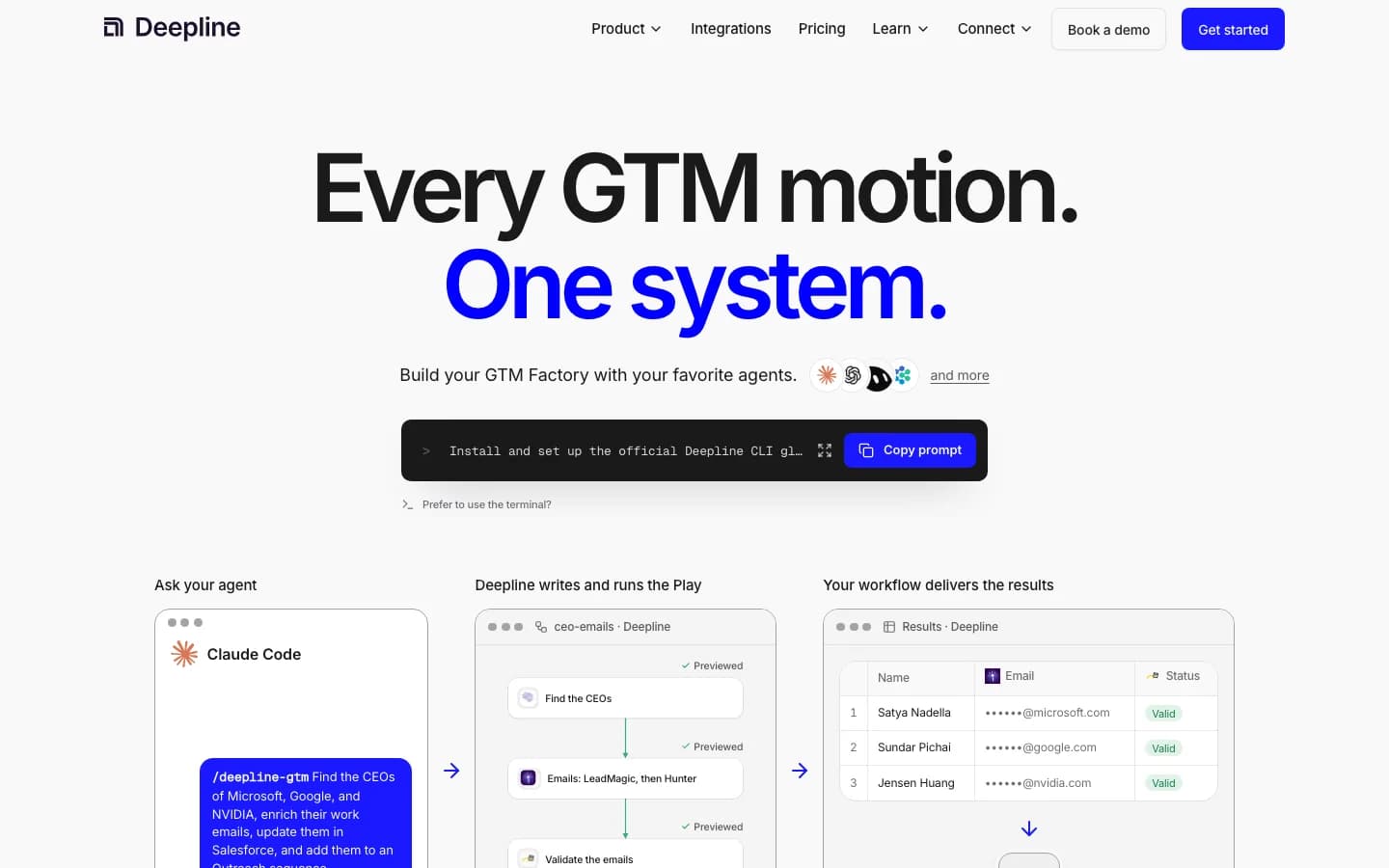
Deepline's homepage on October 28, 2026: an agent writes and runs a Play, and results land in a table
Deepline is a GTM data platform that agents drive through a CLI, a remote MCP server and a Claude Code skill. Its homepage pitch is "Every GTM motion. One system."
Your agent writes Plays: workflow code your team can read, change and rerun on demand, on a schedule or from a webhook. Waterfalls try the next source when a lookup comes back empty, results save to a workspace database, and monitors watch for custom signals.
The homepage claims 125+ integrations, and its FAQ names Claude Code, Codex, Cursor, Gemini CLI and Antigravity as supported agents. Older Deepline pages cite 79, 95+ and 97+ integrations, so confirm the providers you need are live before you commit.
| Deepline plan | Platform fee | What is included |
|---|---|---|
| Pay as you go | $0/mo + usage | No minimum, up to 5 workspaces, 15 scheduled Plays and live monitors combined, 60-day retention, 50,000 BYOK calls a month then $0.005 per call |
| Growth | $395/mo + usage | $200 monthly usage credits, up to 50 scheduled Plays, 500 live monitors, 180-day retention, visitor identification, real-time CRM sync |
| Enterprise | Custom | Contracted credits and volume pricing, full-TAM monitoring, audit logs, Okta SSO, HIPAA, SLA |
Source: Deepline pricing, checked October 28, 2026.
Usage runs at $0.10 per credit (10 credits = $1) on every plan. Deepline lists managed rates from $0.014 per email found, $0.17 per phone, $0.002 per email verification and $0.002 per company or person search.
With your own provider keys, you pay providers directly and Deepline adds no markup. There are no per-seat fees; for the full picture, read our Deepline review.
Why Teams Look for Deepline Alternatives
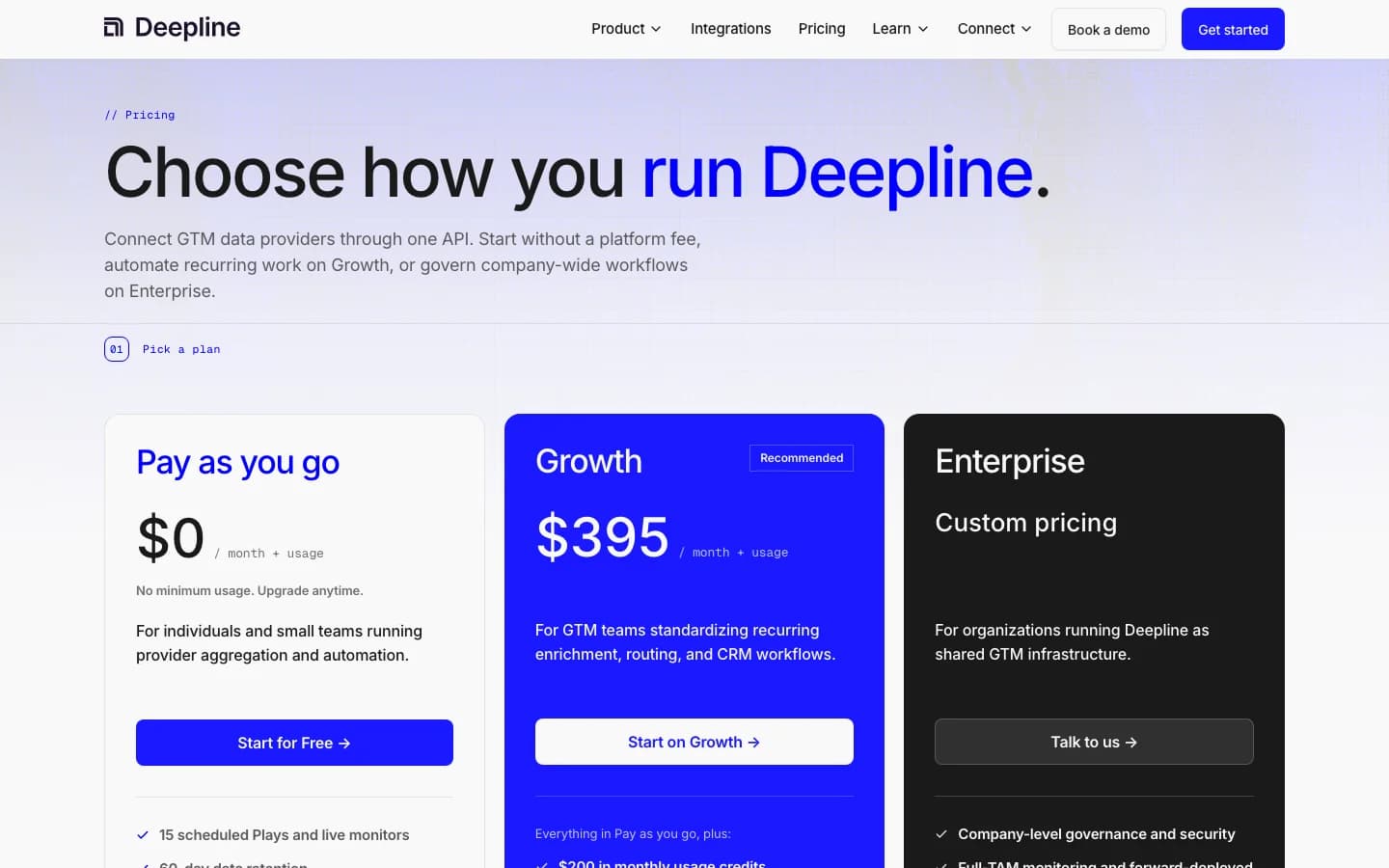
Deepline's three plans: free platform fee on Pay as you go, $395/mo on Growth, custom Enterprise
Deepline is a strong fit for GTM engineers who live in a terminal. These are the trade-offs that push other teams to compare Deepline alternatives.
- The cheapest path means owning provider accounts. BYOK pricing only pays off once you have opened, funded and maintained accounts with each provider. Teams that want one bill and one credit balance often prefer a bundled credit model.
- Scheduling scales with the plan. Pay as you go caps scheduled Plays and live monitors at 15 combined, with 60-day retention. Growth lifts that to 50 Plays and 500 monitors for $395 a month plus usage.
- It is built for builders. Plays are code your agent writes. If reps or RevOps people need to run the same lists without an agent session, a tool with a no-code app or table UI may fit better.
- You may need one job, not a platform. If all you want is a work email waterfall or a contact database inside Claude, a focused tool is simpler to budget.
- Control and hosting. Some teams want an open-source gateway or a self-hosted workflow engine they can run on their own infrastructure.
New to running GTM from an agent? Start with our guide to GTM engineering in Claude Code, which covers how MCP servers, skills and CLIs fit together.
How We Picked These Tools
We kept tools an agent can drive directly, through an MCP server, a CLI or an API. Each one also had to cover at least one of Deepline's core jobs: enrichment, search, signals or workflows.
- Agent surface: remote or local MCP, CLI, API, and which clients the vendor documents.
- Enrichment depth: single source or waterfall, and how many providers the vendor claims.
- Signals and workflows: scheduled runs, monitors, sequences or reusable flows.
- Pricing model: credits, pay per call, BYOK, per seat or per execution, plus the lowest paid entry point.
The Model Context Protocol is the open standard most of these tools use to expose actions to agents. Claude Code's MCP docs explain how remote and local servers connect.
1. SyncGTM: Best Overall Deepline Alternative
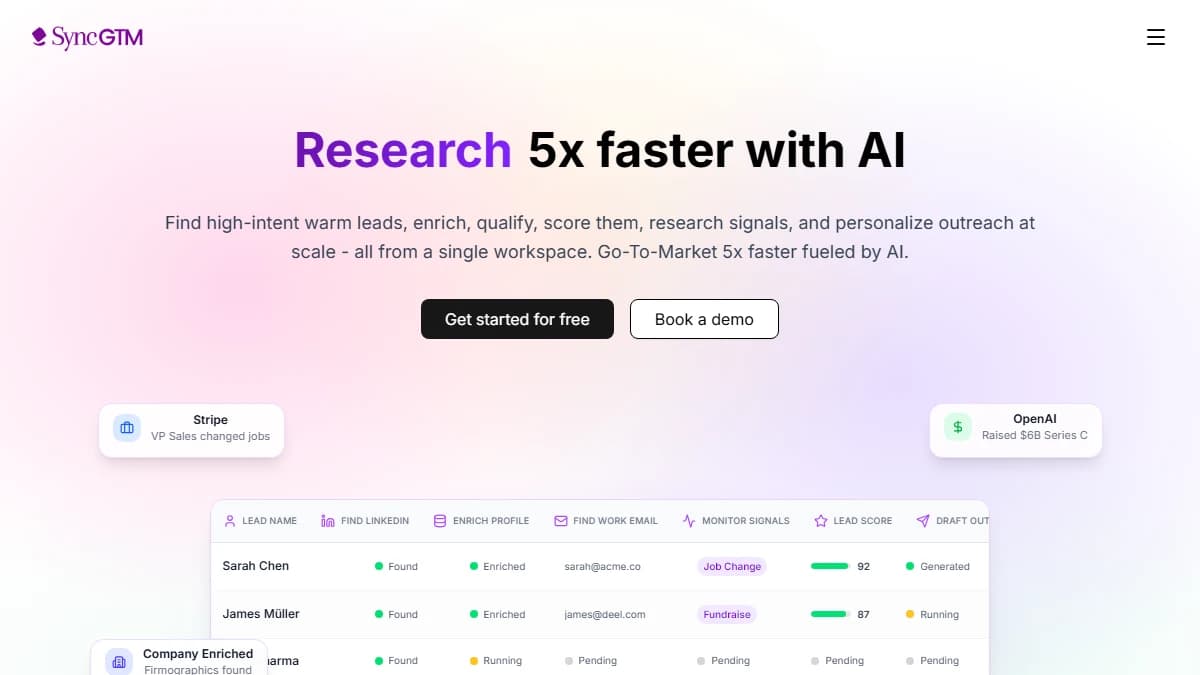
SyncGTM: waterfall enrichment, search and buying signals through one MCP server, plus a no-code app
SyncGTM is a GTM data platform whose remote MCP server gives Claude Code and other agents 40+ tools for search, waterfall enrichment and buying signals, billed in credits from $49 a month. It also ships a no-code app, so the same data works outside an agent session.
Setup is one command: claude mcp add --transport http syncgtm https://api.syncgtm.com/mcp, then authenticate through /mcp. SyncGTM publishes setup guides for Claude Code, Claude desktop, Cowork, Cursor, Codex, ChatGPT, Gemini CLI, OpenClaw and Manus.
Enrichment runs as a waterfall: find_work_email tries several providers in turn for 1 credit, and misses are not billed. Mobile numbers cost 10 credits, work phones 12, and verify_email 0.2 credits per check.
Search covers people and companies at 0.2 credits per record, with filters for title, seniority, headcount, industry, funding round and HQ. Signal tools add job changes (2 credits), newly hired executives (0.5 credits per profile), company job openings (5 credits), product launches (1 credit) and tech stack (1 credit).
Credit costs come from the live tool descriptions on October 28, 2026. See how the pieces fit in our data enrichment MCP guide and Claude Code lead enrichment walkthrough, or read the enrichment MCP overview.
Pros
- ✓ Remote MCP with OAuth: no local install or provider keys to manage
- ✓ Waterfall work email at 1 credit, with misses not billed
- ✓ People and company search plus job-change, hiring, launch and tech-stack signals in one server
- ✓ No-code app alongside the MCP for teammates who do not use agents
- ✓ Plans from $49/mo for 1,000 credits, up to 40,000 credits on Business
Cons
- ✗ No saved, versioned Plays-as-code: MCP calls run inside your agent session
- ✗ Pricing page lists 20+ waterfall vendors, fewer named integrations than Deepline claims
- ✗ Mobile (10 credits) and work phone (12 credits) lookups drain credits on phone-heavy lists
Best for: Teams that want verified contact data and buying signals inside Claude Code, Cursor or Codex without managing provider keys.
Pricing: Solo $49/mo (1,000 credits), Growth $99/mo (3,000), Pro $249/mo (10,000), Business $649/mo (40,000), Enterprise custom. See SyncGTM pricing.
2. Cargo: Closest Like-for-Like Toolkit
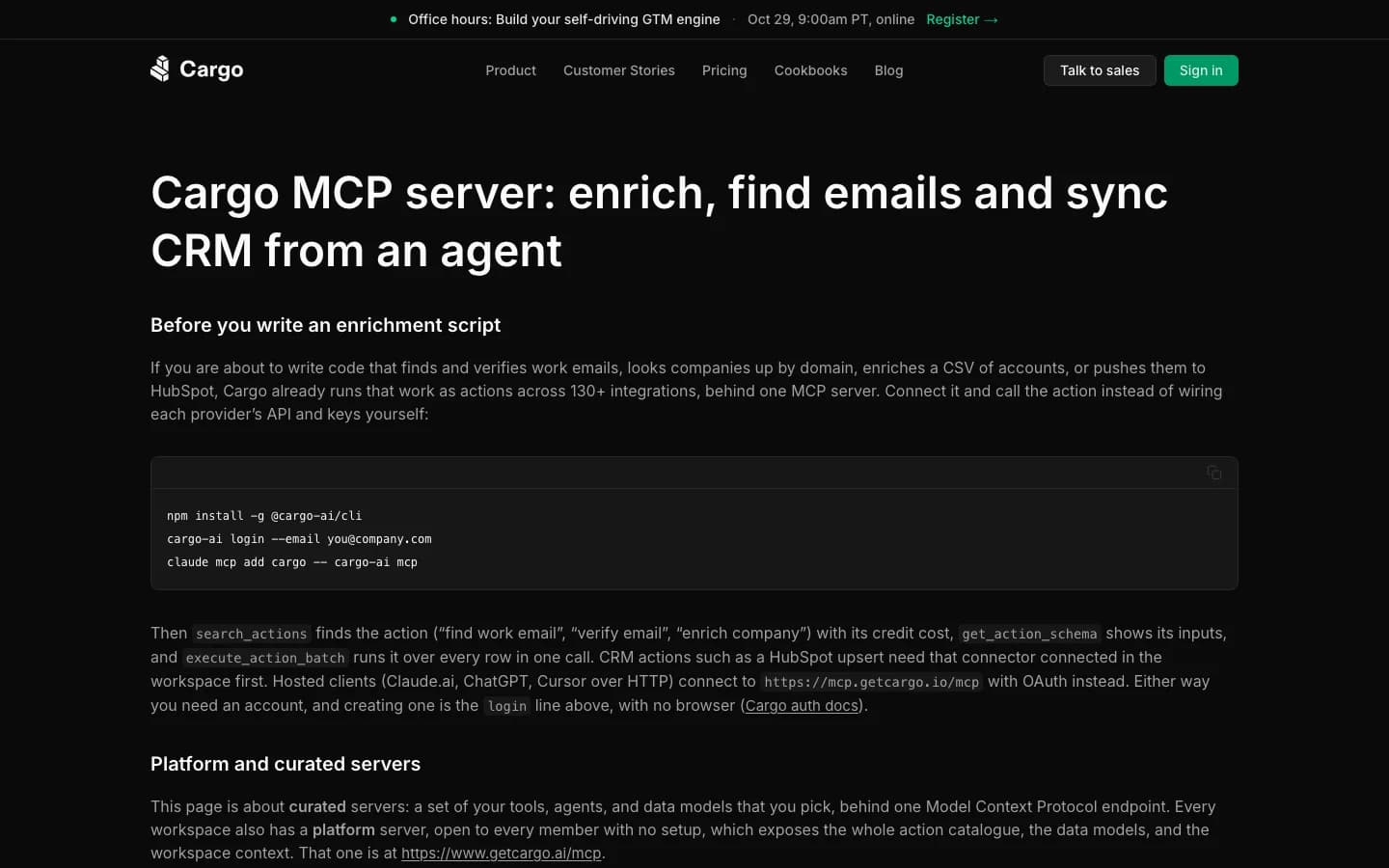
Cargo's MCP developer page: install the cargo-ai CLI, log in, and add it to Claude Code in three commands
Cargo is a GTM orchestration platform with AI agents, workflows and data models that agents call through the cargo-ai CLI or an MCP server. Credit plans start at $165 a month after 100 free credits.
Install with npm install -g @cargo-ai/cli, then add it to Claude Code over stdio with claude mcp add cargo -- cargo-ai mcp. Hosted clients such as Claude.ai, ChatGPT and Cursor connect over HTTP with OAuth, with no token to paste.
Agents call search_actions to find an action and its credit cost, get_action_schema to read its inputs, and execute_action_batch to run it over every row in one call. Cargo says these actions span 130+ integrations behind one MCP server.
Its MCP developer page does not describe a built-in waterfall or name the data providers, so expect to assemble enrichment logic yourself. Our Cargo review covers the workflow builder in depth.
Pros
- ✓ CLI plus MCP, the closest structural match to Deepline's agent toolkit
- ✓ Batch execution over every row in one call
- ✓ Every plan includes agents, workflows, data models and 100+ integrations
- ✓ 100 free credits, no card required
Cons
- ✗ No documented built-in waterfall; enrichment is assembled from actions
- ✗ Credit cost varies by action, so budgets need a search_actions check first
- ✗ First paid tier is $165/mo for 1,500 credits
- ✗ CRM actions need the connector set up in the workspace first
Best for: GTM engineers who want Deepline's CLI-plus-MCP model with a hosted workflow and agent layer.
Pricing: 100 credits free; 1,500 credits from $165/mo; 2,500 from $250/mo; 17,000 from $1,190/mo; 50,000+ from $3,000/mo.
3. Databar: Best Managed Platform with BYOK
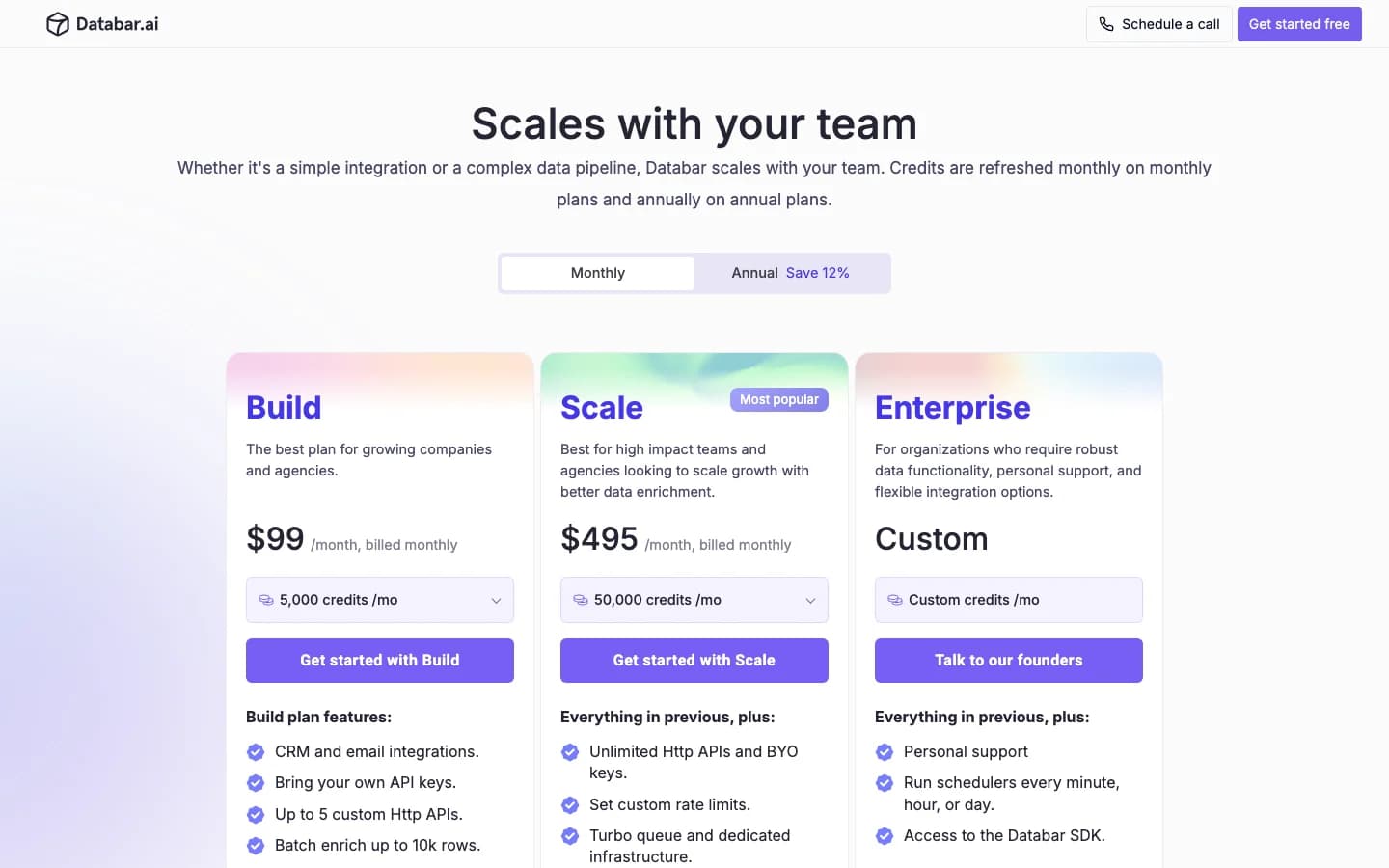
Databar's pricing on October 28, 2026: Build includes 5,000 credits and bring-your-own API keys
Databar is a data enrichment platform with 100+ providers, tables, waterfalls and reusable flows, and its hosted MCP server came out of beta on July 15, 2026. Paid plans start at $99 a month and include BYOK.
Databar's changelog lists 35+ MCP tools. Agents can build tables end to end, run enrichments and waterfalls without a table, assemble or call flows, wire in custom REST endpoints, and push results to a CRM through exporters.
The endpoint is mcp.databar.ai/mcp, with OAuth for Claude and an API key option for other clients. The Databar MCP docs name Claude, Cursor, Codex and Gemini CLI, plus an mcp-remote bridge for clients that only launch local processes.
Provider counts vary across Databar's own pages, so check that your must-have sources are listed. Our Databar review goes deeper on table workflows.
Pros
- ✓ BYOK on Build and Scale plans, close to Deepline's cost model
- ✓ Waterfalls callable straight from the agent, no table required
- ✓ Reusable flows and CRM exporters through MCP
- ✓ Custom HTTP APIs: 5 on Build, unlimited on Scale
Cons
- ✗ No permanent free plan, only 100 trial credits
- ✗ $99/mo floor before BYOK is available
- ✗ Provider counts differ across its own pages (80+, 100+, 120+)
Best for: Teams that want a managed enrichment platform with BYOK and a table UI their agent and ops team can share.
Pricing: Build $99/mo (5,000 credits), Scale $495/mo (50,000 credits), Enterprise custom; 100 trial credits per workspace.
4. treg: Best Open-Source, Pay-per-Call Gateway
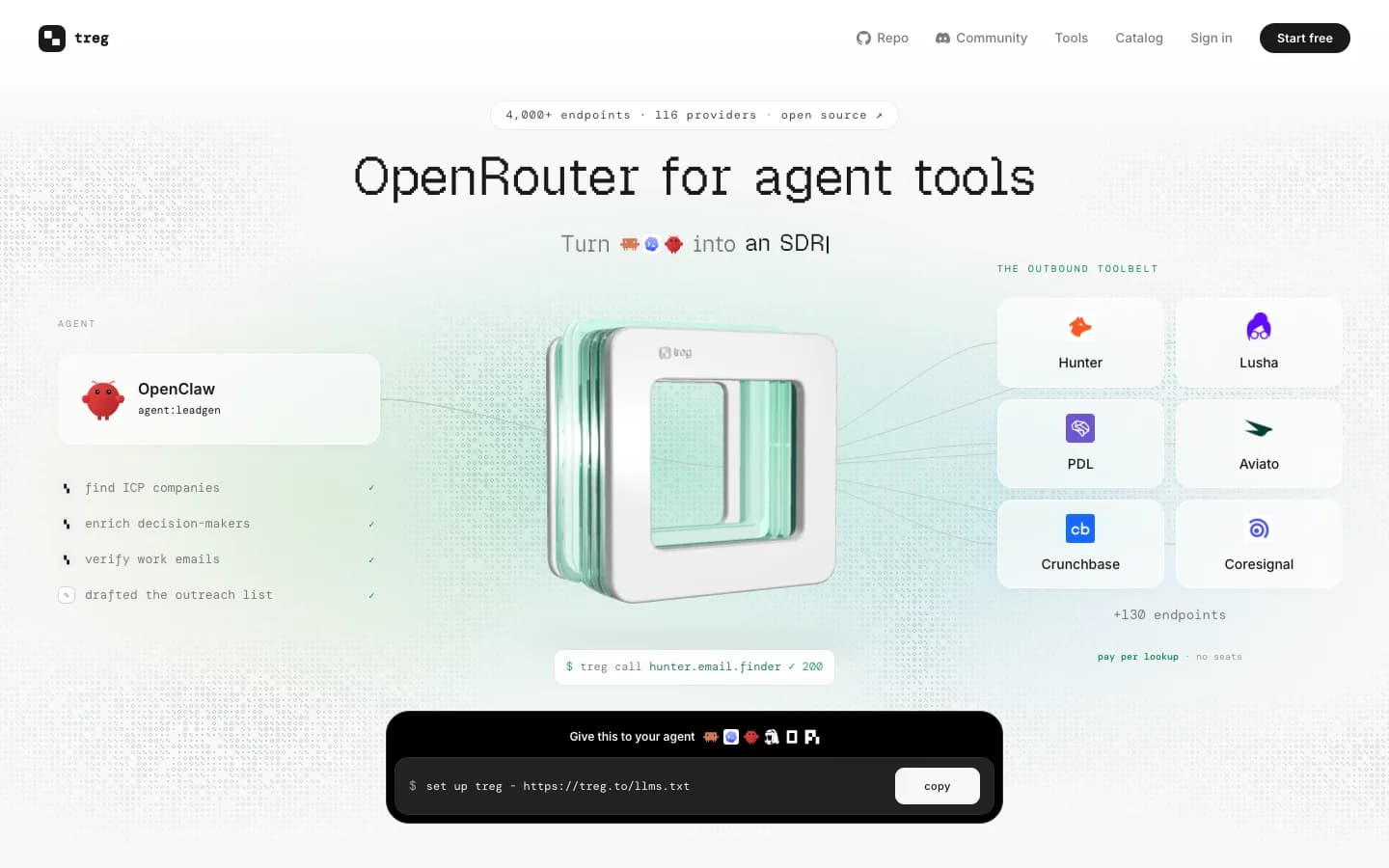
treg: one token for 4,000+ endpoints across 116 providers, priced per call
treg is an open-source gateway that gives agents one token for 4,000+ endpoints across 116 providers, billed per call with no subscription and no markup. Its homepage calls it "OpenRouter for agent tools."
Agents reach it through the treg CLI, a plain HTTP API or an MCP server at treg.to/mcp. Setup is a single instruction pointing your agent at treg.to/llms.txt, and the homepage names Claude Code, Codex, OpenClaw, Hermes and opencode.
Routed capability tools pick a provider, fall back when one fails or misses, and bill only the answer they return. New verified accounts get $1.00 of free credit, once.
treg has no saved workflows, schedules or results database, so your agent owns the logic. Read our treg review for the full breakdown, or browse the treg repository.
Pros
- ✓ Pay per call, no subscription, no markup on provider rates
- ✓ Your own provider keys take precedence and are never billed
- ✓ Routed fallback across providers for common jobs
- ✓ Open source, with the code on GitHub
- ✓ Covers non-GTM endpoints too, such as keyword volume and backlinks
Cons
- ✗ Gateway only: no Plays, schedules, monitors or results database
- ✗ Per-call prices vary by provider, so budgets are checked job by job
- ✗ Younger project with a shorter track record than managed platforms
Best for: Builders who like Deepline's BYOK, pay-per-use model and want an open-source gateway they can inspect.
Pricing: Pay per call (work email lookup listed from $0.0005, funding data $0.01 per call); $1.00 free credit for new verified accounts; BYOK calls are free.
5. FullEnrich: Best for Email and Phone Waterfalls Only
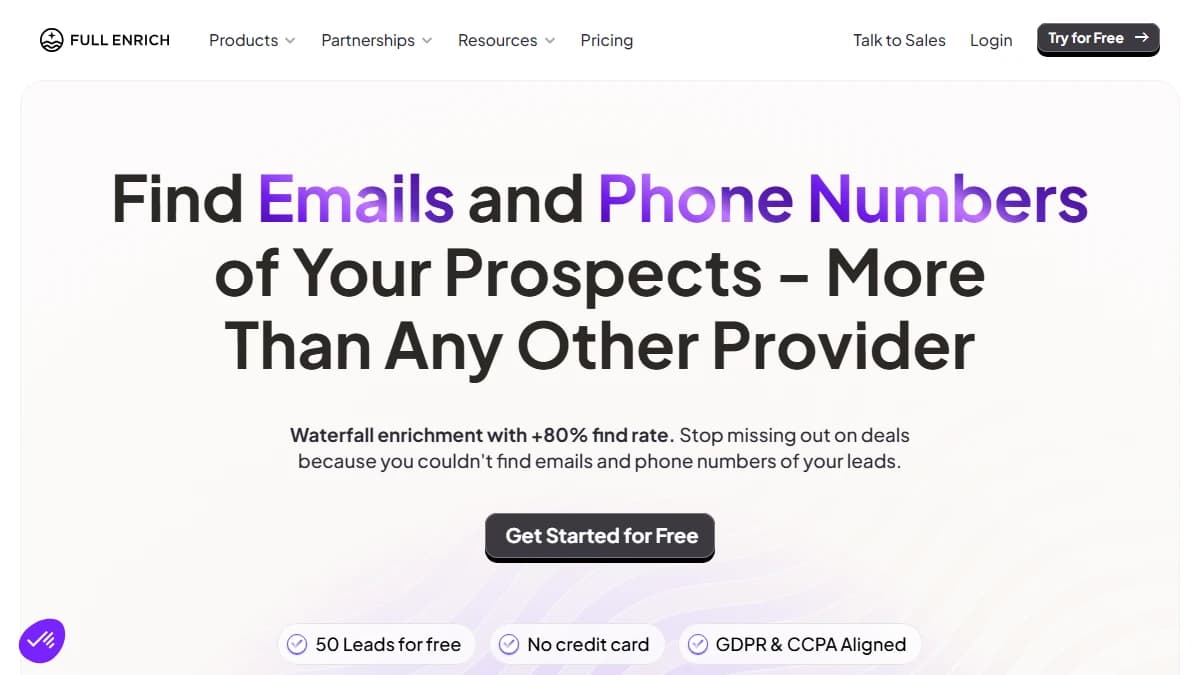
FullEnrich: a contact waterfall across 25+ sources, available through an app, API and MCP server
FullEnrich is a contact enrichment tool that runs a waterfall across 25+ data sources to find work emails, personal emails and mobile numbers through an app, an API or an MCP server. Pro starts at $55 a month for 1,000 credits.
Credits are spent only when data is found. A work email costs 1 credit, a personal email 3, and a mobile number 10.
The MCP server and API come with Pro and Enterprise. A third-party review reports that the MCP connects over OAuth, so there is no API key to paste.
FullEnrich does one job well, with no company search, signal monitoring or workflow layer. Compare it with similar tools in our waterfall email finder roundup and FullEnrich review.
Pros
- ✓ Waterfall across 25+ sources for emails and mobile numbers
- ✓ Credits charged only when data is found
- ✓ MCP server, API and no-code integrations on Pro
- ✓ 50 free credits, no card required
Cons
- ✗ Contact enrichment only: no search, signals or workflows
- ✗ Mobile numbers cost 10 credits each
- ✗ No BYOK option
Best for: Teams whose main Deepline use case is filling in emails and phones on a list they already have.
Pricing: 50 free credits; Pro $55/mo for 1,000 credits; 15,000 credits for $720/mo; Enterprise custom.
6. Apollo MCP: Best Single Database with Sequencing
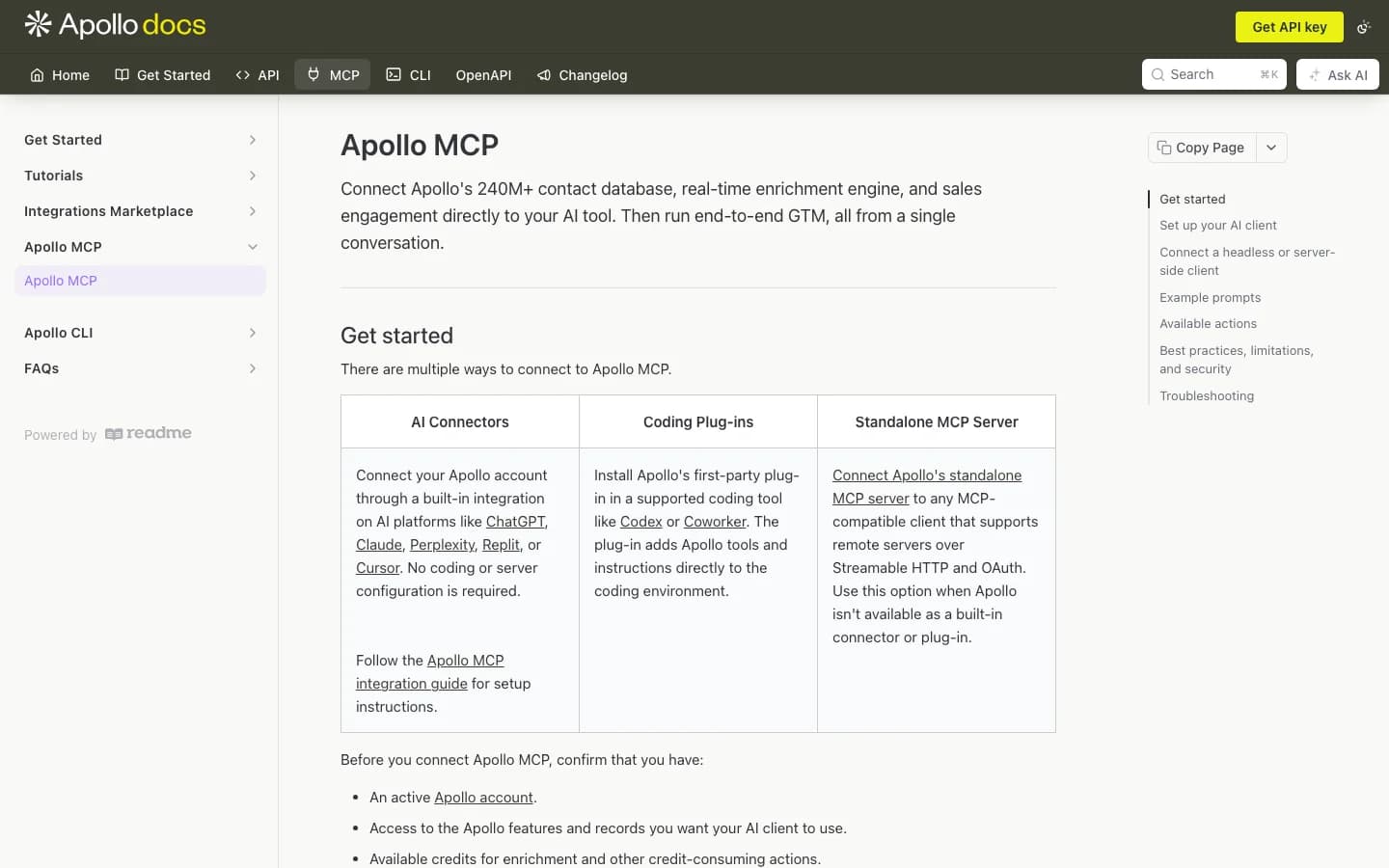
Apollo's MCP docs: built-in AI connectors, coding plug-ins, or a standalone MCP server
Apollo MCP is Apollo.io's official MCP server, which puts its 240M+ contact database, enrichment and sales engagement inside Claude, ChatGPT, Cursor and Claude Code. Connecting is free; enrichment spends your Apollo plan credits.
Agents can search people and companies, enrich records, manage contacts, accounts and lists, create sequences, enroll contacts, send one-off emails, query analytics and manage tasks. Auth is OAuth 2.0, with a master API key for headless setups.
This is a single-database model, not a waterfall. Free accounts need a work email to use search and enrichment.
Paid plans start at $49 per user per month billed annually, and third-party pricing guides report 1 credit per email and 8 per phone. Our Apollo.io review covers credits and plan limits.
Pros
- ✓ Official server, free to connect
- ✓ Prospecting and sequencing in one conversation
- ✓ Large single database (240M+ contacts, vendor claim)
- ✓ Built-in connectors in Claude, ChatGPT and Cursor
Cons
- ✗ One data source, no waterfall fallback
- ✗ Per-seat pricing adds up as the team grows
- ✗ Apollo's pricing page lists API access outside MCP on Custom plans only
Best for: Apollo customers who want their agent to prospect and enroll contacts in sequences without leaving Claude.
Pricing: Free plan; Basic from $49/user/mo billed annually; enrichment spends your plan credits.
7. n8n: Best for Self-Hosted Plays and Schedules
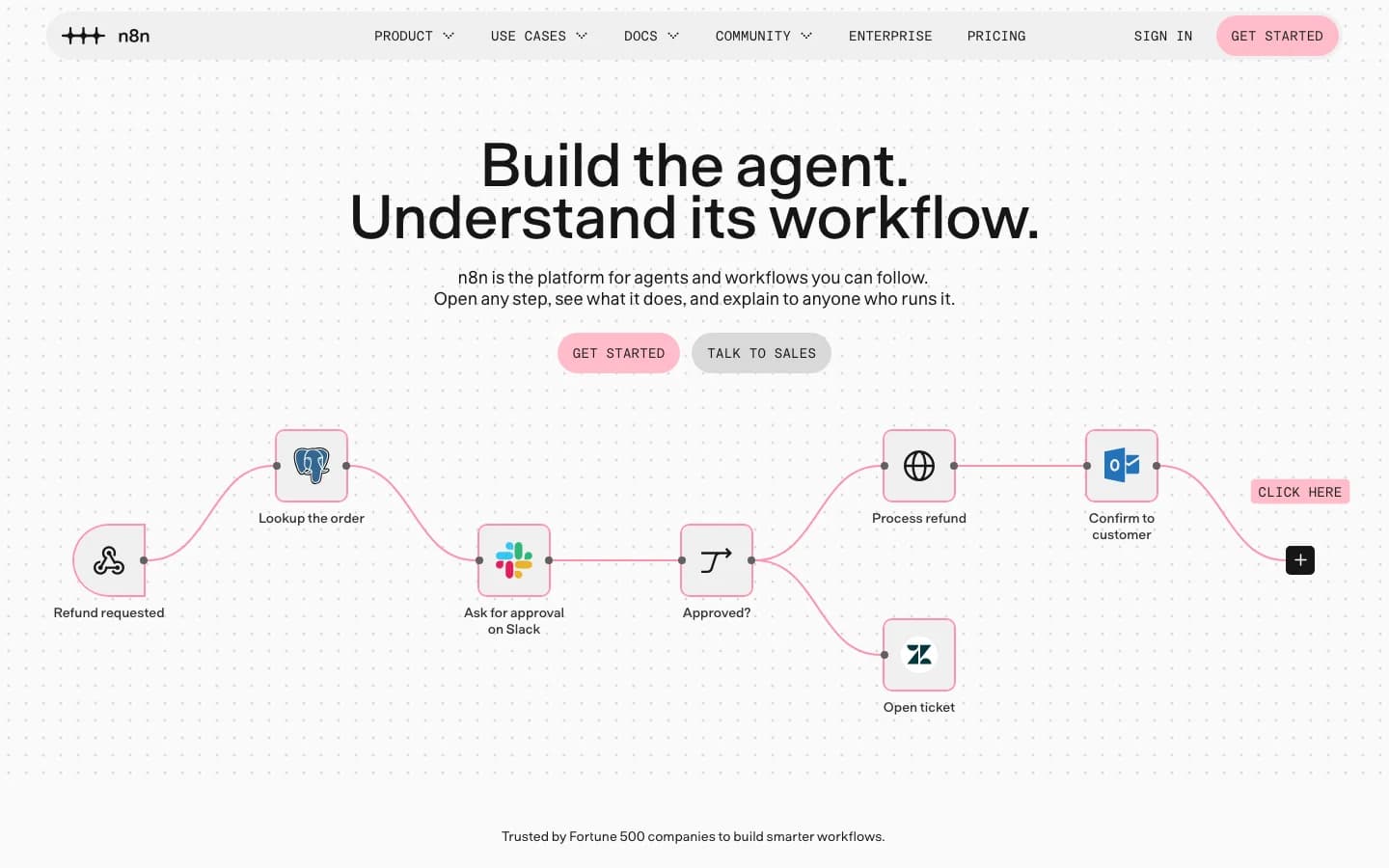
n8n: fair-code workflow automation with an AI Agent node and MCP in both directions
n8n is a fair-code workflow automation platform you can self-host or run in the cloud, with an AI Agent node, an MCP Client and an MCP Server Trigger. Cloud plans start at €20 a month billed annually, and the Community Edition is free to self-host.
The MCP Server Trigger exposes a workflow as a tool your agent can call. That lets you rebuild Deepline-style Plays as n8n workflows that run on a schedule, from a webhook or on demand.
n8n bills per workflow execution, not per step, so a 20-step enrichment run counts once. It ships no GTM data, so you bring provider APIs and build any waterfall yourself; our n8n review covers self-hosting trade-offs.
Pros
- ✓ Schedules, webhooks and on-demand runs, like Deepline Plays
- ✓ MCP in both directions: expose workflows and call other servers
- ✓ Self-host for full data control
- ✓ Per-execution pricing with unlimited users and workflows
Cons
- ✗ No data or providers included
- ✗ Waterfall logic is yours to build and maintain
- ✗ Visual canvas first; agents are listed as a preview feature on the pricing page
Best for: Teams that want a Deepline-style scheduled workflow layer on their own infrastructure and already hold provider contracts.
Pricing: Community Edition free to self-host; Starter €20/mo (2,500 executions), Pro €50/mo (10,000), Business €667/mo (40,000, self-hosted), all billed annually; Enterprise custom.
Deepline Alternatives Compared
The table puts Deepline next to all seven alternatives. Starting prices are list prices from each vendor's site on October 28, 2026.
| Tool | Agent surface | Enrichment depth | Signals and workflows | Pricing model | Starts at |
|---|---|---|---|---|---|
| Deepline (baseline) | CLI, remote MCP, Claude Code skill | Waterfalls across 125+ claimed integrations | Plays, schedules, webhooks, monitors, database | Usage credits ($0.10 each) or BYOK | $0 + usage; Growth $395/mo |
| SyncGTM | Remote MCP (OAuth), API, no-code app | Waterfall email and phone across 20+ vendors | Job changes, exec hires, hiring, launches, tech stack | Credits; email misses not billed | $49/mo (1,000 credits) |
| Cargo | cargo-ai CLI, MCP (HTTP or stdio) | Actions across 130+ integrations | Agents, workflows, data models | Credits, all features on every plan | 100 free credits; $165/mo |
| Databar | Hosted MCP (35+ tools), API | Waterfalls over 100+ providers | Tables, flows, signal monitors, CRM exporters | Credits plus BYOK | 100 trial credits; $99/mo |
| treg | CLI, HTTP API, MCP | 4,000+ endpoints, 116 providers, routed fallback | None built in (gateway) | Pay per call, no markup, BYOK | $1 free credit; no subscription |
| FullEnrich | MCP, API, no-code integrations | Email and phone waterfall, 25+ sources | None | Credits, charged only when found | 50 free credits; $55/mo |
| Apollo MCP | Official MCP (OAuth or API key) | Single 240M+ contact database | Sequences, tasks, analytics | Per-seat plans plus credits | Free; $49/user/mo (annual) |
| n8n | MCP Server Trigger, MCP Client, AI Agent node | None included; bring your providers | Schedules, webhooks, workflows | Per execution; self-host free | Free self-hosted; €20/mo (annual) |
What 1,000 Work Email Lookups Cost
Per-lookup pricing is where these tools differ most. The table uses each vendor's listed rates on October 28, 2026 and ignores volume discounts and taxes.
| Tool | Cost for 1,000 lookups | How it is billed |
|---|---|---|
| Deepline (managed credits) | From $14 | Email finding listed from $0.014 each at $0.10 per credit |
| Deepline (BYOK) | Provider's rate | No Deepline fee inside 50,000 BYOK calls a month on Pay as you go |
| SyncGTM | $49 on Solo; about $16 on Business | 1 credit per found email, misses not billed |
| FullEnrich | $55 on Pro | 1 credit per work email, charged only when found |
| treg | From $0.50 | Lowest listed work-email rate is $0.0005 per call; varies by provider |
| Apollo MCP | 1,000 plan credits | 1 credit per email, per third-party pricing guides |
| Cargo / Databar | Varies | Depends on the provider action you run; Databar also supports BYOK |
| n8n | Provider cost + executions | You pay the providers you wire in |
Compare cost per found, verified email, not cost per call. Tools that bill only on success shift the cost of misses to the vendor, which matters on hard-to-find lists.
When Deepline Is Still the Right Call
Deepline is still the better pick in a few cases.
- You already hold provider contracts and want BYOK with zero markup across its claimed 125+ integrations.
- You want Plays as code that your team can version, review and rerun.
- You need scheduled monitors at volume: Growth includes up to 500 live monitors.
- You want no per-seat fees as more teammates run agents.
How to Choose
- Contact data and signals inside Claude Code, no provider keys: SyncGTM.
- The same CLI-plus-MCP shape with hosted workflows: Cargo.
- BYOK inside a managed platform with tables: Databar.
- Open source and pay per call: treg.
- Only emails and phones on an existing list: FullEnrich.
- You already run outbound in Apollo: Apollo MCP.
- Scheduled workflows on your own servers: n8n.
Picking skills for the agent itself? Our list of the best Claude skills for B2B sales pairs well with any of these data layers.
Final Verdict
Deepline is a capable agent-first GTM toolkit, and its BYOK model is hard to beat if you already pay providers directly. The trade-offs are provider management, plan-gated scheduling and a code-first workflow that not every teammate can run.
For most teams, SyncGTM is the best Deepline alternative: one MCP connection for waterfall emails, phones, people and company search, and buying signals, from $49 a month. Cargo is the closest like-for-like toolkit, Databar the best managed BYOK option, and treg the open-source pick.
FullEnrich, Apollo MCP and n8n each cover one slice well: contact waterfalls, a single database with sequencing, and self-hosted schedules. Start with the job your agent runs most often, then pick the tool that prices that job best.