

Hirebase Review 2026: Job Postings API, Data Quality, Pricing

By Kushal Magar · November 28, 2026 · 13 min read
Key Takeaway
Hirebase is a career-page-first job postings API with public, volume-based pricing ($0 to $999 a month), 1–2 hour freshness, and a pay-per-posting Hiring Manager API. It's a strong pick for prospecting tools, staffing agencies and job boards that want fresh employer-sourced jobs at a low cost per record. Skip it if you need Indeed or Glassdoor coverage, deep firmographics, or verified third-party reviews before you buy.
Short version of this Hirebase review: it's a job postings API that reads jobs straight from employer career pages, prices by job volume in public, and adds a pay-per-posting hiring manager lookup. Our rating is 4.2/5.
Most search results for “Hirebase” are directory listings, and several describe a different product with the same name. Competitor roundups that do cover it often quote older coverage numbers and say it has no webhooks, which is no longer true.
This review uses Hirebase's live pricing page, product pages, docs and changelog as of November 28, 2026. Every figure links to the page it came from, and vendor claims are labelled as claims.
TL;DR
- What it is: a job data API and web app indexing 6.6M+ live jobs from 1.2M+ company career pages and 80+ ATS platforms (vendor claim).
- Pricing: Free (500 jobs), Starter $99 (25K), Growth $249 (250K), Scale $999 (2M) per month. Pay-as-you-go is $5.00 per 1,000 jobs (pricing page).
- Standout: the Hiring Manager API returns the recruiter and team leads behind a posting for $0.30 per run, with email and phone reveals priced separately (source).
- Watch out for: no Indeed or Glassdoor jobs, thin company records, hard caps on lower plans, and no independent reviews yet.
- Best for: prospecting tools, staffing agencies, job boards and market researchers comfortable with an API.
If you are still comparing the category, our ranking of the best job postings APIs covers Hirebase next to five other options.
What Is Hirebase?
Hirebase is a job data platform that indexes job postings directly from company career pages and applicant tracking systems, then sells them through an API and a search web app. Its homepage claims 6.6M+ live jobs from 1,180,000+ career pages and 80+ ATS platforms.
The company started in 2023, according to its About page. It is a small team, and the founder's email is the listed route for paid-plan trials.

Hirebase positions itself as a career-page-first job data API.
One naming trap to know: G2's main “HireBase” listing describes an applicant tracking system and CRM, not this API. Check the domain (hirebase.org) before you trust any rating you find.
How Hirebase Works
Hirebase crawls employer career pages and ATS platforms such as Greenhouse, Lever, Workday and Ashby, then parses each posting into a structured record. Its homepage lists 50+ data points per job and coverage across 140+ countries.
Each record carries the posting basics plus AI-extracted fields: skills, technologies, salary range, benefits, visa sponsorship, experience level and team. Every job links to a company profile with industry, headcount and tech stack.
Freshness and expiry
The pricing page FAQ says paid plans update continuously, with new jobs typically in the API within 1–2 hours of posting. Expired listings are removed hourly, and the Free plan refreshes once a day.
Expiry has a nuance worth knowing. Per the November 2026 changelog, a job that vanishes from its source is first marked pending expired, and confirmed expired 1 to 3 days after it left search.
Where LinkedIn fits
The pitch is “no aggregators,” but Hirebase does serve LinkedIn-sourced jobs. Its LinkedIn Jobs API page showed about 1 million live LinkedIn-sourced jobs, returned with the same schema when you set job_board to linkedin.
Hirebase's own comparison page says LinkedIn only fills in employers with no career page. If you want employer-sourced jobs only, the exclude_job_board parameter drops LinkedIn.
Hirebase Key Features
Hirebase has grown from a jobs search API into a set of related endpoints. Every plan, including Free, can call the core job, company, semantic search and export APIs, per the docs.
Job Search and Neural Search
Keyword search filters by title, location radius, salary, skills, seniority, company and posting date, returning up to 100 results per page. Neural Search matches natural-language queries or resume text against 768-dimensional job embeddings, per the pricing page FAQ.
Company Search and Tech Stack API
Company search pulls hiring companies with firmographic filters, and the Tech Stack API infers the software a company runs from its job posts. Each tool is rated high, medium or low confidence and links back to the posting sentence that names it.
Hirebase is candid about the limit here. Its page notes that job posts show what a company uses or plans to use, but don't prove a licence, and companies that rarely hire have thin stacks.
Hiring Manager API
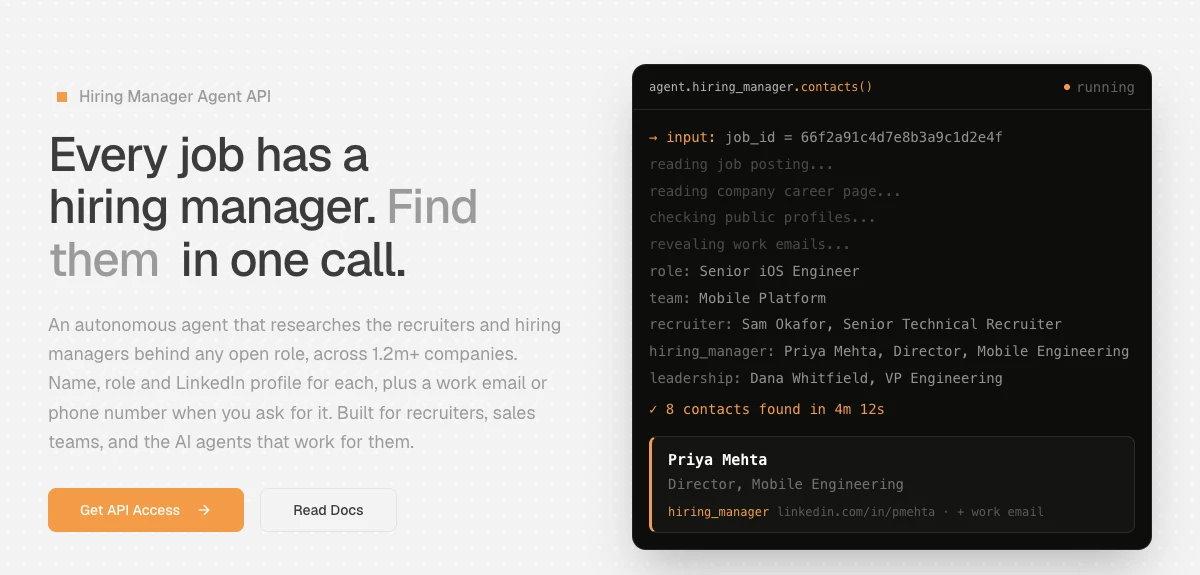
The Hiring Manager API takes a job ID and returns the people behind the role.
You pass a job ID and get back the recruiter, hiring manager and team leaders for that posting. The product page says it typically finds 5 to 10 contacts per posting, each with name, role and LinkedIn profile.
Work emails and phone numbers are optional reveals, charged only when found. Contacts come labelled by relationship, such as hiring_manager, recruiter or function_leader, and you can filter to just the ones you want.
Speed depends on the version. The V2 docs say most postings finish in about 5 seconds, versus a few minutes for V1 on a new posting. V2 is still labelled beta.
Signals API and Webhooks
The Signals API turns posting changes into events: a first hire in a team, a hiring surge, a new leadership role, a repost, or a tool appearing in job posts for the first time. Signals are computed nightly and delivered by API, daily email or webhook.
Separate job webhooks push each new job that matches a saved search to your URL. Each event costs one job from your allowance, and the daily cap defaults to 1,000 events, adjustable up to 5,000.
Salary Benchmarks, Insights and Historical Jobs
Salary benchmarking prices a role from posted pay, and the Insights API returns aggregates such as hiring velocity and top hiring companies. The historical archive holds roughly 35M expired jobs, searchable for free and exported per record.
Hirebase Pricing: Plans, Limits, What You Actually Pay
Hirebase pricing is public and based on jobs and companies returned, not API calls. A search that returns 100 jobs uses 100 jobs from your monthly allowance, per the pricing page.
| Plan | Monthly price | Jobs / month | Companies / month | Refresh | Past the cap |
|---|---|---|---|---|---|
| Free | $0 | 500 | 50 | Daily | Hard stop until reset |
| Starter | $99 | 25,000 | 10,000 | Hourly | Hard stop until reset |
| Growth | $249 | 250,000 | 50,000 | Hourly | $1.50 / 1K jobs, $5 / 1K companies |
| Scale | $999 | 2,000,000 | 200,000 | Hourly | $1 / 1K jobs, $5 / 1K companies |
| Pay as you go | $5.00 / 1,000 jobs | No subscription; runs through Apify | |||
| Enterprise | Custom | Unlimited volume, SLAs, custom delivery (S3, feeds) | |||
List prices from hirebase.org/pricing, checked November 28, 2026. A seasonal promo code was running on Starter for new customers; it is not reflected here.
Annual billing takes 20% off. The pricing FAQ puts Starter at $79 and Growth at $199 a month on annual plans, billed upfront and non-refundable.
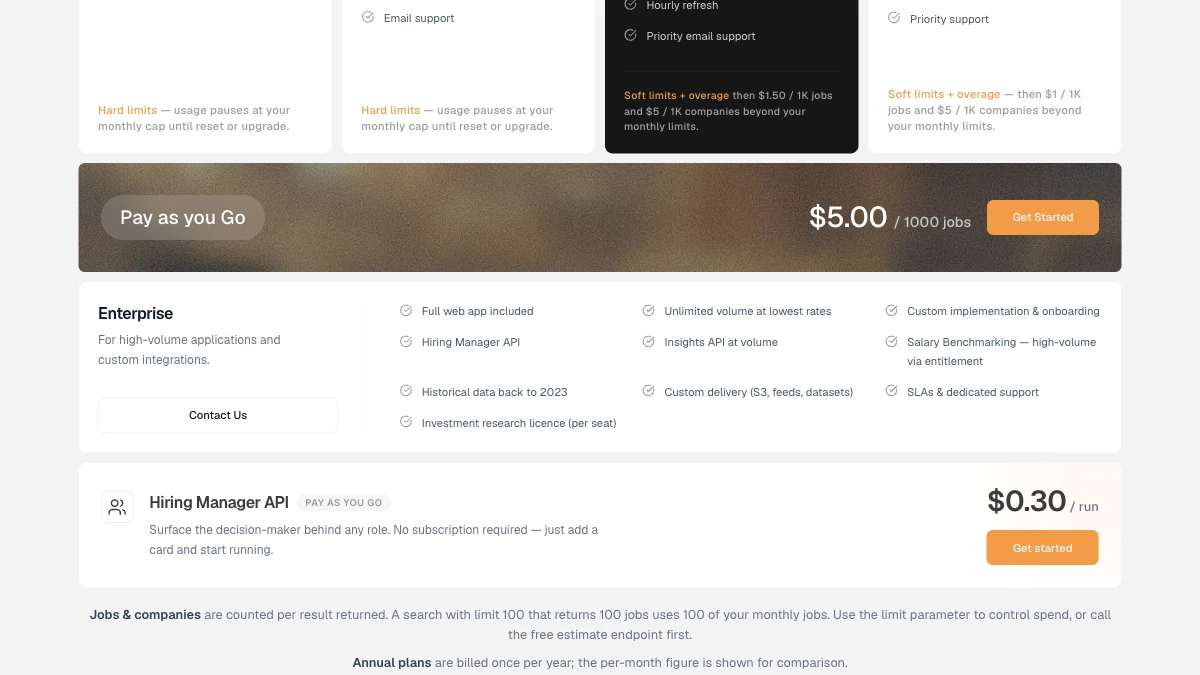
Hirebase pricing page: overage, pay-as-you-go and Hiring Manager API rates (November 2026).
Cost per 1,000 jobs
Simple division on the list prices shows how fast the unit cost falls. Starter works out to $3.96 per 1,000 jobs, Growth to about $1.00, and Scale to about $0.50.
Pay-as-you-go at $5.00 per 1,000 only makes sense for one-off pulls. If you need more than about 20,000 jobs a month, Starter is already cheaper.
Add-ons that change the bill
These metered extras sit on top of the plan price; rates below are from the Hirebase pricing page unless another source is linked.
- Hiring Manager API: $0.30 per posting that returns contacts, $0.05 per work email found, $0.40 per phone number found. Re-running the same posting within 24 hours is free, and it works on any plan, including Free (source).
- Saved signals: Free gets 1 (matches shown 7 days late), Starter 10, Growth 50, Scale 200 (source).
- Salary benchmarks: 3 a month on Free, 25 on paid plans, then $0.25 each.
- Insights API: 25 calls a month on every plan, then $10 per 1,000.
- Historical export: from $0.12 per record, falling to $0.001 at volume, bought per dataset outside your allowance.
A worked example for a sales team
Say you pull 20,000 matching jobs a month on Starter ($99) and run the Hiring Manager API on 200 of the best postings. If every run returns contacts, that adds $60.
Reveal one work email per posting and you add 200 × $0.05 = $10, so about $169 a month. This is arithmetic on list prices, not a measured hit rate; emails are only charged when found.
Data Quality and Coverage
Hirebase's data quality argument rests on sourcing. Jobs come from the employer's own page, so the posting URL points to the real application and duplicates from job board reposts are easier to remove.
The homepage claims automated deduplication, sub-200ms lookups and a 99.9% uptime SLA. We did not test these; treat them as vendor claims.
What the vendor's own customers report
Two testimonials on the Hirebase homepage make specific claims. One customer says 80% of the jobs they get from Hirebase weren't in their LinkedIn or Apollo workflows.
Another says 94% of Hirebase's jobs were still live when checked, against 33% from another provider. Both are vendor-published and unaudited.
Known gaps
- No job board copies from Indeed or Glassdoor. Hirebase's comparison page lists this itself. Roles posted only on boards will be missing.
- Thinner company records. The same page admits raw company records are thinner than People Data Labs or Crustdata. Plan on a separate firmographic or contact source.
- Tech stack is inferred. It comes from job post text, so companies that rarely hire will show sparse stacks.
- Contact coverage is unpublished. The Hiring Manager API gives a typical contact count, not a hit rate for emails or phones.
For how career-page sourcing compares with board scraping across vendors, see our guide to job posting data providers.
Docs, Integrations and Support
The developer experience is one of Hirebase's better qualities. The docs include a quickstart, a Postman collection, a typed Python SDK and a dated changelog with frequent releases.
A free estimate endpoint tells you how many jobs a search would return before you spend allowance. URL lookup takes up to 100 posting links and bills only for matches.
Integrations
- MCP server: a remote MCP server for Claude, ChatGPT, Cursor and VS Code, billed against your plan like normal API calls.
- No-code: ready-made n8n and Make templates. There is no native Zapier app, but webhooks can post to a Zapier catch hook.
- Marketplaces: pay-as-you-go actors on Apify and a listing on RapidAPI.
Limits and support
Data endpoints share 100 requests per minute per key, and task polling has its own 600 per minute, per the October 2026 changelog. Large backfills should use the export endpoints rather than paging through search.
Support scales with plan: community on Free, email on Starter and priority on Growth and Scale. Enterprise adds SLAs and dedicated support.
What Users Say
There is almost no independent user feedback on Hirebase yet. Its Product Hunt page shows a 2024 launch and no reviews.
On G2, the main HireBase listing belongs to an ATS product and showed no reviews when we checked. Don't mistake either listing for a verdict on the job data API.
Third-party roundups also lag the product. TheirStack's job posting API comparison still lists Hirebase as pull-only with no webhooks, while Hirebase's changelog shows webhooks shipped in November 2026.
Practical takeaway: the free plan is your real review. Pull 500 jobs for your own target accounts and compare them with their career pages before you pay.
Who Should Use Hirebase — and Who Shouldn't
Good fit
- Prospecting and sales intelligence tools that need fresh hiring data as an input and can handle an API. Volume pricing keeps unit costs low as you scale.
- Staffing and recruiting agencies that want new employer reqs fast, plus the recruiter or hiring manager behind each one.
- Job boards and marketplaces that want a clean feed with expiry handling, webhooks and resume matching.
- Market researchers and investors who need hiring velocity, salary data and a historical archive back to 2023.
Poor fit
- Teams that need Indeed or Glassdoor jobs, or employers that only post on boards.
- Sales teams that want a contact database, enrichment and sequencing in one tool. Hirebase is a data layer; you still need email verification and a sending tool.
- Buyers who need deep firmographics or funding data on every account.
- Non-technical teams that won't touch the API. The web app works, but most of the value sits in the endpoints.
If you are using job posts as a buying signal, our guides to hiring signal tools and timing outreach with hiring signals cover the workflow around the data.
Hirebase Alternatives
The right alternative depends on why Hirebase falls short for you: coverage, company data, or signal breadth.
- TheirStack suits teams that prospect by tech stack. It combines job alerts with technographic data on 33k technologies; see our TheirStack review.
- Fantastic.jobs is the closest like-for-like option: a jobs API that pulls from career sites and job boards with similar freshness claims.
- PredictLeads bundles job openings with company news events and technographics; read our PredictLeads review and our PredictLeads alternatives.
- Crustdata pairs a job listings API with people and company data, which covers Hirebase's thin-firmographics gap. More in our Crustdata review.
- For bulk datasets beyond jobs, compare Coresignal and its alternatives or our People Data Labs review.
Hirebase Pros and Cons
Pros
- Jobs come straight from employer career pages and 80+ applicant tracking systems, so most records link to the employer's own posting instead of a job board copy.
- Public, volume-based pricing: $99 for 25,000 jobs, $249 for 250,000 and $999 for 2 million a month, with a free plan of 500 jobs to test on.
- Freshness is a core promise: new jobs typically land within 1–2 hours of posting on a paid plan, and expired listings drop out of search hourly.
- Hiring Manager API turns a job ID into named recruiters and team leads, charged at $0.30 only when contacts come back. Empty searches are free.
- Unusually broad API surface for its size: keyword and neural search, company search, tech stack, signals, webhooks, salary benchmarks, historical exports and an MCP server.
- A free estimate endpoint returns the match count before you spend allowance, which makes budgeting a pull easy.
- Month-to-month plans with no long-term commitment on monthly billing.
Cons
- No Indeed or Glassdoor jobs. Roles that only live on job boards, or at employers without a crawled career page, will be missing.
- Company records are thinner than dedicated firmographic providers. Hirebase's own comparison page says so about People Data Labs and Crustdata.
- Free and Starter plans stop hard at the monthly cap and return 429 errors until the reset, so a busy month can break a pipeline.
- No independent user reviews yet. The G2 listing under the same name describes a different ATS product, and the Product Hunt page has none.
- Hiring Manager V2 is still in beta, and contact coverage per posting is not published beyond the vendor's "typically 5 to 10" claim.
- Data endpoints share a 100-requests-per-minute limit per key, which caps how fast you can backfill without the export endpoints.
Final Verdict: Is Hirebase Worth It in 2026?
Hirebase earns a 4.2/5. It is a well-documented, fairly priced job postings API with employer-sourced data, fast freshness and an unusually useful hiring manager lookup.
The Growth plan at $249 for 250,000 jobs is the sweet spot for most prospecting tools and agencies. Start on Free, check the data against your own target accounts, and upgrade once the coverage holds.
The score loses points for gaps it admits itself: no Indeed or Glassdoor jobs and thin company records. It also loses points for hard caps on lower plans and no independent reviews to confirm the vendor's claims.
If stitching Hirebase data to a separate enrichment and verification tool is a dealbreaker, SyncGTM is one alternative worth a look: it pairs job-openings signals with waterfall email and phone enrichment from 50+ providers in one table.