
By Kushal Magar · September 30, 2026 · 12 min read
5 Best Onfire AI Alternatives for B2B Buying Signals in 2026
Onfire AI raised $20M to catch a buying signal almost nobody else can see: developers asking deal-related questions on Reddit, Discord, and GitHub before they ever fill out a form. That's a real, narrow edge in technical verticals like observability and cloud infrastructure. But read Onfire's own homepage closely and the next step after a signal fires is that it "writes to the CRM, enrolls the sequence" — meaning it hands off to the CRM and sequencer you already pay for, rather than delivering a verified contact and a channel itself. If your ICP isn't developers, or you want the signal, the enrichment, and the outreach bundled under one subscription instead of stitched across three, the calculus changes. Here are five alternatives ranked on what actually matters once a trigger fires: how much of your buyer universe the signal covers, how fresh it is by the time it reaches a rep, and whether you get an actionable contact or just another alert.
Onfire AI came out of stealth with $20M in funding — a $14M Series A co-led by Grove Ventures and TLV Partners — built by a team of Israeli intelligence veterans, according to TechCrunch's coverage of the raise. The pitch is specific: monitor developer communities — Reddit, Discord, StackOverflow, GitHub, X — for people discussing tools and problems, then identify which companies those commenters work for and who the technical decision-makers are. It's a genuinely differentiated signal source for IT and infrastructure vendors, and customers like Aiven, Spectro Cloud, and Cyera use it to target technical buyers other data providers miss.
That specialization is also the limit. Onfire's coverage is anchored to public developer-community chatter in technical verticals — it isn't built to catch a finance buyer researching AP automation software or a marketing team evaluating a CDP. And every tier on onfire.ai/pricing — Basic, Pro, and Elite — is listed as custom pricing with a "Get a demo" button, so there's no public number to budget against before a sales call. We cover Onfire's own feature set and positioning in full in our Onfire AI review; this post is about the five tools teams actually put on the shortlist next to it.
We're ranking each alternative on three things: signal coverage (how many source types and buyer segments it actually monitors, not just its marketing copy), freshness (how quickly a trigger reaches a rep, where the vendor discloses it), and what happens after a trigger fires — whether you get an enriched, actionable contact and a way to reach them, or just an alert you still have to work.
Quick Summary
Onfire AI is a real, currently-operating product — a $20M-funded revenue intelligence platform (per TechCrunch's October 2025 coverage of its Series A) that monitors developer communities like Reddit, Discord, GitHub, and StackOverflow for buying signals, then identifies the companies and technical decision-makers behind the chatter. It's a genuinely narrow and useful signal source for IT and infrastructure vendors selling to technical buyers. The gap most teams hit isn't accuracy — it's scope and what happens next. Onfire's own site describes post-signal action as writing into the CRM and enrolling the sequence you already have connected, not delivering its own verified, enriched contact or its own outreach channel, and every pricing tier (Basic, Pro, Elite) on onfire.ai/pricing is listed as custom with no public figure. Among the five alternatives compared here, 6sense claims the broadest raw signal volume but is fully quote-only and geared toward enterprise ABM teams already running paid media. Bombora is positioned by its own homepage as "a data company, not a platform" — strong company-level intent data (16B+ monthly events, 21,600+ topics) but no outreach channel of its own and no disclosed latency. Clay doesn't detect signals natively; it layers third-party signal providers into a 150+ provider waterfall enrichment plus native sequencing and ad-audience sync, and it's the only tool here with fully public, verifiable pricing (Free, then $167/mo and $446/mo, confirmed on clay.com/pricing). UserGems tracks 30+ contact-level signals and is the only vendor that discloses a latency figure at all ("within days"), but its published pricing starts at $40,000/year. Common Room is the closest like-for-like swap for Onfire's specialty — it explicitly tracks GitHub activity alongside product usage, web visits, and CRM data across a 400M+ contact directory, and bundles built-in email and phone outreach, starting at a published $2,500/mo. SyncGTM approaches the gap differently: rather than specializing in one signal category, it runs 15 native intent signals (job change, funding, hiring, techstack change, leadership change, and more) that waterfall-enrich the account the moment a signal fires and hand the contact straight into an outreach sequence — all inside one $99/mo subscription with a free tier, so the signal, the enrichment, and the follow-up don't live in three separate tools with three separate bills.
TL;DR
- Short answer: Onfire AI's edge is narrow and real — developer-community signals (Reddit, Discord, GitHub, StackOverflow) for technical verticals — but it hands signals off to a CRM and sequencer you already run, and its pricing is quote-only at every tier. The right alternative depends on whether you need broader signal coverage, faster/disclosed latency, or a built-in contact-and-outreach layer.
- Broadest signal coverage: 6sense claims the largest disclosed signal volume (an unverified "one trillion signals" daily) across intent, first-party, and third-party data; Common Room and SyncGTM both pull from the widest range of distinct source types rather than one category.
- Only vendor with a stated latency number: UserGems, which says new high-intent accounts typically surface "within days" — slower than the real-time framing most competitors use, but it's the one number in this list any vendor actually discloses.
- Contact + channel bundled in, not just an alert: SyncGTM, Common Room, UserGems, and Clay all route a fired trigger into a waterfall-enriched contact and a built-in outreach channel (sequence, email, or phone). Bombora and 6sense are stronger on raw signal breadth but route intelligence into a CRM/ad stack you already run rather than acting on it directly.
- Pricing transparency varies sharply: Clay ($167–$446/mo, verified on clay.com/pricing) and Common Room ($2,500/mo Essential, verified on commonroom.io/pricing) publish real numbers. UserGems publishes real but enterprise-scale numbers ($40K–$150K/year). 6sense, Bombora, and Onfire itself are quote-only across every tier.
- SyncGTM runs 15 native intent signals into a 50+ provider waterfall enrichment and built-in outreach sequencing, starting at $49/mo with a free plan — one subscription instead of a signal tool, an enrichment tool, and a sequencer stitched together.
What We Evaluated
- Signal coverage: how many distinct source types and buyer segments each tool actually monitors, not just marketing language
- Freshness/latency: whether the vendor discloses how quickly a trigger reaches a rep, and what that number actually says
- What happens after a trigger fires: an enriched, verified contact and an outreach channel, versus an alert that still has to be worked manually
- Pricing transparency: published tiers and figures versus fully quote-only, and what a mid-market team would actually need to budget
- Best-fit motion: enterprise ABM, PLG/developer-tool, contact-level champion tracking, or general B2B outbound
1. SyncGTM — Teams that want signal detection, waterfall enrichment, and outreach in one subscription instead of three stitched-together tools
SyncGTM — Teams that want signal detection, waterfall enrichment, and outreach in one subscription instead of three stitched-together tools
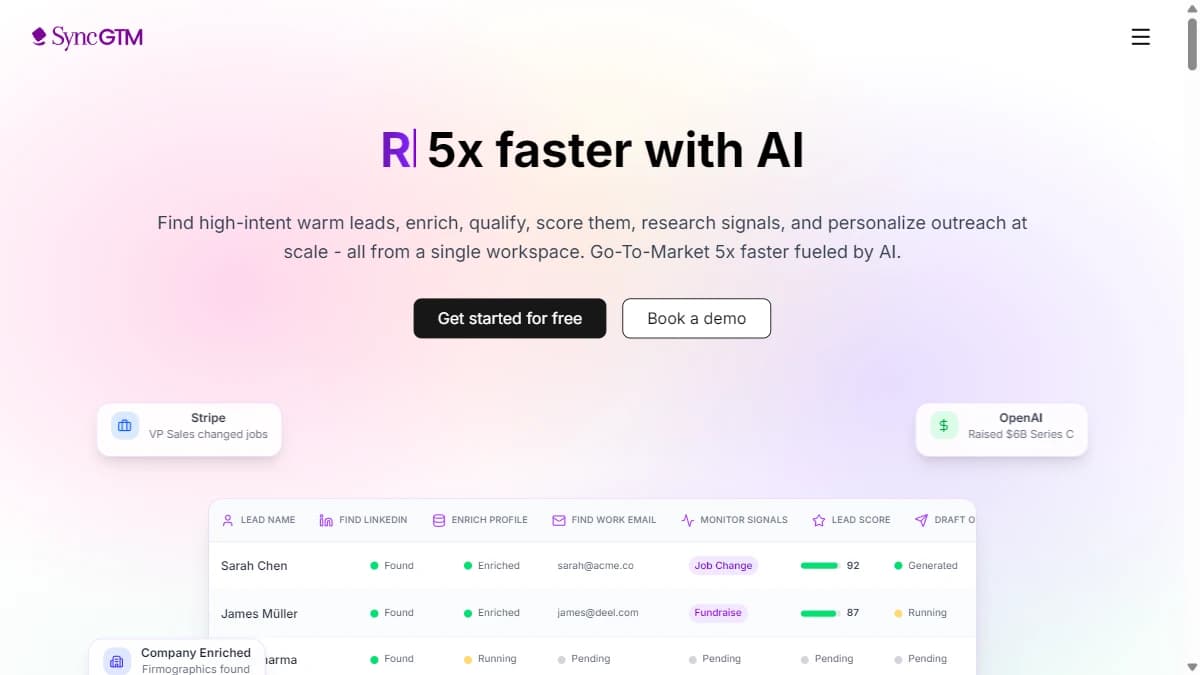
Quick context before the head-to-head: SyncGTM isn't trying to out-narrow Onfire's developer-community specialty — it runs a wider net of 15 native intent signals (job change, is-hiring, techstack change, news mentions, raised funding, leadership change, headcount growth, revenue growth, and more) and treats the trigger as the start of a workflow, not the end of one.
When a signal fires, SyncGTM runs a real-time waterfall across 50+ data providers to add 76+ data points to the account — verified email, direct phone, firmographics — and that enriched contact can go straight into an outreach sequence inside the same workspace. No export to a separate enrichment tool, no manual hand-off to a sequencer with its own login and bill.
See the GTM agent library for how signal, enrichment, and outreach connect end to end, or check pricing for current plans. Now, the five alternatives.
Pros
- +15 native intent signals in one library, spanning company-level (funding, hiring, techstack change) and executive-level (leadership change, promotions) triggers
- +Waterfall enrichment across 50+ providers (76+ data points) runs automatically the moment a signal fires — no separate enrichment tool required
- +Built-in outreach sequencing means a trigger can move to an actual email or sequence without leaving the workspace
- +Transparent, flat pricing starting at $49/mo with a free plan — no custom quote required to see a number
Cons
- −Doesn't parse Reddit, Discord, GitHub, or StackOverflow chatter the way Onfire does — no developer-forum-level anonymous intent detection
- −Signal set is broader company/contact intelligence rather than Onfire's narrow technical-buyer niche, so it's less specialized for pure developer-tool GTM motions
Best for: Teams that want signal detection, waterfall enrichment, and outreach in one subscription instead of three stitched-together tools
Pricing: Starts at $99/mo. Free tier available.
2. 6sense — Enterprise ABM teams that want intent signals activated across ads, email, and sales inside one predictive platform
6sense — Enterprise ABM teams that want intent signals activated across ads, email, and sales inside one predictive platform
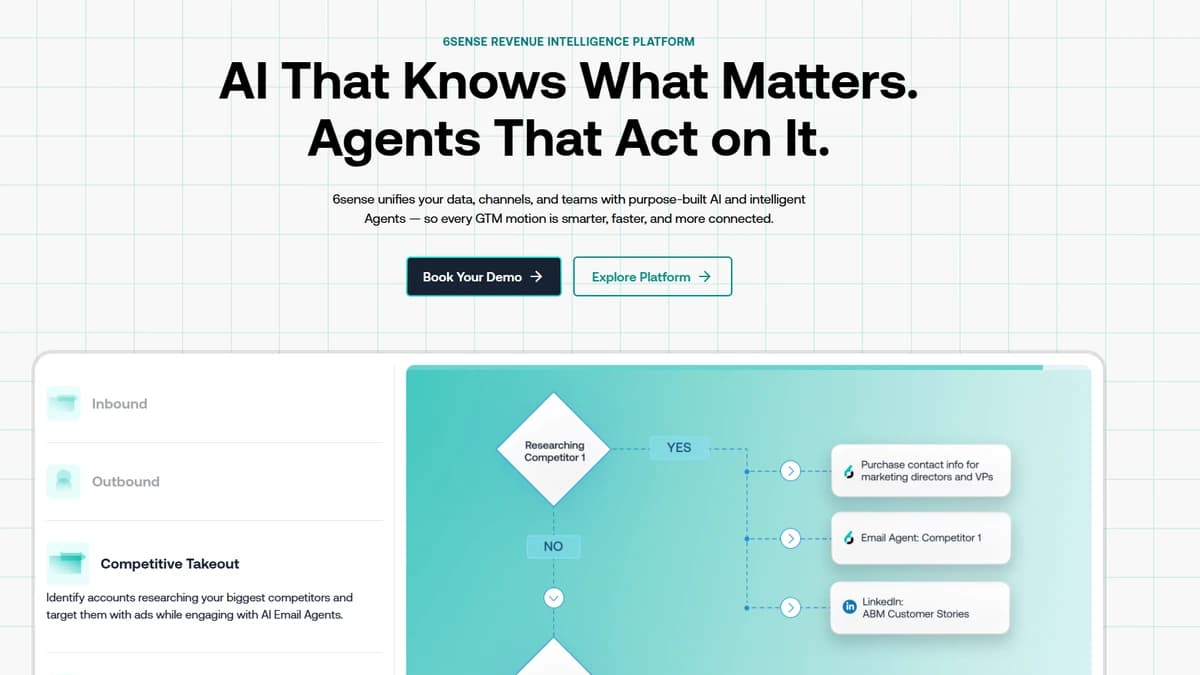
6sense is an enterprise revenue intelligence and ABM platform built around what it calls the "Signalverse" — an unverified claim of one trillion signals processed daily across intent data, first-party CRM/MAP/product data, and third-party events like job changes and funding. It's the broadest disclosed signal volume of any tool in this comparison, though 6sense's own homepage discloses no specific refresh rate or latency figure for how current those signals are by the time a rep sees them.
Once a signal is scored, 6sense pushes it through AI models designed to answer "why this account, why now, who's deciding," then activates it across Email Agents, digital advertising, and workflow orchestration, with API/MCP distribution into Salesforce and Salesloft. That's a real contact-and-channel story, but it's built for teams already running an ads-and-ABM motion, not a lightweight add-on. For more on how it stacks up against other options, see our 6sense alternatives roundup and our full 6sense review.
Pros
- +Largest disclosed signal volume among these alternatives, spanning intent, first-party, and third-party data categories
- +AI-driven account prioritization ("why this account, why now") rather than a raw signal feed
- +Multi-channel activation built in — Email Agents, digital ads, and workflow orchestration — plus API/MCP push into Salesforce and Salesloft
- +Purpose-built for enterprise ABM teams that need signal, scoring, and ad activation in one platform
Cons
- −No disclosed latency or refresh-rate metrics for how fresh signals are when they reach a rep
- −Every tier on 6sense.com/platform/sales/pricing is quote-only — three tier combinations, all "Schedule a Demo," no public figures
- −Heavier platform than a point signal tool — built around an ads/ABM motion most mid-market outbound teams don't run
Best for: Enterprise ABM teams that want intent signals activated across ads, email, and sales inside one predictive platform
Pricing: Quote-only. Three Sales Intelligence tier combinations listed on 6sense.com/platform/sales/pricing, all priced "Schedule a Demo" with no public figures as of September 2026.
3. Bombora — Marketing teams that already run a MAP/ABM stack and want a pure third-party intent-data feed, not a new platform
Bombora — Marketing teams that already run a MAP/ABM stack and want a pure third-party intent-data feed, not a new platform
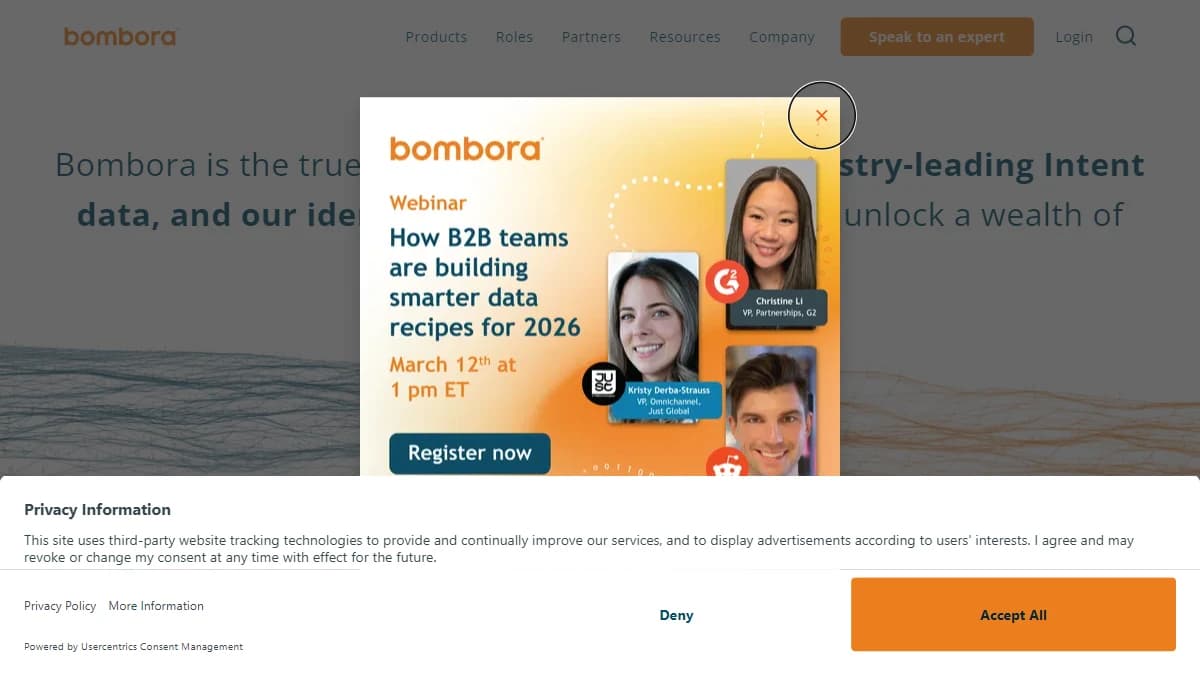
Bombora is an intent-data cooperative, not a full platform — a distinction its own homepage draws explicitly ("a data company, not a platform"). Its Company Surge® product analyzes 16B+ monthly content-consumption events across 5M+ company domains and 21,600+ Intent topics, sourced from a network of B2B publishers, to flag which accounts are actively researching a category. No specific latency or refresh cadence is disclosed on the homepage.
Company Surge is company-level by default; getting to a named, contact-level person requires the separate Visitor Insights add-on, which de-anonymizes site traffic. Either way, Bombora delivers intelligence into a CRM, marketing automation platform, or ad-tech stack you already run — it doesn't include its own outreach channel, so a fired trigger still needs a sequencer on the other end. See our Bombora review for the full breakdown.
Pros
- +Large underlying data footprint — 16B+ monthly events, 5M+ domains, 21,600+ Intent topics
- +Positions cleanly as a data feed into an existing CRM/MAP/ad stack rather than requiring a new platform
- +Visitor Insights add-on can de-anonymize website traffic to contact level
- +90%+ match rates claimed for buying-group-level engagement measurement
Cons
- −Company-level Surge scores are the default product — contact-level identification is a separate, additional layer
- −No outreach channel of its own; a trigger has to be routed into a sequencer or ad platform you already own
- −No disclosed refresh latency for how current the intent signal is by the time it reaches a rep
- −Fully quote-only pricing — bombora.com routes every inquiry to "speak to an expert" with no tiers listed
Best for: Marketing teams that already run a MAP/ABM stack and want a pure third-party intent-data feed, not a new platform
Pricing: Quote-only. No tiers or figures published; bombora.com/pricing/ routes every inquiry to "speak to an expert."
4. Clay — Teams that want to build a custom signal-to-enrichment-to-outreach workflow instead of buying one off the shelf
Clay — Teams that want to build a custom signal-to-enrichment-to-outreach workflow instead of buying one off the shelf
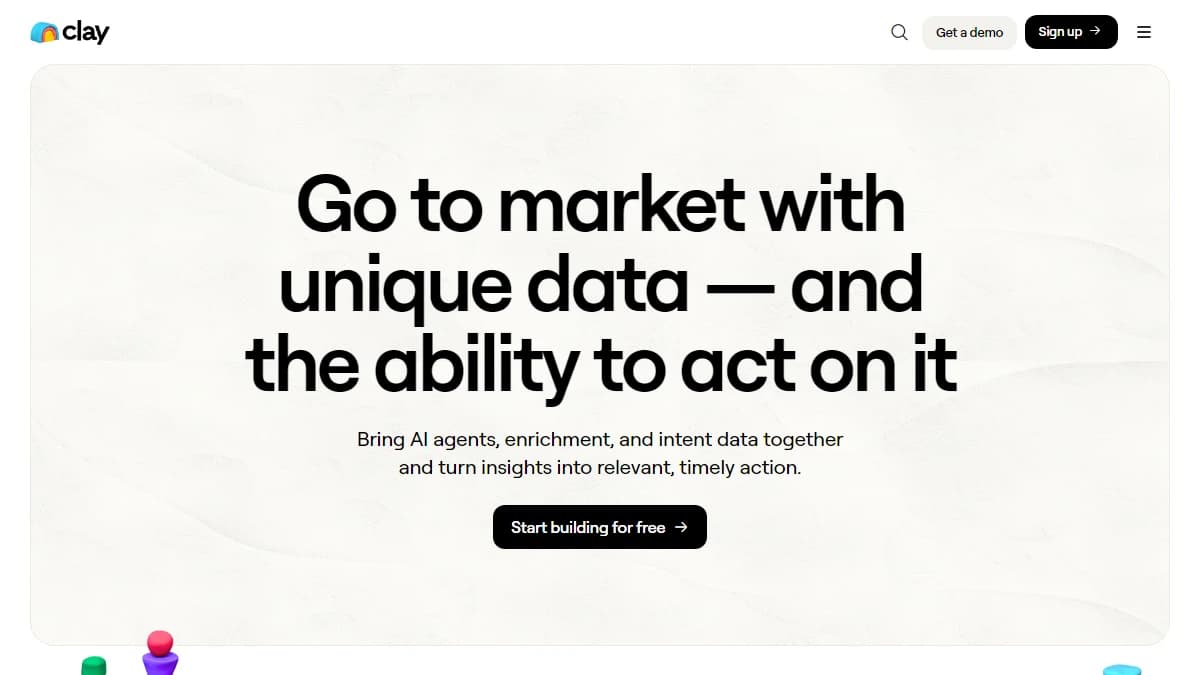
Clay doesn't detect buying signals natively — it layers in third-party signal providers (job changes, promotions, and more) alongside a waterfall enrichment engine that combines 150+ data providers for coverage. Once a signal or a list of accounts is in a Clay table, the same workflow can enrich, verify, and route it into a native email sequencer or sync targeted audiences to LinkedIn, Meta, and Google Ads.
The tradeoff is assembly: Clay is infrastructure, not an out-of-the-box signal tool, so a signal-to-outreach workflow has to be built in its table/agent interface rather than switched on. It's also the only tool in this list with fully public pricing — Free (500 actions/mo, 100 data credits/mo), Launch from $167/mo, Growth from $446/mo, and custom Enterprise, all verified on clay.com/pricing. For teams considering it specifically as a signal layer, see our Clay review.
Pros
- +Fully public, verifiable pricing — Free, then $167/mo and $446/mo tiers, confirmed directly on clay.com/pricing
- +Waterfall enrichment across 150+ data providers means a signal can be enriched and verified in the same workflow that ingests it
- +Native email sequencing plus LinkedIn/Meta/Google ad-audience sync as built-in "then what" steps
- +Flexible enough to combine multiple third-party signal providers rather than being locked into one vendor's definition of intent
Cons
- −Doesn't detect signals on its own — needs a signal source (native provider integration or third-party feed) connected first
- −Actions and data credits both meter usage, so cost scales with volume rather than a flat seat price
- −Building a signal-to-enrichment-to-outreach workflow takes real setup time in Clay's interface, more assembly than a point tool
Best for: Teams that want to build a custom signal-to-enrichment-to-outreach workflow instead of buying one off the shelf
Pricing: Free (500 actions/mo, 100 data credits/mo) / Launch from $167/mo / Growth from $446/mo / Enterprise custom. Verified on clay.com/pricing, September 2026.
5. UserGems — Revenue teams whose highest-intent signal is a champion or past customer changing jobs, who want contact-level detail with an ROI guarantee
UserGems — Revenue teams whose highest-intent signal is a champion or past customer changing jobs, who want contact-level detail with an ROI guarantee
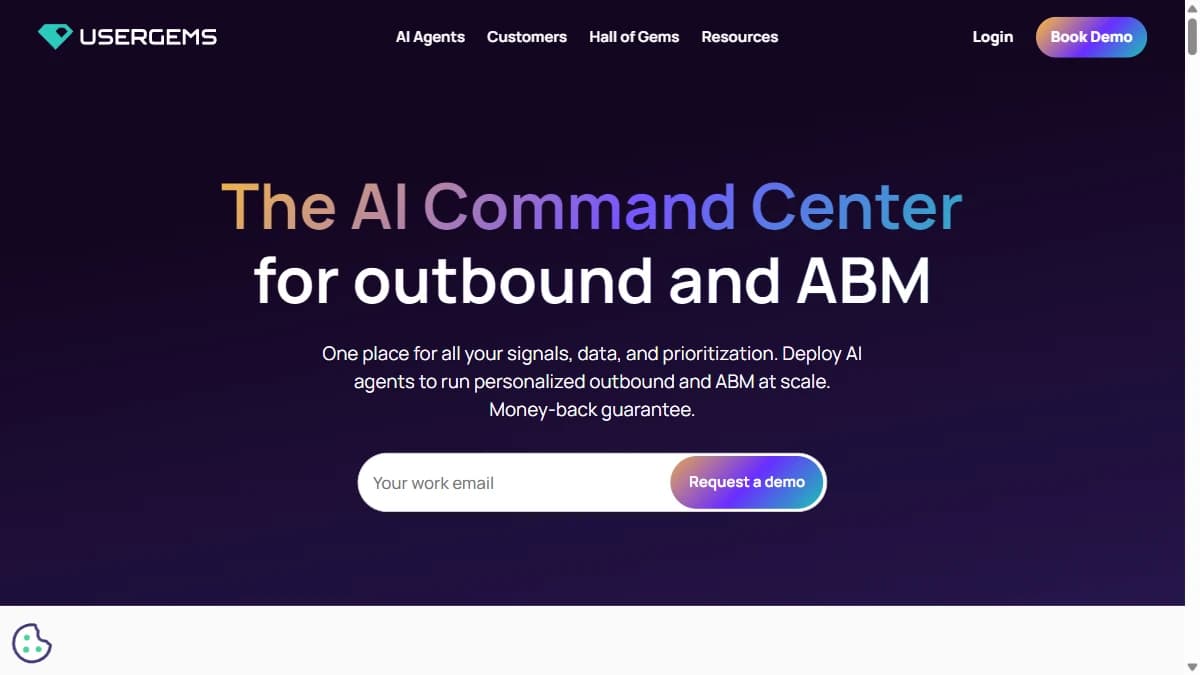
UserGems tracks 30+ native signals — job changes, contact-level intent, website visits, M&A, hiring — and offers a Research Agent for custom signal definitions, layered on top of first-party CRM, call-transcript, and product-usage data. It's the only vendor in this comparison that publishes an actual latency figure: new high-intent accounts "typically" surface "within days," which is slower than the real-time framing most competitors use, but it's a real, stated number rather than marketing language.
Once a signal is flagged, UserGems delivers person-level contact data plus a Writing Agent for personalized outreach, and queues tasks or messages directly inside Outreach, Salesloft, or Gong Engage. Pricing is public but enterprise-scale: Core at $40,000/year (4M credits), Advanced at $75,000/year, and Elite at $150,000/year, each with $3,000–$10,000 implementation fees on top, confirmed on usergems.com/pricing. See our UserGems review for the full breakdown.
Pros
- +30+ native signals with genuine contact-level detail, not just company-level scoring
- +The only vendor here that discloses an actual latency figure ("within days") instead of unquantified "real-time" language
- +Person-level delivery plus a Writing Agent and direct integration into Outreach, Salesloft, and Gong Engage
- +Money-back ROI guarantee, and publishes real pricing rather than routing everyone to a demo
Cons
- −Most expensive published option in this list — Core starts at $40,000/year plus $3,000–$10,000 implementation
- −Signal set leans toward champion and relationship tracking (job changes, past customers moving) more than raw new-account intent
- −"Within days" is explicitly slower than the real-time signal delivery other tools claim (without disclosing their own numbers)
Best for: Revenue teams whose highest-intent signal is a champion or past customer changing jobs, who want contact-level detail with an ROI guarantee
Pricing: $40,000/year (Core, 4M credits) / $75,000/year (Advanced, 10M credits) / $150,000/year (Elite, 25M credits), plus $3,000–$10,000 implementation. Enterprise custom. Verified on usergems.com/pricing, September 2026.
6. Common Room — PLG and dev-tool companies that want Onfire-style community-signal coverage plus product usage, CRM data, and built-in outreach channels
Common Room — PLG and dev-tool companies that want Onfire-style community-signal coverage plus product usage, CRM data, and built-in outreach channels
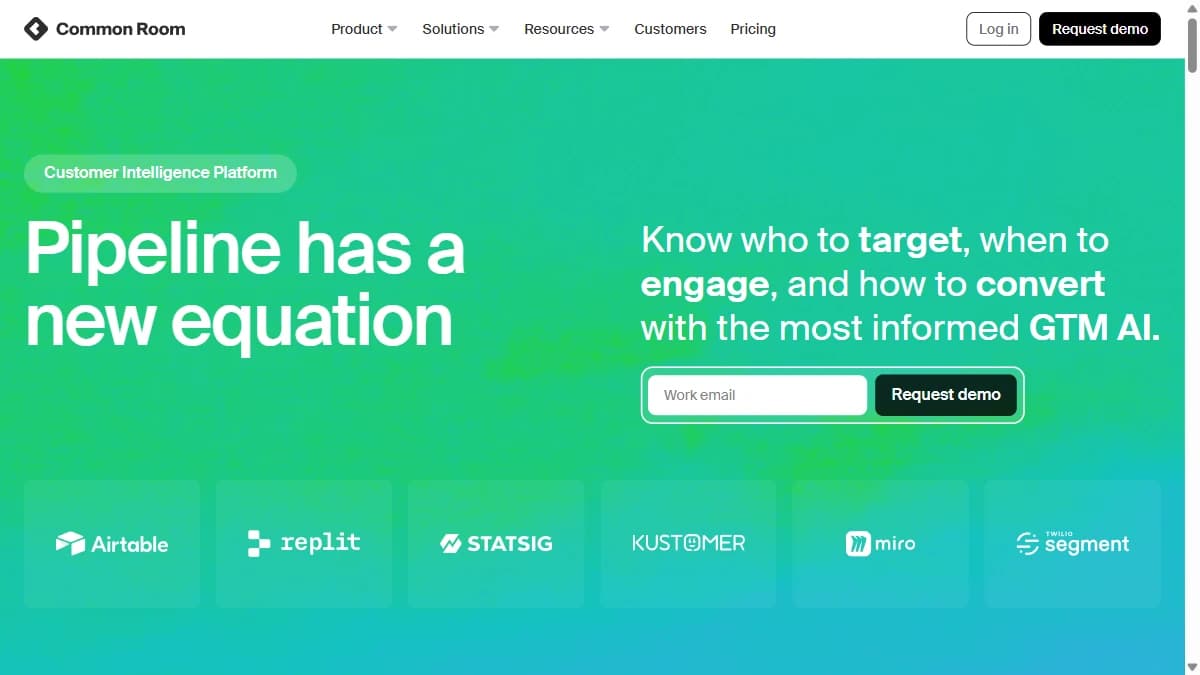
Common Room is the closest direct analog to Onfire's community-signal specialty — it explicitly tracks GitHub activity alongside product usage, web visits, CRM records, email engagement, and call interactions, unifying it all across a claimed 400M+ contact directory. The platform describes its intelligence as "continuously refreshed" and "always-current," though like most vendors here it doesn't publish a specific numeric latency.
Where it goes further than Onfire's positioning is the built-in channel layer: Engage handles email sequences and Dial handles phone outreach, both natively integrated alongside Salesforce, Slack, and a browser extension, so a fired trigger can move straight to outreach without a hand-off. Pricing starts at a published $2,500/mo for the Essential tier (5 seats, up to 100k contacts, billed annually); Advanced and Enterprise both go quote-only past that. See our Common Room review for the full feature breakdown.
Pros
- +Closest direct match to Onfire's developer-community specialty — explicitly tracks GitHub activity, not just generic web/product signals
- +Broader than Onfire's niche: also pulls in product usage, CRM records, email, and calls into one buyer profile
- +Built-in Engage (email) and Dial (phone) outreach channels, so a trigger doesn't require exporting to a separate sequencer
- +Publishes an actual entry price ($2,500/mo) rather than routing every tier to a demo
Cons
- −Essential tier caps at 5 seats and 100k contacts; both higher tiers (Advanced, Enterprise) are quote-only past that ceiling
- −"Continuously refreshed" and "always-current" aren't backed by a stated numeric refresh interval
- −Its community-signal strength is most differentiated for PLG and dev-tool companies — less of an edge for a non-technical ICP
Best for: PLG and dev-tool companies that want Onfire-style community-signal coverage plus product usage, CRM data, and built-in outreach channels
Pricing: $2,500/mo (Essential, 5 seats, up to 100k contacts, billed annually) / Advanced and Enterprise both quote-only (15 and 30 seats, up to 250k/750k contacts). Verified on commonroom.io/pricing, September 2026.
Comparison Table
| Tool | Best For | Free Tier | Starting Price | Standout Feature |
|---|---|---|---|---|
| SyncGTM | Teams that want signal detection, waterfall enrichment, and outreach in one subscription instead of three stitched-together tools | Yes | $99/mo | 15 signals into enrichment into outreach in a single workspace, not three separate subscriptions and three separate bills |
| 6sense | Enterprise ABM teams that want intent signals activated across ads, email, and sales inside one predictive platform | No | Quote-only | The broadest claimed signal volume of the five, but every tier requires a sales conversation to get a number |
| Bombora | Marketing teams that already run a MAP/ABM stack and want a pure third-party intent-data feed, not a new platform | No | Quote-only | A data cooperative, not a platform, by its own description — strong signal, no built-in channel to act on it |
| Clay | Teams that want to build a custom signal-to-enrichment-to-outreach workflow instead of buying one off the shelf | Yes | Free (paid plans from $167/mo) | The only alternative here with fully public, verifiable pricing, and a credit system that scales with exactly what's used |
| UserGems | Revenue teams whose highest-intent signal is a champion or past customer changing jobs, who want contact-level detail with an ROI guarantee | No | $40,000/year (Core) | Publishes real six-figure-scale pricing and a money-back guarantee — a rare combination in this category |
| Common Room | PLG and dev-tool companies that want Onfire-style community-signal coverage plus product usage, CRM data, and built-in outreach channels | No | $2,500/mo (Essential, billed annually) | The most direct like-for-like Onfire swap — same community-signal DNA, plus product usage data and built-in outreach channels |
How to Choose
- SyncGTM if you need teams that want signal detection, waterfall enrichment, and outreach in one subscription instead of three stitched-together tools
- 6sense if you need enterprise abm teams that want intent signals activated across ads, email, and sales inside one predictive platform
- Bombora if you need marketing teams that already run a map/abm stack and want a pure third-party intent-data feed, not a new platform
- Clay if you need teams that want to build a custom signal-to-enrichment-to-outreach workflow instead of buying one off the shelf
- UserGems if you need revenue teams whose highest-intent signal is a champion or past customer changing jobs, who want contact-level detail with an roi guarantee
- Common Room if you need plg and dev-tool companies that want onfire-style community-signal coverage plus product usage, crm data, and built-in outreach channels