7 Best Intricately Alternatives for B2B Enrichment in 2026

By Kushal Magar · August 4, 2026 · 14 min read
Key Takeaway
Intricately is no longer sold standalone. HG Insights acquired it in March 2022, intricately.com now 301-redirects to hginsights.com, and the data set lives on as HG Cloud Dynamics — demo-gated, with no published pricing. If you specifically need dollar-level cloud infrastructure spend estimates, HG Insights is the only true successor and you will pay enterprise rates for it. If you needed Intricately mainly to find and reach companies running a particular stack, presence-based technographics plus contact data is a cheaper and more complete answer: SyncGTM pairs tech-stack signals with waterfall enrichment across 50+ providers and built-in outreach from $99/mo, BuiltWith leads on web-crawl breadth with modelled SaaS spend, TheirStack surfaces backend tools via job postings from $59/mo, and Wappalyzer remains the best free lookup.
If you are searching for Intricately alternatives, start with the fact that changes the whole decision: Intricately is no longer a product you can buy. Visit intricately.com today and you get a 301 redirect straight to HG Insights.
Intricately was not a generic technographics tool. It answered a question almost nobody else could: how many dollars a month does this company spend on CDN, hosting, DNS, and cloud vendors?
That is why replacing it is harder than swapping one tech-detection tool for another. This guide separates the tools that estimate infrastructure spend from the much larger group that only detects vendor presence — because picking the wrong side of that line is the most expensive mistake in this category.
TL;DR — One-Line Verdict Per Tool
- SyncGTM — best for teams that used Intricately to find and contact accounts: technographic signals plus waterfall enrichment across 50+ providers and built-in outreach, from $99/mo.
- HG Insights (HG Cloud Dynamics)— the literal successor and the only tool that still sells Intricately's cloud spend data. Demo-gated, enterprise pricing.
- BuiltWith — widest web-crawl coverage and a modelled monthly tech spend figure, but for SaaS list prices, not cloud consumption. From $295/mo.
- TheirStack — the only strong option for backend and internal tooling, inferred from job postings. Free tier, paid from $59/mo.
- ZoomInfo Technologies — technographics welded to the deepest contact database. Detection only, five-figure annual contracts.
- 6sense (formerly Slintel) — technographics plus intent scoring for ABM teams. Detection only, enterprise pricing.
- Wappalyzer — the best free baseline for one-off lookups. Detection only, paid API from $250/mo.
What Happened to Intricately?
HG Insights acquired Intricately in an acquisition announced on 29 March 2022. The brand has since been fully absorbed rather than run as a separate product.
Three things are true in 2026, and they matter in different ways. The marketing domain intricately.com 301-redirects to hginsights.com, so there is no longer a place to sign up.
The application itself still runs. Existing customers log in at my.intricately.com, which HG links from its own product menu — the data did not disappear, the standalone purchase path did.
And the data set now ships as HG Cloud Dynamics, a module inside HG's lineup. In March 2026 HG folded it into a unified RGI Platform alongside its technographic, intent, and contact data sets.
The practical consequence:there is no self-serve path to Intricately's data any more, and no published price. Every route to it now runs through an HG Insights sales conversation — which is precisely why so many former users are shopping for something else.
Spend Estimates vs Presence-Only Detection
Almost every tool in this category tells you which vendors a company uses. Very few estimate how much it spends on them, and the two capabilities are built from completely different raw material.
Presence detection works by crawling a website and reading what is publicly exposed — JavaScript tags, HTTP headers, DNS records, and meta tags. It is cheap, fast, and accurate for anything that renders in a browser.
Intricately took a much more expensive route. It ran a global sensor network positioned at internet gateways operated by major ISPs, observing actual traffic patterns across more than 100 countries to infer which cloud products a company consumed and at what volume.
That measured consumption is then converted into a dollar figure using real spend data from comparable customers. Today HG Cloud Dynamics tracks 16,000+ products across IaaS, PaaS, and SaaS.
One important nuance, because it trips people up: BuiltWith also publishes a “technology spend” number. But BuiltWith models it by summing the published list prices of paid SaaS products it finds on a site — a martech budget proxy, not measured infrastructure consumption.
So be honest about which one you actually needed. If you used Intricately to size cloud consumption, only HG replaces it; if you used it to build target lists of companies running a stack, six cheaper tools do that job well.
1. SyncGTM: Technographic Signals Plus Enrichment and Outreach
SyncGTM — technographic signals, waterfall enrichment, and outreach in one subscription
SyncGTM is a GTM data platform best suited to teams who used Intricately to build target lists and then had to go find contacts somewhere else. It pairs technographic signals with contact enrichment and outreach from $99/mo.
The gap it closes is the one most Intricately users felt. Knowing that a company runs Fastly and spends heavily on CDN is only useful once you know who owns that budget and can email them.
SyncGTM runs waterfall enrichment across 50+ providers, falling through to the next source whenever one comes back empty. That produces up to 76 data points per lead — firmographics, technographics, verified email, direct dial, and role context — in a single pass.
Sequencing is built in rather than bolted on. A tech-stack change or hiring signal can write straight into HubSpot, Salesforce, Pipedrive, or Attio and trigger an outreach sequence without a CSV export in the middle.
You can test the technographic layer before committing with the free bulk website technology checker. Paste a list of domains and see what comes back.
Pros
- ✓ Technographic signals and contact data in one workflow — no second vendor for emails
- ✓ Waterfall enrichment across 50+ providers, up to 76 data points per lead
- ✓ Outreach sequencing included in the same subscription
- ✓ Native CRM sync to HubSpot, Salesforce, Pipedrive, and Attio
- ✓ Published pricing from $99/mo, no annual contract
- ✓ Free tier and free bulk technology checker
Cons
- ✗ No dollar-level cloud infrastructure spend estimates — this is Intricately's one capability SyncGTM does not replicate
- ✗ No global sensor network; detection is web crawl, job postings, and provider data
- ✗ Not the right fit if cloud consumption sizing was your only use case
Best for: GTM, sales, and RevOps teams that used Intricately to find accounts running a given stack and now want contact data and outreach in the same tool.
Pricing: Free tier available; paid from $99/mo. See full pricing →
2. HG Insights (HG Cloud Dynamics): Intricately's Direct Successor
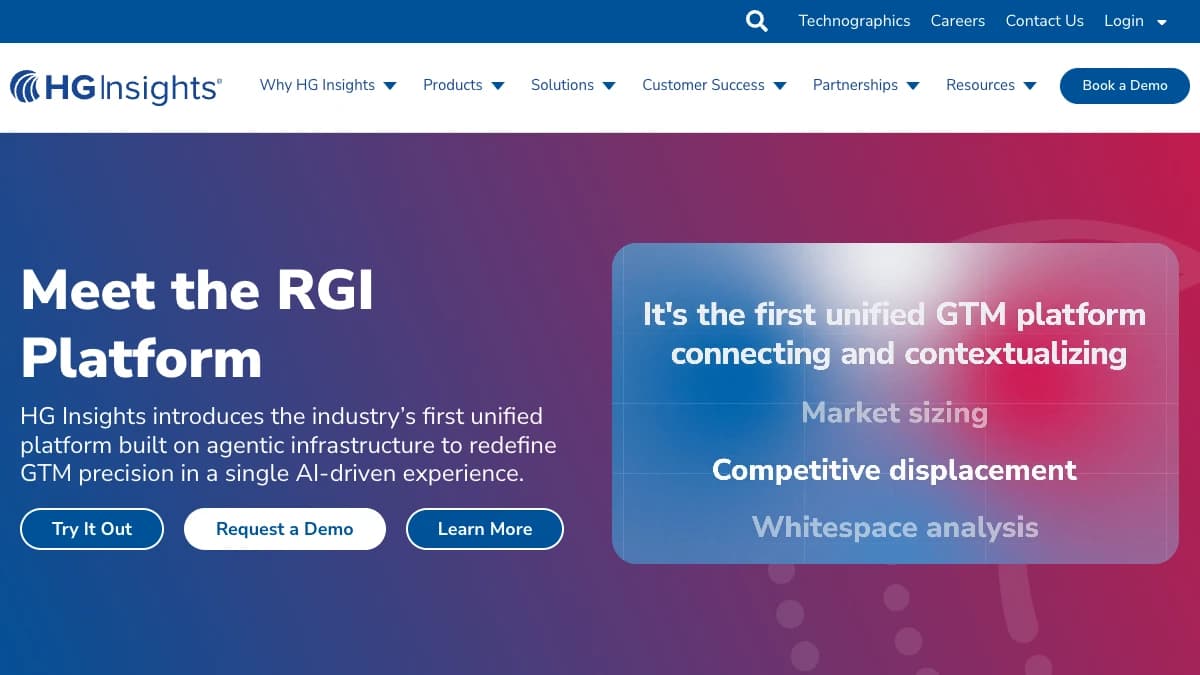
HG Insights — Intricately's cloud spend data now ships as HG Cloud Dynamics
HG Insights is the only genuine replacement if you need Intricately's actual capability, because it owns it. HG Cloud Dynamics is the same data set under a new name.
Coverage runs to 16,000+ products across IaaS, PaaS, and SaaS — cloud hosting, CDN, DNS, security, and performance monitoring — with monthly estimated spend attached. It also maps a company's global cloud and on-prem footprint down to physical locations.
The methodology is the moat. Thousands of physical sensors across six continents sit at ISP-operated internet gateways and observe how traffic actually flows, which is why HG sees backend consumption that no website crawler can reach.
The catch is commercial, not technical. Pricing is unpublished and consumption-based, every path runs through sales, and HG has moved upmarket into its unified RGI Platform — so a team that just wanted cloud spend data now buys into a much larger suite.
Pros
- ✓ The only source of Intricately's original cloud spend data
- ✓ Monthly IaaS/PaaS dollar estimates, not just vendor presence
- ✓ Sensor-network methodology reaches backend infrastructure
- ✓ 16,000+ products tracked; global footprint mapping
- ✓ Bundled with HG's technographic, intent, and firmographic data
Cons
- ✗ No published pricing — demo-gated, consumption-based contracts
- ✗ No free tier and no self-serve signup
- ✗ Enterprise sales cycle for what used to be a focused product
- ✗ Legacy v1 API is scheduled to sunset on 1 September 2026 — factor migration into any build
- ✗ Contact data is a separate concern from the spend data
Best for: Cloud, CDN, and infrastructure vendors whose deal sizes scale with consumption and who can justify an enterprise contract.
Pricing: Not published. HG states pricing is based on data consumption and routes buyers to a demo; reported enterprise contracts commonly start around $50,000/year.
3. BuiltWith: Web-Crawl Breadth With Modelled Tech Spend
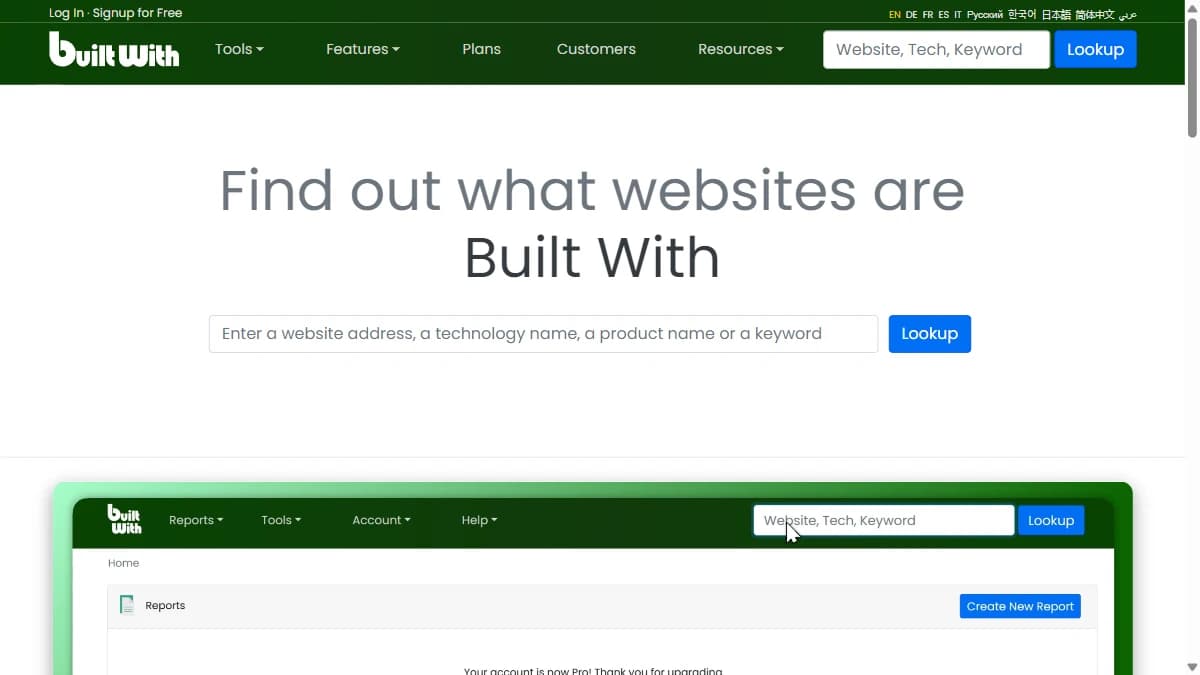
BuiltWith — the deepest web-crawl technology index, with a modelled monthly spend figure
BuiltWith is the closest thing to a spend estimate outside HG, and the broadest web-crawl index in the category. It is the strongest pick for martech and ecommerce targeting.
Its technology spend figure sums the average list price of the paid products detected on a domain, then charts that over time. For a company running Marketo and Shopify Plus, that produces a credible martech budget band.
Historical depth is the underrated feature. BuiltWith tracks technology lifecycle events going back decades, so you can target companies that dropped a competitor last quarter rather than just those using one today.
But be clear-eyed about what the spend number is. It is a model built from published list prices, so it says nothing about cloud consumption and does not see backend infrastructure at all — for a deeper breakdown see our BuiltWith review.
Pros
- ✓ Widest web-crawl coverage of any provider here
- ✓ Monthly technology spend estimate plus spend-over-time charts
- ✓ Deep historical data for competitive displacement plays
- ✓ Published pricing — no sales call required
- ✓ Strong list building and CRM export on higher tiers
Cons
- ✗ Spend is modelled from list prices, not measured consumption
- ✗ Blind to backend infrastructure that never renders in a browser
- ✗ Basic plan limits you to two technologies and UI-only access
- ✗ API access gated to the $495/mo Pro tier
- ✗ Thin contact data — you will need a second tool
Best for: Martech, ecommerce, and SaaS teams targeting frontend stacks, and anyone running competitive displacement campaigns.
Pricing: $295/mo Basic (2 technologies, 2,000 lookups), $495/mo Pro (full API, unlimited downloads), $995/mo Team.
4. TheirStack: Backend Detection via Job Postings
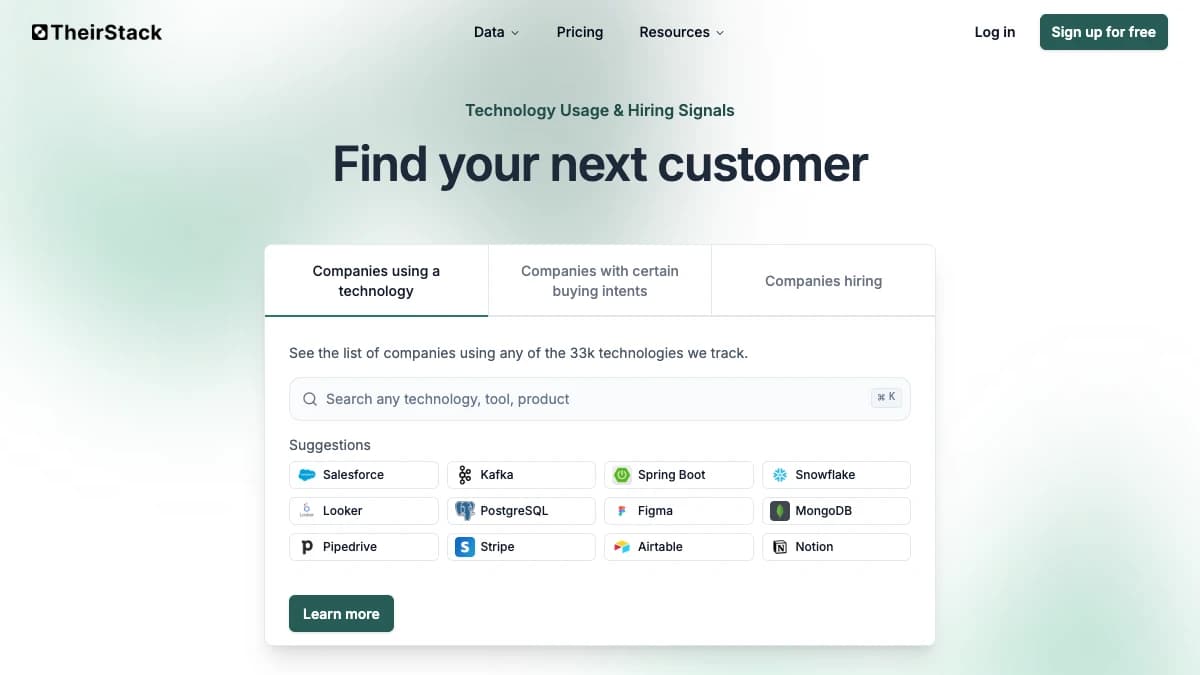
TheirStack — infers tech stacks from millions of job postings
TheirStack is the best-value way to see infrastructure that web crawlers miss, starting at $59/mo with a free tier. It parses job postings instead of websites.
That method reaches exactly the layer Intricately cared about. Kubernetes, Terraform, Snowflake, and specific AWS services show up constantly in engineering job descriptions and never in client-side page source.
It also carries a timing signal that presence data lacks. A company posting fourteen roles mentioning a technology this quarter is expanding that footprint right now, which is closer to buying intent than a static detection.
The trade-off is dependency on hiring activity, and there are no dollar figures anywhere. Our TheirStack review covers signal quality in depth, and we compare the field in TheirStack alternatives.
Pros
- ✓ Detects backend and internal tooling invisible to crawlers
- ✓ Hiring velocity doubles as an expansion signal
- ✓ Cheapest paid entry point here — from $59/mo
- ✓ Free tier and a clean, well-documented API
Cons
- ✗ No spend estimates of any kind
- ✗ Goes dark on companies that are not actively hiring
- ✗ Weaker on frontend and martech than web crawlers
- ✗ Raw data API needs engineering work to operationalise
Best for: Infrastructure and devtool vendors who need backend visibility and adoption timing on a modest budget.
Pricing: Free tier available; paid plans from $59/mo.
5. ZoomInfo Technologies: Technographics Plus the Deepest Contact Database
ZoomInfo — technographic filters layered on its contact database
ZoomInfo treats technographics as a filter on the largest B2B contact database rather than a standalone product. That framing is the whole value proposition.
For a former Intricately user, the appeal is skipping a step. You filter for companies using a technology and immediately get named contacts with verified emails and direct dials attached.
Detection depth is weaker than a dedicated technographic vendor, and there are no infrastructure spend estimates. Contract sizes are also the real barrier — see our full ZoomInfo cost breakdown and ZoomInfo review.
Pros
- ✓ Technographic filters attached to contacts — one workflow
- ✓ Verified emails and direct dials at scale
- ✓ Mature CRM integrations and workflow automation
- ✓ Intent data available as an add-on
Cons
- ✗ No cloud or infrastructure spend estimates
- ✗ Shallower tech detection than BuiltWith or TheirStack
- ✗ Five-figure annual contracts with seat and credit limits
- ✗ Annual commitment; pricing is quote-only
Best for: Enterprise sales teams that want technographic targeting and contact data from a single vendor and have the budget for it.
Pricing: Not published. Reported contracts run roughly $15,000–$40,000+/year depending on seats, credits, and add-ons.
6. 6sense (formerly Slintel): Technographics Plus Intent Scoring
6sense — Slintel's technographic data inside an ABM platform
6sense is worth a look mainly if you want technographics fused with predictive intent. Slintel's technographic data set sits inside it after the acquisition.
Its distinguishing move is combining stack detection with anonymous web research signals to score which accounts are actually in a buying cycle. That is a different axis to Intricately's spend sizing.
Like Intricately, the standalone brand is gone — slintel.com now redirects to 6sense. We cover what that means in our Slintel review, with cheaper options in 6sense alternatives.
Pros
- ✓ Technographics combined with predictive intent scoring
- ✓ Strong ABM orchestration and advertising integration
- ✓ Inherits Slintel's technographic coverage
- ✓ Account-level buying stage prediction
Cons
- ✗ No infrastructure spend estimates
- ✗ Enterprise pricing — reported $35,000–$130,000+/year
- ✗ Heavy implementation; overkill for pure list building
- ✗ Demo-gated with annual contracts
Best for: Enterprise ABM teams that need intent scoring layered on technographic targeting.
Pricing: Not published. Reported contracts range from roughly $35,000 to $130,000+/year.
7. Wappalyzer: The Free Baseline
Wappalyzer — free browser-extension detection, paid API from $250/mo
Wappalyzer is the fastest zero-cost way to check what a company runs. Its browser extension identifies technologies on any site you visit, free and instantly.
For reps doing manual account research before a call, that is often all the technographic data needed. No procurement, no onboarding.
At scale the economics get less friendly. The Pro plan runs $250/mo for 5,000 lookups and advanced filters need the $450/mo Business tier — details in our Wappalyzer review.
Pros
- ✓ Genuinely free browser extension with no limits
- ✓ Instant real-time detection during manual research
- ✓ Clean API and published pricing
- ✓ Lookups can include some contact data on paid tiers
Cons
- ✗ No spend estimates at all
- ✗ Frontend only — cannot see backend infrastructure
- ✗ Expensive per lookup at scale versus competitors
- ✗ Advanced filters locked to the $450/mo tier
Best for: Individual reps and small teams doing manual account research, plus developers who need a simple detection API.
Pricing: Free browser extension; Pro $250/mo (5,000 lookups), Business $450/mo.
Intricately Alternatives Compared: Spend Estimates vs Detection Only
The first column is the one that matters most. Only two tools attempt a dollar figure, and they model very different things.
| Tool | Spend Estimates | Detection Method & Coverage | Refresh Cadence | Contact Data Included | Starting Price |
|---|---|---|---|---|---|
| SyncGTM | No — detection only | Waterfall across 50+ providers; 76+ data points per lead | Continuous, on-demand per enrichment | Yes — email, phone, plus outreach | Free tier; $99/mo |
| HG Insights | Yes — measured IaaS/PaaS consumption | Global ISP sensor network; 16,000+ products | Monthly spend estimates | Separate module | Demo-gated, unpublished |
| BuiltWith | Modelled — SaaS list-price sums | Web crawl — HTML, JS, headers, DNS | Regular crawl; deep history | Limited | $295/mo |
| TheirStack | No — detection only | Job-posting NLP; strong on backend tooling | Near real-time as jobs post | No | Free tier; $59/mo |
| ZoomInfo | No — detection only | Crawl plus third-party data on a large company base | Continuous | Yes — deepest contact set | ~$15k–$40k+/yr |
| 6sense | No — intent scoring instead | Slintel technographics plus intent signals | Continuous | Yes | ~$35k–$130k+/yr |
| Wappalyzer | No — detection only | Web crawl and browser extension; frontend only | Real-time on lookup | Limited, paid tiers | Free; $250/mo Pro |
How to Choose the Right Intricately Alternative
Work down this list and stop at the first line that describes you.
- You sell cloud infrastructure and price on consumption. Go to HG Insights. It is the only tool that still sells the spend data, and no combination of the others reproduces it.
- You used Intricately to build lists and then chase contacts. Choose SyncGTM. Technographic signals, waterfall enrichment across 50+ providers, and outreach live in one subscription from $99/mo.
- You target martech or ecommerce stacks. Choose BuiltWith. Its crawl breadth, historical lifecycle data, and modelled SaaS spend fit that motion better than anything else.
- You need backend and DevOps visibility cheaply. Choose TheirStack. Job-posting inference sees Kubernetes and Snowflake that crawlers never will, from $59/mo.
- You are an enterprise ABM team. Choose 6sense for intent scoring, or ZoomInfo if contact depth matters more than detection depth.
- You just need occasional lookups.Use Wappalyzer's free extension and spend the budget elsewhere.
Two adjacent notes. If your real need is buying intent rather than stack data, our Bombora alternatives guide is the better starting point.
And if budget is the binding constraint, Datanyze offers basic technographic lookups from $29/mo — thin coverage and a restrictive credit system, but the cheapest paid entry into the category.
Final Verdict
Intricately is not coming back, and no tool on this list fully replaces it except the company that bought it. If measured cloud spend is genuinely load-bearing for your territory planning, budget for HG Insights and accept the enterprise sales cycle.
For everyone else, be honest that the spend number was a nice-to-have wrapped around a list-building job. Most teams used Intricately to answer “which companies run this, and who do I email there?” — and that question has much cheaper answers in 2026.
That is where SyncGTM lands for most former Intricately users. It will not tell you a company spends $40,000 a month on hosting, but it will tell you the company runs that stack, hand you 76+ data points and a verified contact, and send the email — for $99/mo instead of a five-figure contract.