

5 Best LinkedIn Jobs Scrapers for Hiring Signals in 2026

By Kushal Magar · November 28, 2026 · 15 min read
Key Takeaway
A LinkedIn jobs scraper gives you job rows, not leads. SyncGTM is the best pick for sales teams: LinkedIn job search with company-level filters (0.3 credits per job) feeds company resolution, people search and work email finding in one table. Apify actors are the cheapest raw scrape at $0.28 to $1.00 per 1,000 results if you own the pipeline. Bright Data suits data teams that want managed LinkedIn job JSON at $1.50 per 1,000 records. TheirStack is the best multi-board feed (LinkedIn plus 376k other sources, deduplicated). Coresignal wins on history with 580M+ job postings. Whatever you pick, never run a scraper on your own LinkedIn login.
A LinkedIn jobs scraper pulls open roles off LinkedIn's job search so you can see which companies are hiring, for what, and where. For sales teams, that list is a hiring signal: a company posting three SDR roles is building outbound right now.
The catch is what happens after the scrape. Raw job rows have no domains and no contacts, LinkedIn's terms restrict scraping, and the cheapest actor is only cheap until it breaks.
This guide compares five ways to get LinkedIn job data in 2026: SyncGTM, Apify actors, Bright Data, TheirStack and Coresignal. Every price below comes from the vendor's own page, checked on November 28, 2026.
TL;DR
- SyncGTM — best for sales teams: LinkedIn job search with headcount, recency and agency filters, then decision-maker emails and CRM push in the same table. 0.3 credits per job, plans from $49/mo.
- Apify actors — cheapest raw scrape: popular LinkedIn jobs actors charge $0.28 to $1.00 per 1,000 results. You own dedupe, enrichment and upkeep.
- Bright Data — best managed scraper API for data teams: $1.50 per 1,000 records pay-as-you-go, 5,000 free records a month, plus a 21.7M-record LinkedIn jobs dataset.
- TheirStack — best multi-board job feed: LinkedIn plus 376k other sources, deduplicated, with webhooks. Free 350 credits a month, paid from $19/mo.
- Coresignal — best for historical depth: 580M+ job postings and 6+ years of history through an API. Plans from $49/mo.
What a LinkedIn Jobs Scraper Actually Gives You
Every tool here returns roughly the same core record. Bright Data's LinkedIn Jobs Scraper API page lists a typical set: job posting ID, title, company name and ID, location, job summary, seniority level, employment type, posted date and application details.
What none of those fields give you is a buyer. A job row says Acme is hiring a RevOps Manager; it doesn't say acme.com, who runs sales there, or how to email them.
That gap is why the scrape is the easy half of the job. The useful hiring signals are patterns across rows:
- A function head being hired (VP of Sales, Head of RevOps): a tool evaluation is likely coming
- Two or more open roles in the same team: a team is being built, not backfilled
- A job description that names a tool or competitor: the stack is visible in the requirements
- Roles posted in a new city or country: an expansion that needs local vendors
Noise matters as much as signal. Recruiting agencies repost the same role for many clients, and one opening often shows up in several cities, so dedupe and agency filtering decide how much of a raw scrape is usable.
For timing these signals, see our guide on using hiring signals to time outreach.
Is a LinkedIn Jobs Scraper Legal?
Scraping public LinkedIn job pages is mainly a contract and account question, not a criminal one, and the risk depends on how the data is collected. What follows is the public record, not legal advice.
LinkedIn's User Agreement (effective November 3, 2025) lists among its Don'ts using "software, devices, scripts, robots or any other means or processes (such as crawlers, browser plugins and add-ons or any other technology) to scrape or copy the Services, including profiles and other data from the Services." If you agreed to those terms, scraping breaks them.
The best-known test case is hiQ Labs v. LinkedIn. Per Proskauer's summary, hiQ prevailed on the federal CFAA "unauthorized access" issue for public data, but faced a ruling that it breached the User Agreement through scraping and fake accounts, and the case ended with a $500,000 judgment against hiQ.
LinkedIn still enforces. It sued Proxycurl, a LinkedIn data API, in January 2025, and Proxycurl announced it was shutting down on July 4, 2025.
For a sales team pulling job postings, that adds up to a few practical rules:
- Never scrape on your own LinkedIn login or cookies. That is where account restrictions land, and it ties the activity to you.
- Collect job data, not member profiles. Job listings are company-level; recruiter and poster names are personal data under laws like GDPR.
- Use the data to prospect, not to republish. Rebuilding LinkedIn's job board as your own product is a different risk profile.
- Get counsel for commercial use at scale. Volume and resale change the picture.
None of the five options below makes the terms question disappear. What they change is who runs the collection, whose account is exposed, and how much upkeep you carry.
How We Compared Them
We scored each option on five things that matter when job data feeds outbound, not a research report:
- Freshness: searched live when you run it, or pulled from a pre-collected database
- Filters: how much noise you can cut before you pay for it (company size, recency, agencies)
- Cost per 1,000 jobs: from the vendor's own pricing page
- Account and terms exposure: whether your LinkedIn account is involved and who runs the collection
- What you get after the scrape: company data, contacts and a path into your sequencer or CRM
For job data beyond LinkedIn, our job posting data providers comparison and job postings API roundup cover ATS-first sources, and our Hirebase review looks at one that reads career pages directly.
1. SyncGTM
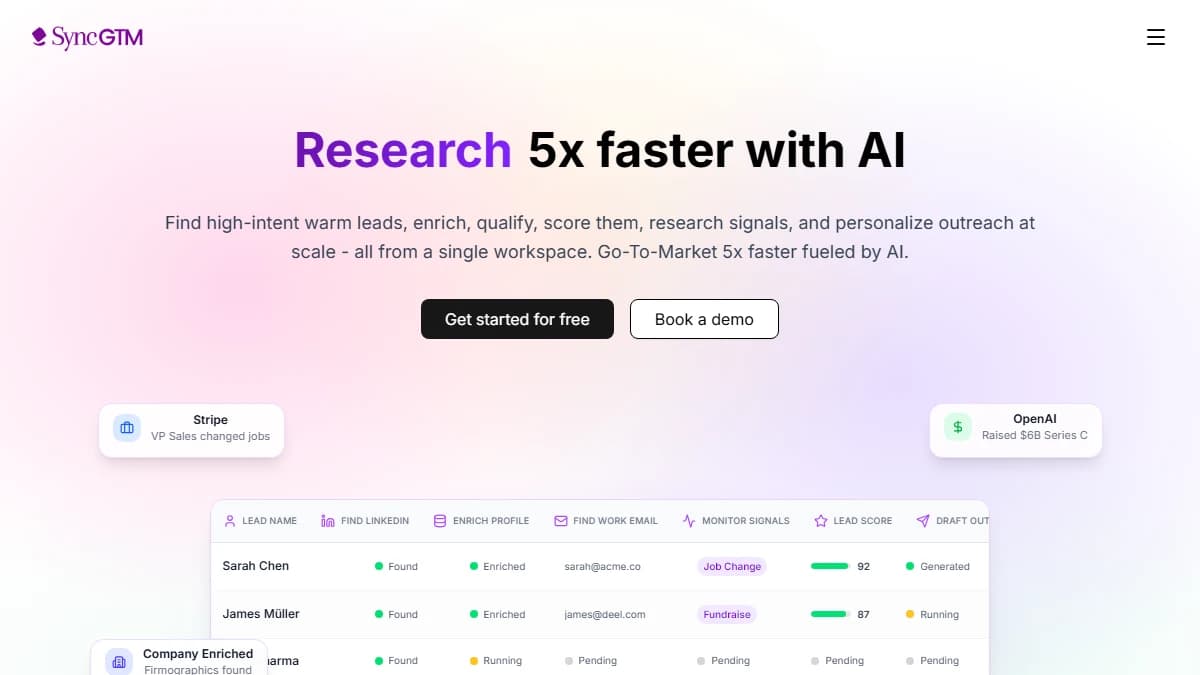
SyncGTM — LinkedIn job search, company resolution and contact enrichment in one table
SyncGTM is a GTM data platform that searches LinkedIn job openings and turns the hiring companies into enriched, outbound-ready rows, with no scraper for you to run. Each job returned costs 0.3 credits, and plans start at $49/mo.
Its LinkedIn job search takes job titles and locations as lists, then filters on the hiring company: headcount range, founding year, follower count, and an option to drop recruiting-agency posts. Quality filters narrow it further: published salary, Easy Apply, under 10 applicants, a named recruiter, and a posted-in-the-last 24 hours, week or month window.
Each call returns up to 100 openings with title, company, location, posted date and job URL. You never connect your LinkedIn account or paste cookies.
How the workflow runs
- Search "RevOps Manager" and "Revenue Operations" in the US, 50 to 500 employees, no agencies, posted in the past week.
- Group openings by company and keep employers with two or more related reqs.
- Resolve each company to a domain, industry and headcount.
- Find the VP of Sales, CRO or Head of RevOps at each account.
- Find and verify their work email: 1 credit per email found, and misses aren't billed.
- Push the list to Instantly, Smartlead, HeyReach, HubSpot, Salesforce, Attio, Pipedrive, Close or Zoho, with duplicates removed before sync.
The LinkedIn job search skill runs the same search from Claude or Cursor through the MCP server, and the SyncGTM CLI (npm install -g @syncgtm/cli) runs it from a terminal. For openings beyond LinkedIn, the Job Listing lead source searches across multiple job data providers.
Pros
- Job search, company resolution, contacts and CRM push in one table, no CSV hand-offs
- Company-level filters (headcount, founding year, followers, agency exclusion) cut noise before you pay for it
- No LinkedIn login, cookies, proxies or actor maintenance on your side
- Same search in the app, CLI and MCP
Cons
- Not a bulk archive: up to 100 openings per call and no historical backfill
- Job rows come back without domains, so a company resolution step runs before enrichment
- Built for prospecting lists, not for powering a job board or labor-market research at millions of rows
Best for: Sales and RevOps teams who want hiring companies with decision-maker emails, not a pile of job JSON.
Pricing: Solo $49/mo (1,000 credits), Starter $99/mo (3,000), Pro $249/mo (10,000), Business $649/mo (40,000), per SyncGTM pricing. At 0.3 credits per job, 1,000 jobs use 300 credits.
2. Apify LinkedIn Jobs Scraper Actors
Apify — a scraping platform with several community-built LinkedIn jobs actors
Apify is a scraping platform whose Store hosts several community-built LinkedIn jobs scrapers, billed per result against a free or paid Apify plan. It's the cheapest way to get raw LinkedIn job rows if you're happy to own the pipeline.
The most used, curious_coder's Linkedin Jobs Scraper, prices from $1.00 per 1,000 results, with 185K total users and a 4.5 rating from 144 reviews. It takes LinkedIn search URLs or filters and returns full job details plus job poster and company details.
Cheaper options exist. valig's LinkedIn Jobs Scraper starts at $0.28 per 1,000 results, offers Easy Apply and under-10-applicants filters, and caps a run at 1,000 results.
cheap_scraper's actor runs $0.70 per 1,000 jobs on Apify's free tier down to $0.35 at Gold, says no login or cookies are needed, and can skip duplicate postings so you don't pay twice. An optional AI filter adds $0.50 per 1,000 analyses.
Actor fees come out of your Apify plan: Free includes $5 of monthly usage, Starter is $19/mo, Scale $199/mo and Business $999/mo. Our Apify review covers the platform in depth.
Pros
- Lowest per-result prices in this list
- Filters that mirror LinkedIn's own search: keywords, location, posted date, Easy Apply, applicant count
- Exports to JSON, CSV or Excel and connects to n8n, Make and Zapier
Cons
- Community-maintained: field coverage, run limits and reliability differ by actor and can shift when LinkedIn changes its pages
- Output stops at job rows (some actors add poster names); domains and work emails are a separate build
- You run the collection, so the LinkedIn terms question sits with you
Best for: Developers and growth engineers who want cheap raw LinkedIn job data and will build dedupe and enrichment themselves.
Pricing: Actor fees from $0.28 to $1.00 per 1,000 results; Apify Free plan with $5 monthly usage, paid plans from $19/mo.
3. Bright Data
Bright Data — managed LinkedIn Jobs Scraper API plus pre-collected datasets
Bright Data is a web data company whose LinkedIn Jobs Scraper API collects public job data on request and bills per record. It suits data teams that want structured LinkedIn job JSON without running proxies or browsers.
You collect by job URL or discover jobs by keyword or company URL. The bill covers proxies, unblocking and parsing, and results deliver to AWS, GCP, Azure, Snowflake or a webhook.
Its scraper pricing page lists $1.5 per 1,000 records pay-as-you-go, or Scale at $499/mo with 384,000 records included and $1.3 per 1,000 after. The first 5,000 records each month are free, no credit card required.
If you'd rather not scrape at all, Bright Data also sells a pre-collected LinkedIn job listings dataset with 21.7M records, with a $250 minimum order. Our Bright Data review covers the wider product line.
Pros
- Managed unblocking and parsing, so no scraper code to maintain
- 5,000 free records a month to test field quality
- Bulk delivery to cloud storage, Snowflake or webhooks
Cons
- Developer-first: you work with API calls and JSON, not a prospecting UI
- Per-record billing counts every job, relevant or not
- No company domains or contacts; enrichment is a separate stack
Best for: Data and engineering teams that need large volumes of structured LinkedIn job data in a warehouse.
Pricing: 5,000 free records a month; $1.5 per 1,000 records pay-as-you-go; Scale $499/mo.
4. TheirStack
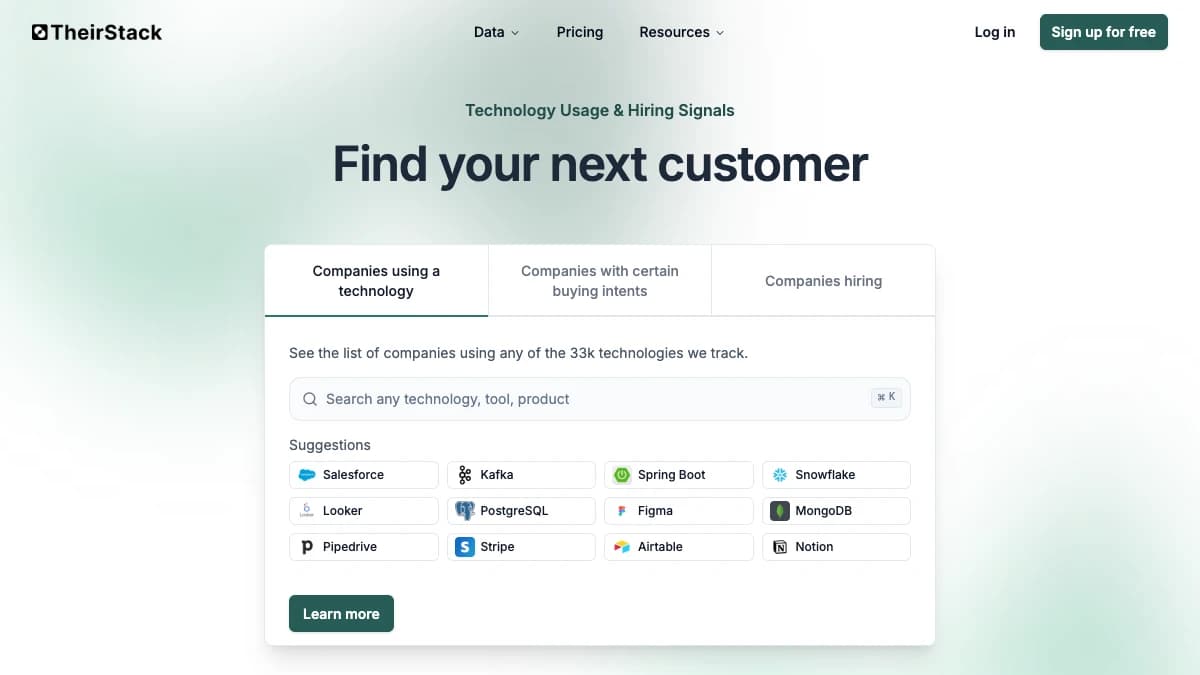
TheirStack — one deduplicated job feed across LinkedIn and hundreds of thousands of other sites
TheirStack is a job postings data platform that aggregates listings from LinkedIn and 376k other websites into one deduplicated feed, sold on credits. It's the pick when you want LinkedIn jobs plus every other board without running a scraper.
It claims 278M jobs across 195 countries since 2021 and says it finds 71% of new jobs within 3 hours of posting. The same role posted on LinkedIn, Indeed and Glassdoor collapses into one result.
Filters cover 25+ job, company and technology criteria, and you can filter for postings that carry hiring-manager data (name, role and LinkedIn profile). Access runs through the app, API, MCP and webhooks.
Per its pricing page, the Free plan includes 350 credits a month and paid plans run from $19/mo (1,500 credits) to $1,399/mo (1,000,000 credits). A job costs 1 credit, and the company behind it comes free with the job.
More detail is in our TheirStack review.
Pros
- LinkedIn plus hundreds of thousands of other sources, deduplicated
- Company data included with each job
- Webhooks and MCP, not just API polling
- Free tier to test before paying
Cons
- Entry tier works out to $12.67 per 1,000 credits; per-job cost only drops at high volume
- Hiring-manager data covers only some postings, and there are no work emails or phones
Best for: Teams that want one clean multi-board job feed, LinkedIn included, with webhooks for new matches.
Pricing: Free plan with 350 credits a month; paid from $19/mo for 1,500 credits.
5. Coresignal

Coresignal — multi-source job postings database with years of history
Coresignal is a B2B data provider whose Jobs API serves postings from multiple sources, deduplicated into one format and billed per record. It's built for teams that build products or analytics on job data and need history.
Its Jobs API page lists 580M+ job postings, 52M+ active jobs (28M in the US) across 195+ countries, and 6+ years of historical data. It says it adds 1 million new jobs daily and rescrapes all active jobs every 24 hours.
On its pricing page, a full job posting record costs 1 credit. Plans start at $49/mo (Mini, 2,500 credits) and step through Starter $199, Pro $499 and Growth $1,000 (150,000 credits); the Jobs API page offers 2,000 free credits to start, no credit card.
Our Coresignal alternatives guide compares it with other data APIs.
Pros
- Deep history for hiring trend analysis
- Natural-language query building or filters by job title, company and location
- Same account covers company, employee and contact data (10 credits per email found)
Cons
- Pre-collected database, so you don't control when a specific LinkedIn search runs
- Its jobs page describes multi-source data without breaking out LinkedIn coverage, so check sample records if LinkedIn specifically matters
- Developer-oriented API; no prospecting workflow on top
Best for: Data teams and product builders who need historical, multi-source job data at scale.
Pricing: 2,000 free credits; Mini $49/mo for 2,500 credits.
Side-by-Side Comparison
| Tool | How you get LinkedIn jobs | Freshness | Key filters | Your LinkedIn account involved? | Contacts | Entry price |
|---|---|---|---|---|---|---|
| SyncGTM | Managed LinkedIn job search | Searched when you run it; past-24-hours window | Title, location, headcount, founding year, agency exclusion, salary, applicants | No | Yes: work email, phone, CRM push | $49/mo |
| Apify actors | Community actors you run | Scraped at run time | Keyword, location, search URL, posted date, Easy Apply, applicants | Depends on the actor | Poster names on some actors; no emails | Free plan; actors from $0.28/1K |
| Bright Data | Managed scraper API or dataset | API on request; dataset pre-collected | Job URL, keyword, company URL | No | No | 5K free records/mo; $1.5/1K |
| TheirStack | Aggregated feed (LinkedIn + 376k sources) | Vendor claim: 71% of new jobs within 3 hours | 25+ job, company and tech criteria | No | Hiring manager on some jobs; no emails | 350 free credits/mo; $19/mo |
| Coresignal | Multi-source jobs database API | Vendor claim: active jobs rescraped every 24 hours | Title, company, location, natural language | No | Paid add-on (10 credits per email) | 2,000 free credits; $49/mo |
What 1,000 LinkedIn Jobs Actually Cost
Here is the raw cost of 1,000 job records on each option, worked out from the unit prices on each vendor's pricing page. Credit-based tools are shown at their entry and higher tiers.
| Option | Unit price | 1,000 jobs | Source |
|---|---|---|---|
| Apify: valig | From $0.28 per 1,000 results | $0.28 and up | Apify actor page |
| Apify: cheap_scraper | $0.70 (free tier) to $0.35 (Gold) per 1,000 | $0.35 to $0.70 | Apify actor page |
| Apify: curious_coder | From $1.00 per 1,000 results | $1.00 and up | Apify actor page |
| Bright Data | $1.5 per 1,000 records pay-as-you-go; $1.3 on Scale | $1.30 to $1.50 | Bright Data pricing |
| TheirStack | 1 credit per job; $19 for 1,500 credits or $1,399 for 1,000,000 | $12.67 (entry) to $1.40 (1M tier) | TheirStack pricing |
| Coresignal | 1 credit per job; $49 for 2,500 credits or $0.007 per credit on Growth | $19.60 (Mini) to $7.00 (Growth) | Coresignal pricing |
| SyncGTM | 0.3 credits per job; $49 for 1,000 credits or $249 for 10,000 | $14.70 (Solo) to $7.47 (Pro) | SyncGTM docs |
On raw price per job, Apify wins by a wide margin. Cost per usable account is a different number once you add dedupe, agency reposts, domain resolution, contact enrichment and the hours spent fixing an actor after LinkedIn changes a page.
That is why the cheapest scrape and the cheapest pipeline are rarely the same tool. If contacts are the end goal, compare the full path, including the waterfall contact providers you will need after the scrape.
How to Choose
- You want hiring companies with decision-maker emails in your sequencer: use SyncGTM. Job search, company resolution, people search and email finding sit in one table, and your LinkedIn account stays out of it.
- You're a developer and want the cheapest raw rows: use an Apify actor. Pick one with duplicate removal, and test it on 100 results before a big run.
- You need millions of LinkedIn job records in a warehouse: use Bright Data, either the scraper API or the pre-collected dataset.
- You want LinkedIn plus every other board, deduplicated, with webhooks: use TheirStack.
- You need years of job history for analysis or a product: use Coresignal.
- Whatever you pick: never run a scraper on your own LinkedIn login, and keep the data to job postings rather than member profiles.
Comparing more signal sources than job posts? Our hiring signal tools roundup covers job-change and headcount tracking too.
Final Verdict
The best LinkedIn jobs scraper depends on what you do with the rows. If the end of the line is a booked meeting, the scrape is the cheap part and everything after it is the real cost.
SyncGTM is the best fit for sales teams because it starts where the others stop: filtered LinkedIn job search feeds company resolution, decision-maker search and verified work emails in one table. You never hand it a LinkedIn login, and plans start at $49/mo.
Apify is the right call for builders who want raw rows at well under $1 per 1,000. Bright Data fits data teams that want the same data managed and delivered to a warehouse.
TheirStack is the strongest choice when LinkedIn is one source among many, and Coresignal when history matters more than this week's posts. For the broader LinkedIn data picture, see our top LinkedIn scrapers for 2026.