

Persana.ai Review 2026: We Tested the AI Prospecting Platform (Pricing Inside)

By Kushal Magar · March 16, 2026 · 12 min read · Last updated: September 30, 2026
Key Takeaway
Persana.ai is an AI-powered sales prospecting platform that combines waterfall enrichment across 100-plus data providers, signal detection for job changes, hiring, funding, and website activity, AI-generated personalization, and native email sending in a spreadsheet-like interface. At the time of our March 2026 review, pricing started with a free plan, then approximately 85 dollars per month for Starter, 189 dollars for Growth, and 350 dollars for Pro. Key strengths include AI agents that automate prospect research and opening line generation, and competitive pricing compared to established alternatives. Key weaknesses include CRM integration limited to HubSpot and Salesforce, inconsistent AI output quality for niche prospects, and platform maturity concerns since launching in 2023. Reviewers praise the product overall but note occasional bugs. Our rating: 3.5 out of 5.
Persana.ai is an AI-powered sales prospecting platform that combines waterfall enrichment across 100+ data providers, signal detection for job changes and hiring, and AI-generated personalization in a spreadsheet-like interface. Pricing starts at approximately $85/mo. The platform uses AI agents for automated prospect research and outreach personalization. CRM integration is limited to HubSpot and Salesforce. Our rating: 3.5/5.
Every sales team wants AI that actually helps with prospecting, not just a chatbot bolted onto a contact database. Persana.ai is building toward that vision with AI agents that research prospects, generate personalized opening lines, and trigger workflows based on buying signals. It competes with established platforms like Apollo.io and Clay.
The question is whether a platform that launched in 2023 can deliver at scale what it demonstrates in demos. We tested Persana.ai across real prospecting workflows and documented what works, what falls short, and how it stacks up against more established alternatives.

Persana.ai Review: What You Get (and What You Don't)
Persana.ai is a sales intelligence platform built around AI agents and waterfall data enrichment. You create prospect lists, run AI research across 100+ data providers, detect buying signals, and generate personalized outreach, all from a spreadsheet-like interface. The target user is a sales team or SDR manager who wants AI to handle the manual research that slows down prospecting.
Here is what is actually included and where the limits show up.
| Feature | What's Included | Limitations |
|---|---|---|
| AI Agents | Automated prospect research, LinkedIn analysis, personalized opening lines, ICP scoring | Output quality varies by prospect; generic results for niche contacts with limited public data |
| Waterfall Enrichment | 100+ data providers with automatic cascading across sources | Some provider integrations are newer and less battle-tested than established platforms |
| Signal Detection | Job changes, hiring, funding news, website visits, technographics, and intent signals with automated triggers | Broad list on paper; test coverage and freshness on your own target accounts |
| CRM Integration | HubSpot and Salesforce sync | No Pipedrive, Attio, Zoho, or other CRM support |
| Workflow Automation | Signal-triggered workflows with AI research and outreach queuing | Workflow builder is functional but less flexible than Clay's formula-based approach |
| Email Finder | Verified business emails via waterfall providers | Match rates not publicly documented; results vary by industry |
Persana.ai AI Features: What's Real vs Marketing
Persana.ai's core differentiator is its AI agents. These agents can research prospects by scraping LinkedIn profiles, company websites, and news articles, then generate personalized opening lines and score leads based on your ICP criteria. The research quality is solid when prospects work at well-known companies and have active public profiles.
Where AI works well
For enterprise contacts at companies like Salesforce, HubSpot, or Series B+ startups, the AI returns detailed summaries: recent role changes, company growth metrics, and relevant talking points. The personalized opening lines reference specific details from LinkedIn posts and company announcements, which saves 5-10 minutes of manual research per prospect.
Where AI falls short
For niche companies, contacts with minimal online presence, or complex research queries, the AI returns generic summaries or occasionally inaccurate details. One G2 reviewer noted that AI-generated content sometimes includes outdated information or confuses similarly named companies. More mature platforms like Cognism and Lusha rely on verified databases rather than AI generation, which produces more consistent results across all company sizes.
Workflow automation
The workflow automation is where Persana.ai shows real potential. You set up triggers: when a job change signal fires, the AI automatically researches the contact, generates personalized copy, and queues it for outreach. When working correctly, this replaces hours of manual SDR research per week. The limitation is reliability, which can be inconsistent during peak usage.
Persana.ai Pricing: What You Actually Pay
Persana.ai uses a credit-based pricing model. Every enrichment lookup, AI research query, and signal detection action consumes credits. Here is what each plan includes as of March 2026.
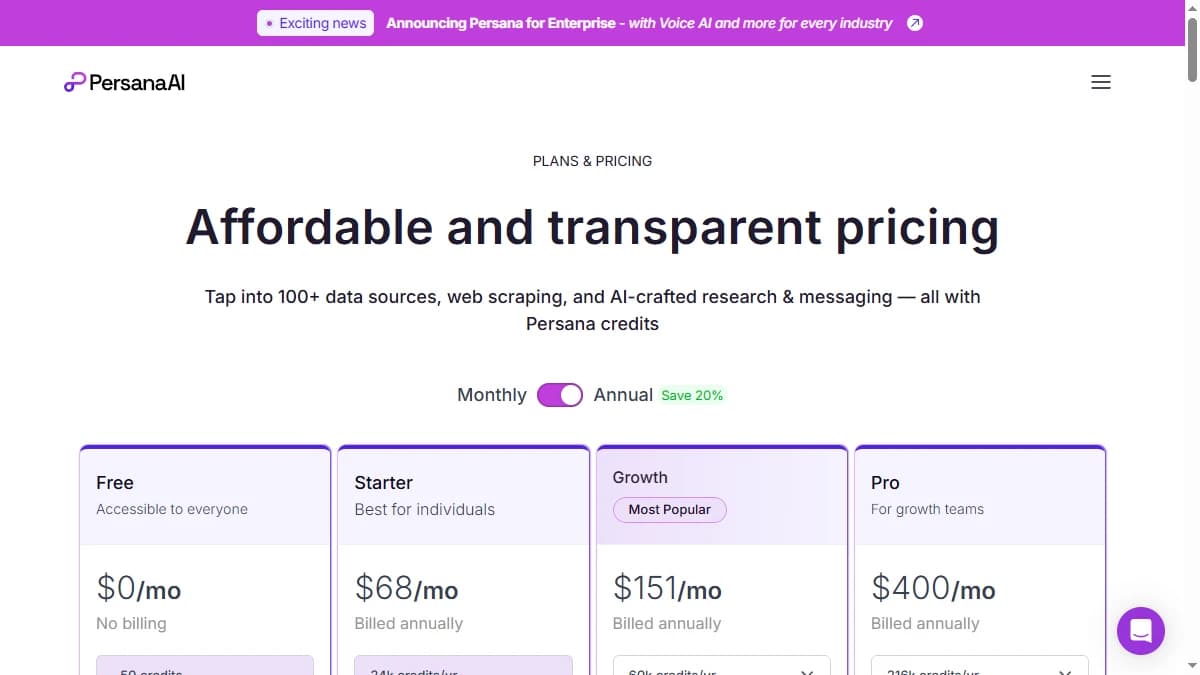
| Plan | Price | Key Features | Best For |
|---|---|---|---|
| Free | $0/mo | Limited credits, basic AI agents | Testing the platform |
| Starter | ~$85/mo | Core enrichment, AI agents, signal detection, CRM sync | Individual SDRs, small teams |
| Growth | ~$189/mo | Higher credit limits, team features, advanced workflows | Growing sales teams (3-10 reps) |
| Pro | ~$350/mo | Full feature set, priority support, API access | Larger teams needing full automation |
How pricing compares: Persana.ai's Starter plan at ~$85/mo undercuts Clay's Launch plan at $167/mo. The trade-off is fewer CRM integrations and a less mature platform. For teams on a tight budget who primarily use HubSpot or Salesforce, the pricing is competitive. Persana's pricing page also lists a 20% discount for annual billing and credit rollover; confirm current plan prices there before you buy.
Persana.ai Integrations: CRM, Outreach, and Data
Persana.ai integrates with HubSpot and Salesforce for CRM sync, and connects to 100+ data providers for waterfall enrichment. The CRM sync pushes enriched contact data, AI research notes, and signal alerts directly into your CRM records.
The gap: teams on any other CRM have no native integration. You would need to export CSV files or build Zapier/Make workflows to bridge the gap, which adds maintenance and raises the risk of stale records.
For outreach, Persana.ai now lists native email sending with built-in warmup and an AI Sequencer for multi-channel sequences (as of September 2026). If you already run sequences elsewhere, it also connects to Instantly, Outreach, and Salesloft, and it integrates with Slack.
Persana.ai Ease of Use: Setup and Learning Curve
Persana.ai has a lower learning curve than Clay or ZoomInfo. The spreadsheet-like interface is intuitive for anyone who has used Google Sheets or Excel. You can create your first enriched prospect list within 30 minutes of signing up.
Setting up AI agents and workflow triggers takes longer, typically 1-2 hours to configure your first automated workflow. The interface guides you through each step, but documentation is lighter than established competitors. The platform does not require any coding or formula knowledge, which is a clear advantage over Clay's formula-heavy approach.
Where onboarding slows down: advanced signal configuration, custom AI prompt tuning, and multi-step workflows require trial and error. There is no dedicated onboarding specialist on the Starter plan, so you rely on docs and support tickets for setup questions.
What Are the Downsides of Using Persana.ai?
What Persana.ai does well
- AI agents automate prospect research, LinkedIn analysis, and personalized opening lines without manual work.
- Waterfall enrichment across 100+ data providers cascades across sources to maximize match rates for email and phone data.
- Signal detection catches job changes, hiring activity, funding news, website visits, and intent signals to trigger outreach at the right moment.
- Spreadsheet-like interface makes it easy to organize prospects without a steep learning curve.
- Pricing starts at approximately $85/mo, which is lower than most competitors offering similar AI features.
Where Persana.ai falls short
- Platform launched in 2023 and is still maturing. G2 reviews note occasional bugs and inconsistent performance under heavy load.
- CRM integration is limited to HubSpot and Salesforce only. Teams on Pipedrive, Attio, Zoho, or other CRMs need workarounds.
- AI research quality varies significantly. Well-known companies get detailed summaries; niche contacts often get generic or inaccurate output.
- Signal breadth is hard to judge from the outside. Persana's site lists funding news, technographics, website visits, and more alongside job changes and hiring, so test coverage and freshness on your own target accounts before building workflows on them.
- Enterprise features like SOC 2 compliance and SSO are not publicly documented, which may block security-conscious buyers.
Platform maturity
Persana.ai launched in 2023 and has grown quickly, but enterprise-grade reliability takes time to build. Persana.ai reviews on G2 are positive overall (Persana's site cites a 4.8/5 G2 rating as of September 2026), but several reviewers mention occasional bugs and inconsistent AI output quality. The G2 review count is still relatively small compared to established platforms like Apollo.io (5,000+ reviews) or ZoomInfo (8,000+ reviews).
CRM integration gaps
Only HubSpot and Salesforce are supported natively. Teams on any other CRM need CSV exports or third-party automation tools to sync data. This creates friction and increases the risk of stale CRM records.
AI output inconsistency
AI-generated research produces detailed, accurate output for some contacts and generic filler for others. The quality depends heavily on how much public information exists about the prospect. You can explore the full feature set on the Persana.ai features page.
How Persana.ai Works: From List to Sent Email
Persana.ai makes the most sense once you see how the pieces connect. Here is how a typical prospecting workflow runs, and where credits get spent along the way.
- Build the list. Search for people and companies, or start from one of Persana's playbooks and templates. Lists live in the spreadsheet-style table used throughout the product.
- Enrich through the waterfall. Run email and phone waterfalls and company enrichment across the 100+ data providers Persana connects to. Provider lookups, web scraping, and AI research all draw on the same pool of Persana credits.
- Add AI research. Point AI research agents at each row to summarize the company, analyze the prospect's LinkedIn activity, score fit against your ICP, and draft opening lines. Keep prompts specific; open-ended research is where output quality drops for niche accounts.
- Layer in signals. Set triggers on job changes, hiring, funding news, website visits, or keyword intent so accounts surface when something changes instead of sitting in a static list.
- Send or sync. Send through Persana's native email sending (with built-in warmup) or its AI Sequencer, push leads to Instantly, Outreach, or Salesloft, and sync records to HubSpot or Salesforce.
Two habits keep costs and quality in check. First, test every new workflow on 20-30 rows before running it on a full list, because each provider lookup and AI step draws credits. Second, spot-check AI research on your smallest target accounts, since that is where generic or inaccurate output shows up first.
If your CRM is not HubSpot or Salesforce, plan the sync step before you commit: without a native connector, enriched records have to move through CSV exports or a Zapier/Make workflow.
Is Persana.ai Worth It in 2026?
Persana.ai is worth it if: You are an early-adopter team excited about AI-first prospecting, you use HubSpot or Salesforce as your CRM, your budget is under $100/mo, and you are willing to work with a platform that is still maturing. The AI agents save real time on prospect research when they work well, and the pricing undercuts most established competitors.
Persana.ai is not worth it if: You need battle-tested reliability for high-volume outbound, broad CRM support beyond HubSpot and Salesforce, or enterprise security requirements like SOC 2 and SSO.
The verdict: Persana.ai earns a 3.5/5 in our review. The AI features are genuinely useful and the pricing is competitive, but CRM limitations and platform maturity hold it back from being a recommendation for most B2B teams today. For a broader view of the landscape, see our guide to the best sales prospecting tools for B2B teams.
If Persana.ai's HubSpot-and-Salesforce-only CRM support is a dealbreaker, SyncGTM is one alternative worth a look: it pairs waterfall enrichment across 50+ data providers with native Pipedrive, Attio, and Close integrations alongside HubSpot and Salesforce.